Tag: interest rate

  • No Way Out, Major Shock, Deeper Cuts as Trade Deficit Reaches $901.5 Billion

    Thursday’s headline from the United States Department of Commerce showed the U.S. trade deficit widening sharply to $70.3 billion in December and reaching $901.5 billion for full-year 2025. December imports jumped 3.6% to $357.6 billion, while exports fell 1.7% to $287.3 billion. Economists had projected a $55.8 billion gap, making the release a significant downside surprise that prompted many to cut fourth-quarter GDP forecasts. Following the data, the Federal Reserve Bank of Atlanta lowered its Q4 GDP estimate to 3% from 3.6%.

    The Commerce Department’s preliminary report showed the economy expanded at just a 1.4% annualized pace in Q4, well below the 2.8% consensus estimate. Federal government spending dropped 16.6% during the quarter — largely due to the shutdown — subtracting roughly one percentage point from growth. The wider trade deficit further weighed on output. For all of 2025, GDP rose 2.2%. Treasury yields drifted lower after the report, increasing expectations that the Federal Reserve may move toward another rate cut.
    One potential obstacle to near-term easing is inflation. The Personal Consumption Expenditures (PCE) index rose 0.4% in December and 2.9% year-over-year. Core PCE, excluding food and energy, also climbed 0.4% on the month and 3% annually. On a positive note, consumer spending advanced 0.4% in December, offering some support for future growth momentum.

    In financial markets, private credit came under scrutiny after Blue Owl Capital permanently restricted redemptions from one of its retail vehicles, Blue Owl Capital Corp II. The move triggered declines in alternative asset managers including Ares Management, Apollo Global Management, KKR, Blackstone, and TPG. Adding to concerns, BlackRock recently marked down portions of its private credit portfolio. Former PIMCO CEO Mohamed El-Erian publicly questioned whether this could signal a broader stress point for the sector.

    In a separate development, The Wall Street Journal reported that President Donald Trump ordered the release of government files related to UFOs and unidentified aerial phenomena following heightened public interest. The directive reportedly came after comments by former President Barack Obama referencing extraterrestrial topics. Christopher Mellon, who previously helped publicize the “Tic Tac” military footage, suggested the move could have far-reaching implications.

    Taken together, the combination of a widening trade deficit, softer GDP growth, persistent inflation, and emerging private credit strains presents a complex macro backdrop — one that leaves markets balancing expectations of further rate cuts against lingering structural risks.

    Sources: Louis Navellier
  • Disinflation Signals Potential for Earlier and Larger Fed Rate Cuts

    Inflation came in cooler than anticipated in January, though markets still largely expect the Federal Reserve to hold its benchmark rate steady until June. However, the bond market appears ready to test that timeline, increasingly factoring in the possibility of a rate cut arriving sooner.

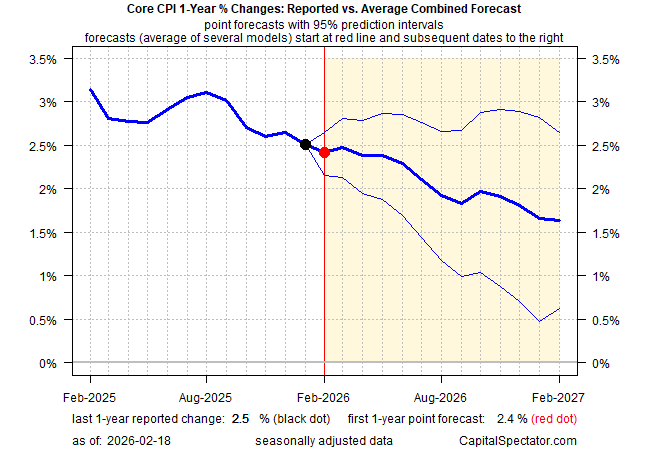
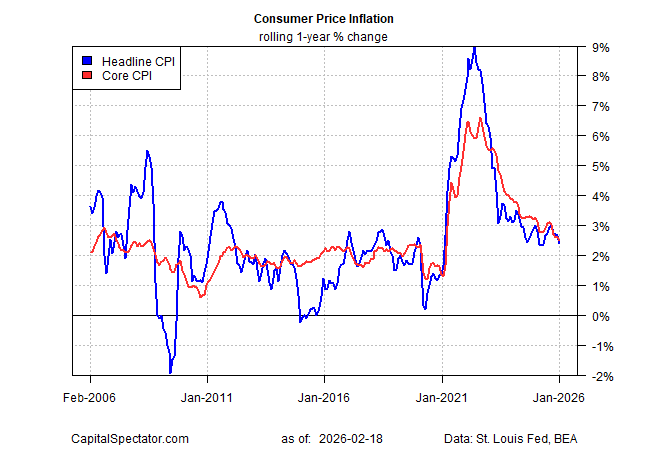
    According to government data released Friday, the Consumer Price Index (CPI) rose 2.4% year over year in January, down from 2.7% in December and marking the lowest reading in eight months. Core CPI—which excludes volatile food and energy prices and is considered a clearer gauge of underlying inflation—also eased to 2.5% annually, its slowest pace since 2021.

    While the slowdown in headline inflation is a welcome development, a deeper dive into the data suggests it may be premature to relax concerns about where prices are headed next. Persistent increases in tariff-sensitive goods remain one pressure point. Food prices are another, climbing 2.9% year over year—elevated by historical standards.

    Energy costs rose even more sharply, and both homeowners’ and renters’ insurance premiums continued to increase. Moreover, inflation is still running above the Federal Reserve’s 2% target, reinforcing the likelihood that policymakers will proceed carefully.

    Although it’s too soon to claim inflation has been fully tamed, the broader trend of moderating price growth strengthens the argument that the worst may be behind us. The Capital Spectator’s ensemble forecast has long projected continued disinflation in core CPI, a view that has so far aligned reasonably well with actual data. The model still anticipates further easing, with core CPI’s 12-month rate expected to edge down to around 2.4% in the upcoming February report.

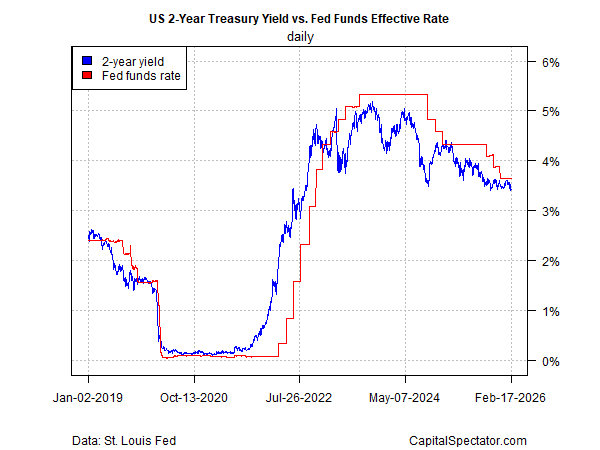
    Fed funds futures continue to indicate that the first rate cut won’t arrive until the June meeting. In contrast, the Treasury market appears to be probing the possibility of an earlier move. The policy-sensitive 2-year Treasury yield has fallen to about 3.45%—near its lowest level since 2022—and now sits below the Federal Reserve’s current target range of 3.50% to 3.75%, signaling that bond investors may be anticipating a faster shift in policy.

    In short, Treasury market sentiment is tilting toward the idea that a rate cut could come sooner than previously anticipated. Other market-based indicators are reinforcing that view by assigning higher odds to continued disinflation.

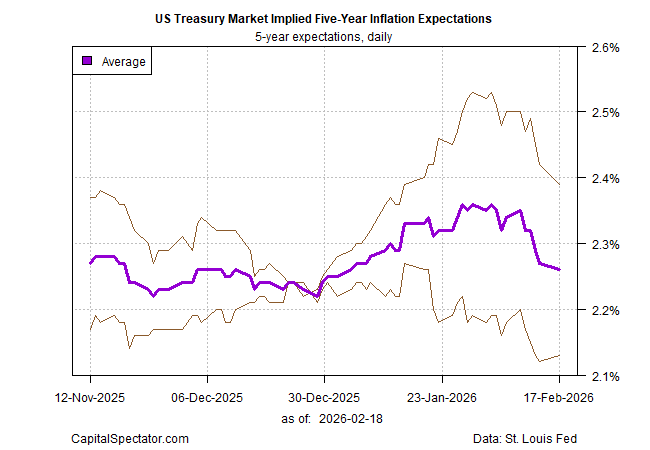
    The average of two Treasury-derived inflation gauges now projects five-year inflation in the low 2% range—the mildest reading in a month and not far from the Federal Reserve’s 2% objective. The surge in inflation expectations seen in January has since unwound, signaling that investors have grown less worried about upside inflation risks in recent weeks.

    Markets are not infallible, but it would likely require a meaningful upside surprise in the economic data—pointing to renewed inflationary pressure—to overturn the prevailing disinflation narrative. For now, investors show little appetite for betting on a reflationary turn.

    Sources: James Picerno

  • U.S. stock futures were little changed as uncertainty over the interest rate outlook lingered, with Walmart earnings in focus.

    U.S. stock index futures were largely unchanged Wednesday night after the minutes from the Federal Reserve’s January meeting delivered mixed signals on interest rates, adding to uncertainty about the longer-term policy path.

    Investors are now turning their attention to upcoming earnings from retail heavyweight Walmart Inc (NYSE:WMT) for fresh insight into the health of the U.S. economy.

    Markets were also pressured by rising geopolitical tensions involving Iran, as reports pointed to a stronger U.S. military presence in the Middle East despite continued talks between Tehran and Washington.

    As of 20:00 ET (01:00 GMT), S&P 500 Futures dipped slightly to 6,892.0, Nasdaq 100 Futures edged down nearly 0.1% to 24,942.75, and Dow Jones Futures slipped 0.1% to 49,685.0.

    Futures held steady after Wall Street posted gains in the regular session, driven mainly by an ongoing rebound in technology stocks and data showing resilience in the U.S. economy. However, caution surrounding the Fed’s outlook kept major indexes below their intraday peaks.

    Fed minutes reveal divisions on inflation and rates

    Minutes from the Fed’s January meeting showed officials unanimously agreed to keep interest rates steady at 3.50%–3.75%. Still, policymakers appeared divided over the next move. Several members warned that inflation could take longer than expected to return to the central bank’s 2% target.

    A number of officials also suggested that rate hikes could be considered if inflation remains elevated for an extended period — a tone that contrasts with market expectations for further easing this year.

    Artificial intelligence emerged as a key area of debate, with officials split on whether the rapidly expanding sector will ultimately fuel inflation or help contain it.

    Walmart earnings in focus

    Walmart Inc (NYSE:WMT) is scheduled to report fourth-quarter results on Thursday, with particular attention on its 2026 outlook, which may offer broader clues about U.S. consumer strength.

    According to Investing.com data, Walmart is expected to post earnings per share of $0.7269 on revenue of $190.4 billion.

    As the world’s largest retailer by valuation and a widely followed barometer of U.S. consumer spending, Walmart’s results come at a time when sticky inflation is showing signs of straining retail demand.

    Also due Thursday are U.S. December trade data and weekly jobless claims.

    Wall Street gains led by tech rebound

    Wall Street ended higher on Wednesday, led by technology stocks as the sector extended its recovery from recent declines.

    Still, both major indexes and tech shares retreated from session highs amid lingering concerns about the impact of artificial intelligence. Worries over AI-driven disruption have recently weighed on software and logistics companies, while concerns about heavy AI-related capital spending have pressured firms exposed to data centers.

    The S&P 500 rose 0.6% to 6,881.32, the NASDAQ Composite gained 0.8% to 22,753.64, and the Dow Jones Industrial Average added 0.3% to 49,662.66.

    Sources: Ambar Warrick

  • Federal Reserve could accelerate rate cuts amid rising deflation risks

    The ISM service index suggests potential positive revisions for fourth-quarter GDP growth. On Wednesday, the Institute for Supply Management (ISM) reported that its non-manufacturing service sector index increased to 54.4 in December from 52.6 in November, marking the third consecutive month of expansion and the fastest pace of growth in over a year.

    The new orders sub-index rose sharply to 57.9 from 52.9, while business activity climbed to 56 from 54.5. Additionally, new export orders improved to 54.2, up from 48.7 in November. Out of 16 surveyed service industries, 11 showed expansion in December.

    Conversely, the ISM manufacturing index fell to 47.9 in December from 48.2 the prior month, continuing its contractionary trend for the tenth straight month (a reading below 50 indicates contraction). Only 2 of 17 manufacturing industries—Electrical Equipment, Appliances & Components, and Computer & Electronic Products—reported growth, likely supported by strong data center demand.

    ADP’s December report showed private payrolls increasing by 41,000, missing economists’ expectation of 48,000. This follows a loss of 29,000 private jobs in November, meaning just 12,000 private jobs were created over the last two months. Manufacturing shed 5,000 jobs in December, while education and health services added 39,000, and leisure and hospitality gained 24,000 jobs. Regionally, the West lost 61,000 private sector jobs, while the South led with a gain of 54,000.

    Residential investment acted as a 5.1% drag on GDP growth during the second and third quarters. Strengthening GDP going forward will depend largely on stabilizing the residential real estate market, which remains sluggish due to high mortgage rates, rising insurance costs, and an oversupply in several key areas. According to the Intercontinental Exchange, prices for U.S. condominiums dropped 1.9% in September and October, with high homeowners association (HOA) fees and insurance expenses cited as major factors. In nine major metropolitan regions, over 25% of condominiums have fallen below their original sale prices. While multiple Federal Reserve rate cuts could help support home prices, the current weakness is fueling deflationary concerns that the Fed needs to address.

    If deflation emerges from (1) weak housing and rental prices, (2) low crude oil prices, and (3) deflation imported from China and other struggling global economies, the Fed may need to implement rapid interest rate cuts totaling around 100 basis points. With President Trump expected to nominate a new Fed Chair soon, current Chair Jerome Powell is likely to become a lame duck. Minutes from the December Federal Open Market Committee (FOMC) meeting indicated at least one more 0.25% rate cut is probable, but any further deflationary signals could prompt the Fed to enact much larger reductions in key rates in the coming months.

    President Trump is expected to nominate a new Federal Reserve Chair in January who will likely reverse the Fed’s current restrictive policies and adopt a more pro-business stance. Should Kevin Hassett, the current Chair of the Council of Economic Advisors, be appointed, the Fed would gain a strong economic advocate, a development that many find promising and exciting.

    Sources: Investing