Tag: Euro

  • EUR/USD Maintains Uptrend While Consolidating Recent Gains

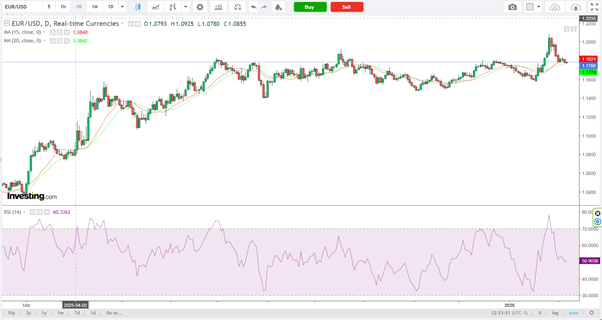
    EUR/USD remains technically constructive, consolidating after a strong push toward recent highs. While short-term momentum has eased, the price action continues to reflect a pause within a broader uptrend rather than a trend reversal.

    Attention now turns to whether the pair can hold key support levels and reassert upside momentum in the sessions ahead.
    Trend Overview: Higher-High Pattern Remains Intact

    From a medium-term standpoint, EUR/USD continues to exhibit a well-defined bullish structure, marked by a sequence of higher highs and higher lows. The recent pullback comes after a sharp rally and appears corrective, suggesting profit-taking rather than a meaningful change in the underlying trend.

    Notably, downside momentum has been contained, supporting the view that buyers are still stepping in on dips.

    Moving Averages Continue to Act as Dynamic Support

    Price is currently holding near and above the 15-day and 20-day moving averages, both of which continue to slope higher.

    Key technical takeaways:

    • Moving averages are still functioning as dynamic support
    • Pullbacks have been modest relative to the preceding advance
    • No decisive break has occurred to signal deterioration in the trend

    As long as EUR/USD remains above these moving averages, the broader technical outlook stays constructive.

    Momentum: RSI Cools Without Undermining the Trend

    The 14-day RSI has pulled back toward the low-50s after previously reaching elevated readings.

    This momentum behavior suggests:

    • A healthy reset following strong upside momentum
    • Reduced risk of near-term overextension
    • Conditions more consistent with consolidation than exhaustion

    Importantly, there is no clear bearish divergence, reinforcing the view that the broader trend remains intact.

    Key Technical Zone: 1.1780–1.1820 in Focus

    The 1.1780–1.1820 area has become a key technical reference zone:

    • It previously served as resistance prior to the recent breakout
    • It is now acting as near-term support
    • A sustained hold above this range would strengthen the case for bullish continuation

    A failure to hold this zone could allow for a deeper pullback toward the moving averages, though such a move would still be considered corrective unless support is decisively broken.

    Broader Market Backdrop

    EUR/USD continues to be closely influenced by:

    • Broader trends in the U.S. dollar
    • Changes in global risk sentiment
    • Evolving expectations around relative monetary policy trajectories

    For now, the technical backdrop suggests that euro resilience remains intact, as long as external conditions stay broadly supportive.

    Outlook

    EUR/USD appears to be shifting from trend extension into a consolidation phase:

    • Holding above key support: The upside bias remains intact
    • Sideways consolidation: Would help reinforce the durability of the trend
    • Break below moving averages: Needed to meaningfully weaken the outlook

    Until such confirmation occurs, the balance of technical evidence continues to favor the bullish scenario.

    Overall, EUR/USD is consolidating following a strong advance, but the broader technical structure remains supportive. Momentum has eased in a constructive manner, key support levels are holding, and price action continues to point toward stabilization rather than reversal.

    As long as EUR/USD remains above established support zones, the uptrend stays intact, with scope for renewed upside once the consolidation phase resolves.

    Sources: Tafara Tsoka
  • The dollar edged higher, extending recent gains, while the euro slipped after inflation data.

    The U.S. dollar held steady on Wednesday after a sharp rebound from near four-year lows, while the euro weakened following the release of key regional inflation data.

    By 11:54 ET (16:54 GMT), the Dollar Index was up 0.3% at 97.69 and has gained more than 1% since Kevin Warsh was nominated as the next Federal Reserve chair.

    The dollar remained resilient despite softer labor market data.

    The dollar got a lift late last week after Kevin Warsh was nominated to succeed Federal Reserve Chair Jerome Powell, with markets viewing him as more hawkish and supportive of shrinking the Fed’s balance sheet.

    Attention has now turned to Warsh’s Senate confirmation and the potential implications of his appointment for U.S. interest rates when he is set to take over from Powell in May.

    A brief government shutdown had little impact on the greenback, as lawmakers approved additional funding this week, though it did delay the release of key employment data originally due on Friday.

    Traders also shrugged off a soft ADP payrolls report for January released on Wednesday.

    Eurozone consumer prices fall.

    In Europe, the euro slipped slightly, with EUR/USD down 0.1% at 1.1802, despite the release of weaker-than-expected preliminary eurozone inflation data. Consumer prices eased to an annual rate of 1.7% last month, below the ECB’s 2% target and down from 2% in December.

    The data did little to alter expectations that the European Central Bank will keep interest rates unchanged at 2% for a fifth consecutive meeting. Policymakers have recently expressed concern about the euro’s rapid rise against the dollar and its dampening effect on inflation. The euro touched a 4½-year high of 1.2084 last week.

    According to Macquarie strategist Thierry Wizman, the euro is being pulled by opposing forces. Falling inflation could pave the way for policy easing in 2026, potentially weighing on the currency as euro area rates lag those elsewhere. However, this is being offset by improving growth prospects, supported by stronger survey data and a more favorable political backdrop, including eased budget tensions in France and renewed reform momentum in Germany. Wizman said stronger growth could ultimately provide greater support for the euro than lower rates would undermine it.

    GBP/USD fell 0.3% to 1.3657, as the Bank of England was also expected to leave interest rates unchanged at its policy meeting on Thursday.

    The yen remained under pressure.

    In Asia, USD/JPY rose 0.5% to 156.55, leaving the pair near a two-week high.

    The yen faced renewed pressure this week after comments from Prime Minister Sanae Takaichi cast doubt on whether Tokyo would step in to support the currency. Attention has shifted to a snap lower house election on February 8, with Takaichi’s party expected to secure a strong victory and strengthen her grip on parliament.

    Elsewhere, USD/CNY edged up to 6.9415, hovering near its lowest level since mid-2023. AUD/USD slipped 0.4% to 0.6988 after rallying earlier in the week on a hawkish Reserve Bank of Australia meeting. The RBA raised interest rates by 25 basis points and lifted its growth and inflation forecasts for the year.

    Sources: Anuron Mitra

  • EUR/JPY is trading with modest gains above 183.00 as traders await the upcoming Eurozone CPI report

    • EUR/JPY gains positive momentum, breaking a three-day losing streak amid a weaker Japanese yen.
    • Uncertainty over the timing of the next Bank of Japan rate hike, along with positive risk sentiment, weigh on the yen.
    • Meanwhile, hawkish bets on the ECB and a softer US dollar support the euro, providing further upside to the pair.

    During Wednesday’s Asian session, the EUR/JPY pair attracted some buying interest, ending a three-day losing streak amid a generally weaker Japanese yen. However, prices remain close to the two-week low reached on Monday, currently trading around 183.20, up just under 0.10% for the day.

    The yen continues to face pressure due to Japan’s fiscal concerns, a prevailing risk-on sentiment, and uncertainty over the timing of the Bank of Japan’s next rate hike, all of which provide support for EUR/JPY. Meanwhile, the euro benefits from a softer US dollar and hawkish signals from the European Central Bank, which showed no intention of cutting interest rates further.

    Investors widely expect the ECB to maintain a steady 2% deposit rate throughout its eight meetings this year, supported by surprisingly strong economic growth across the Eurozone in 2025. Additionally, inflation in Germany—the region’s largest economy—slowed more than anticipated, dropping from 2.6% to 2% in December. Market attention now turns to the preliminary Eurozone consumer inflation data scheduled for release later today.

    Despite this supportive fundamental backdrop for further gains in the EUR/JPY pair, caution remains warranted. Concerns that government authorities might intervene to curb further yen weakness suggest bullish traders should remain careful. Moreover, expectations that the Bank of Japan will continue its policy normalization path mean it’s wise to wait for solid follow-through buying before confirming that the two-week corrective pullback from the all-time high has ended.

    Sources: Fxstreet