Canada and China reached a preliminary trade agreement on Friday to sharply reduce tariffs on electric vehicles and canola, pledging to dismantle trade barriers and deepen strategic cooperation during Prime Minister Mark Carney’s visit.
On his first trip to China since 2017 by a Canadian prime minister, Carney aims to repair relations with Canada’s second-largest trading partner after the United States, following months of diplomatic outreach.
Canada will initially permit imports of up to 49,000 Chinese electric vehicles at a 6.1% most-favoured-nation tariff, Prime Minister Mark Carney said following talks with Chinese leaders, including President Xi Jinping.
The move marks a sharp reversal from the 100% tariff imposed on Chinese EVs in 2024 under former Prime Minister Justin Trudeau, in line with similar measures taken by the United States. China shipped 41,678 electric vehicles to Canada in 2023.
“This restores access to levels seen before the recent trade disputes, but within a framework that offers significantly more benefits for Canadians,” Carney said, adding that the import quota would be expanded gradually to around 70,000 vehicles over the next five years.
“To build a globally competitive electric vehicle industry, Canada must learn from innovative partners, gain access to their supply chains, and stimulate domestic demand,” Carney said, distancing himself from former prime minister Justin Trudeau’s view that tariffs were necessary to shield local manufacturers from subsidised Chinese competitors.
Canada’s decision to ease EV tariffs runs counter to U.S. policy, drawing criticism from some members of President Donald Trump’s cabinet ahead of a planned review of the U.S.–Canada–Mexico trade agreement. However, Trump himself voiced support for Carney’s approach.
“That’s exactly what he should be doing. Signing trade deals is good for him. If you can strike a deal with China, you should take it,” Trump said at the White House.
AGRI-FOOD PARTNERSHIP: Ontario Premier Doug Ford denounces the deal.
“The federal government is effectively opening the door to a surge of low-cost Chinese-made electric vehicles without firm assurances of comparable or timely investment in Canada’s economy, auto industry, or supply chains,” Ford said in a post on X.
China imposed retaliatory tariffs in March on more than $2.6 billion worth of Canadian agricultural and food exports — including canola oil and meal — in response to tariffs introduced by Trudeau. Additional duties on canola seed followed in August.
As a result, China’s imports of Canadian goods fell by 10.4% in 2025.
Under the new agreement, Canada expects China to cut tariffs on canola seed to a combined rate of around 15% by March 1, down from 84%, Carney said. He added that discriminatory tariffs on Canadian canola meal, lobsters, crabs and peas are also expected to be lifted from March 1 through at least the end of the year.
Canadian canola futures climbed.
The agreements are expected to generate nearly $3 billion in export orders for Canadian farmers, fishers and food processors, Carney said.
China’s Ministry of Commerce said it would adjust anti-dumping duties on canola and lift anti-discrimination measures on certain Canadian agricultural and seafood products, citing Canada’s decision to lower tariffs on electric vehicles.
Carney added that President Xi Jinping had agreed in principle to grant visa-free travel for Canadians visiting China, though further details were not provided.
In a statement released by state-run Xinhua, the two countries said they would resume high-level economic and financial talks, expand trade and investment, and deepen cooperation in sectors including agriculture, oil, gas and green energy.
Carney said Canada plans to double the size of its power grid over the next 15 years, creating potential opportunities for Chinese investment, including in offshore wind projects. He also said Canada is ramping up liquefied natural gas exports to Asia, with annual production set to reach 50 million tonnes by 2030, all of which will be shipped to Asian markets.
Carney says China has become “more predictable”
Given the growing complications in Canada’s trade relationship with the United States, it is unsurprising that Carney’s government is seeking to strengthen trade and investment ties with Beijing, which offers a vast market for Canadian agricultural exports, said Even Rogers Pay of Beijing-based consultancy Trivium China.
U.S. President Donald Trump has imposed tariffs on certain Canadian goods and has even suggested that the longtime U.S. ally could become America’s 51st state. China, which has also been targeted by Trump’s tariffs, is eager to deepen cooperation with a G7 country traditionally seen as part of the U.S. sphere of influence.
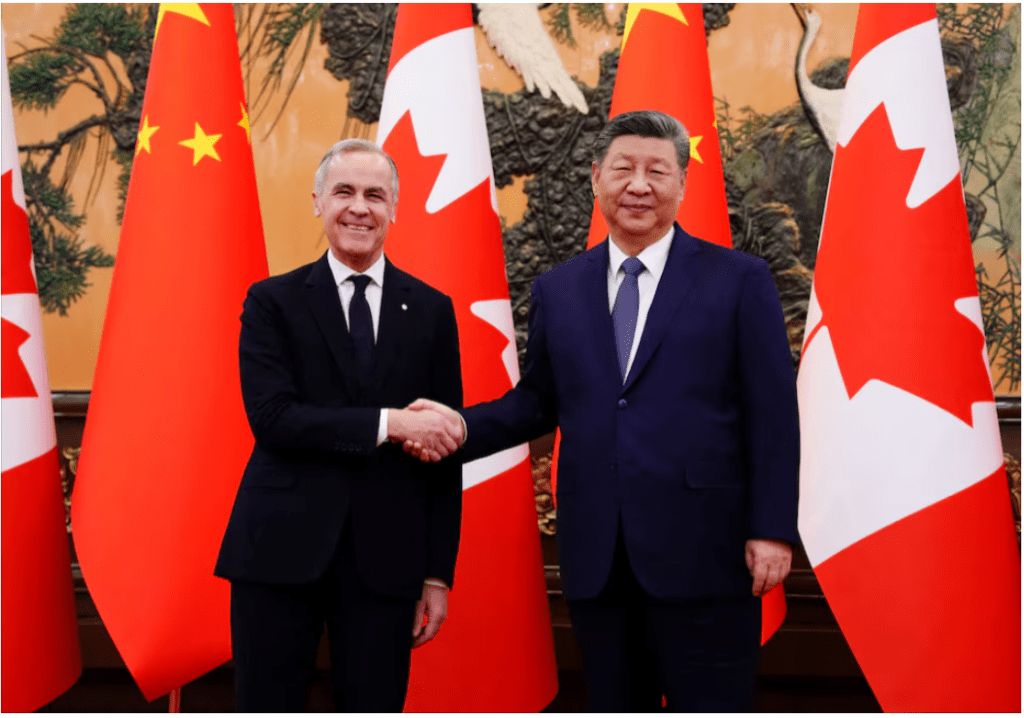
Asked whether China had become a more predictable and reliable partner than the United States, Carney said recent engagement with Beijing had delivered greater clarity and tangible outcomes. “Looking at how our relationship with China has evolved in recent months, it has become more predictable, and we are seeing results from that,” he said.
Carney added that he had also discussed Greenland with President Xi Jinping, saying the two leaders found their views broadly aligned. Trump has recently revived his claim to the semi-autonomous Danish territory, prompting NATO members to push back against U.S. criticism that Greenland is insufficiently defended.
Analysts said the warming of ties between Canada and China could alter the political and economic backdrop of Sino-U.S. competition, though Ottawa is unlikely to shift decisively away from Washington.
“Canada remains a core U.S. ally and is deeply integrated into American security and intelligence systems,” said Sun Chenghao, a fellow at Tsinghua University’s Centre for International Security and Strategy. “A strategic realignment away from Washington is therefore highly unlikely.”
Sources: Reuters
 THE ETERNAL SOVEREIGN