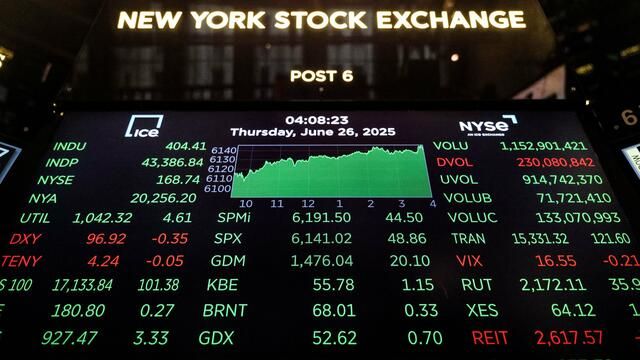
The S&P 500 and the Dow Jones Industrial Average closed at record highs on Wednesday, while gold hovered just below the $4,500 level during a light-volume, shortened Christmas Eve trading session.
All three major U.S. stock indexes finished the day with gains, with the S&P 500 on track to achieve an annual increase of nearly 18%.
U.S. Treasury yields eased, and precious metals retreated slightly from their record highs. For the year, gold and silver are poised to register gains of approximately 70% and 150%, respectively.
“It has been a strong year for equities, without a doubt, and most global markets have mirrored this trend,” said Peter Cardillo, Chief Market Economist at Spartan Capital Securities in New York. “Moreover, it has been an exceptional year for precious metals.”
Recent economic data showed a seasonally volatile drop of 4.5% in initial jobless claims last week, while continuing claims rose 2.0% to 1.923 million. These figures align with consumer surveys indicating weakening job market confidence and bolster expectations for further interest-rate reductions by the U.S. Federal Reserve in 2026.
“I anticipate the Fed will cut rates twice next year, as the labor market appears weaker than official data suggest,” Cardillo added.
The Dow Jones Industrial Average increased by 289.40 points, or 0.60%, closing at 48,731.81. The S&P 500 rose 22.34 points, or 0.32%, to 6,932.13, and the Nasdaq Composite gained 51.46 points, or 0.22%, finishing at 23,613.31.
Exchanges across the Atlantic closed early, with European shares concluding their shortened holiday week near record highs, positioning themselves for the strongest annual performance since 2021 amid easing interest rates.
MSCI’s global equity index rose 2.41 points, or 0.24%, to 1,022.51.
The pan-European STOXX 600 index dipped marginally by 0.01%, while Europe’s broader FTSEurofirst 300 index declined 0.89 points, or 0.04%.
Emerging market equities advanced 5.74 points, or 0.41%, to 1,392.87. MSCI’s broadest index of Asia-Pacific shares outside Japan gained 0.35%, closing at 716.93, whereas Japan’s Nikkei slipped 68.77 points, or 0.14%, to 50,344.10.
U.S. Treasury yields declined following the release of jobless claims data. The yield on the benchmark 10-year Treasury note fell 3.4 basis points to 4.136%, down from 4.169% late Tuesday.
The 30-year bond yield decreased 3.6 basis points to 4.7948%, from 4.831% the previous session.
The 2-year note yield, which closely tracks market expectations for Federal Reserve interest rate changes, declined 1.8 basis points to 3.51%, compared with 3.528% late Tuesday.
Yen Draws Attention from Currency Traders
The dollar traded within a narrow range, poised for its largest annual decline since 2017, with potential for further weakness in the coming year as investors consider the likelihood of additional Federal Reserve easing in 2026.
Currency traders remain closely focused on the yen, remaining vigilant to the possibility of intervention by Japanese authorities.
The dollar index, which tracks the greenback against a basket of currencies including the yen and the euro, rose 0.1% to 98.00, while the euro declined 0.18% to $1.1773.
Crude oil prices retreated from earlier gains and were last modestly lower as geopolitical tensions eased. Despite this, crude remains on course for its steepest annual decline in five years.
U.S. crude oil prices remained steady at $58.36 per barrel, while Brent crude declined 0.21% to $62.25 per barrel.
Gold eased slightly after surpassing the $4,500 per ounce milestone for the first time. Spot gold fell 0.17% to $4,480.23 per ounce, while U.S. gold futures inched up 0.01% to $4,483.40 per ounce.
Sources: Investing
 THE ETERNAL SOVEREIGN