Centralized Market
A centralized market is a market in which buying and selling activities take place at a single central location or through a central system. All transactions are processed and supervised by a central authority or platform.

Key characteristics
- Operated and regulated by a central authority
- Transparent and publicly quoted prices
- High liquidity due to the concentration of buyers and sellers
- Easier to monitor and regulate
Examples
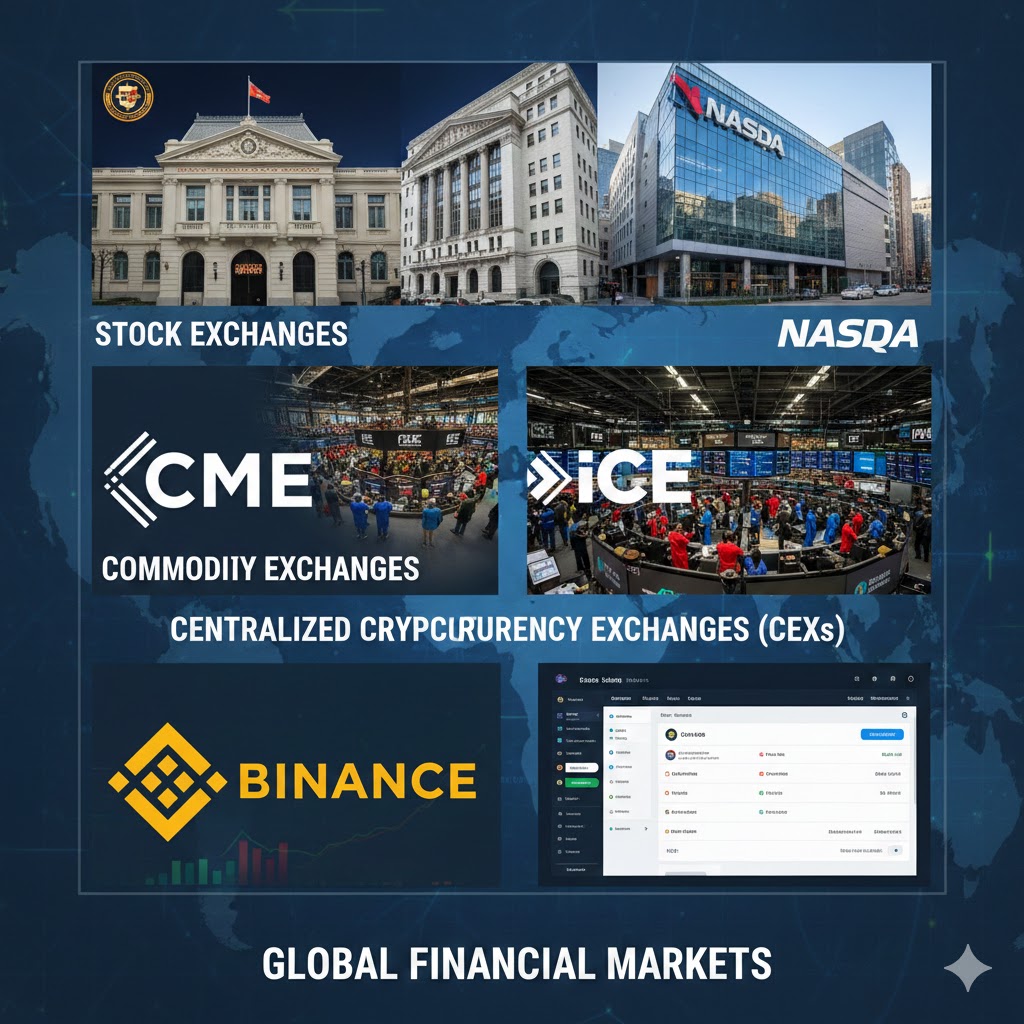
- Stock exchanges: HOSE, NYSE, NASDAQ
- Commodity exchanges: CME, ICE
- Centralized cryptocurrency exchanges (CEXs): Binance, Coinbase
Advantages
- High price transparency
- Fast execution and strong liquidity
- Clear legal and regulatory framework
Disadvantages
- Dependence on a central intermediary
- Systemic risk if the central platform fails or is disrupted
Decentralized Market
A decentralized market is a market without a single central authority, where buyers and sellers trade directly with each other through a network or bilateral agreements.

Key characteristics
- No central governing body
- Prices may vary across participants or locations
- High flexibility
- Limited centralized control
Examples
- The interbank foreign exchange (Forex) market
- Over-the-counter (OTC) markets
- Decentralized cryptocurrency exchanges (DEXs): Uniswap, PancakeSwap
- Traditional agricultural markets

Advantages
- Greater flexibility and independence
- Suitable for customized or private transactions
- Less vulnerable to a single point of failure
Disadvantages
- Lower price transparency
- Higher counterparty risk
- Uneven liquidity
 THE ETERNAL SOVEREIGN