Category: Fundamental Knowledge

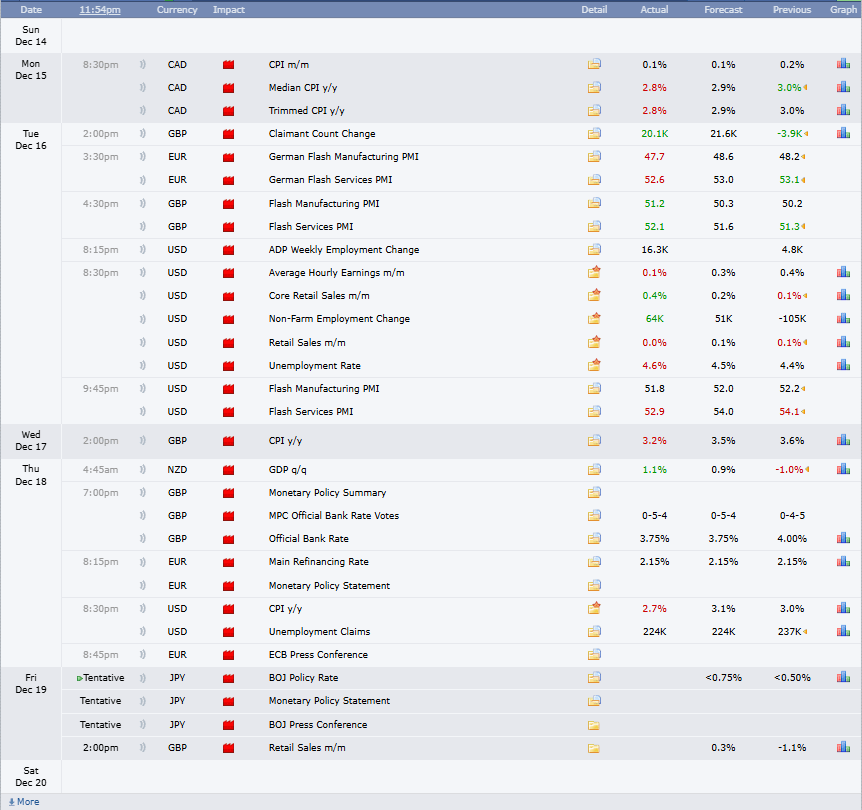
  • Economic Calendar

    An Economic Calendar is a tool used by traders, investors, economists, and analysts to track important scheduled economic events and data releases that can impact financial markets. These events include things like:

    • Economic indicators (e.g., GDP reports, inflation rates, employment data)
    • Central bank announcements (e.g., interest rate decisions, policy statements)
    • Government reports (e.g., trade balances, budget releases)
    • Speeches by key policymakers

    The calendar shows the date and time when these events will be released, often along with the expected figures and previous data for comparison. Market participants use this information to anticipate market volatility, make informed trading decisions, and manage risk.

    In summary

    • It’s a schedule of key economic events.
    • Helps forecast market movements.
    • Used widely in forex, stock, bond, and commodities trading.
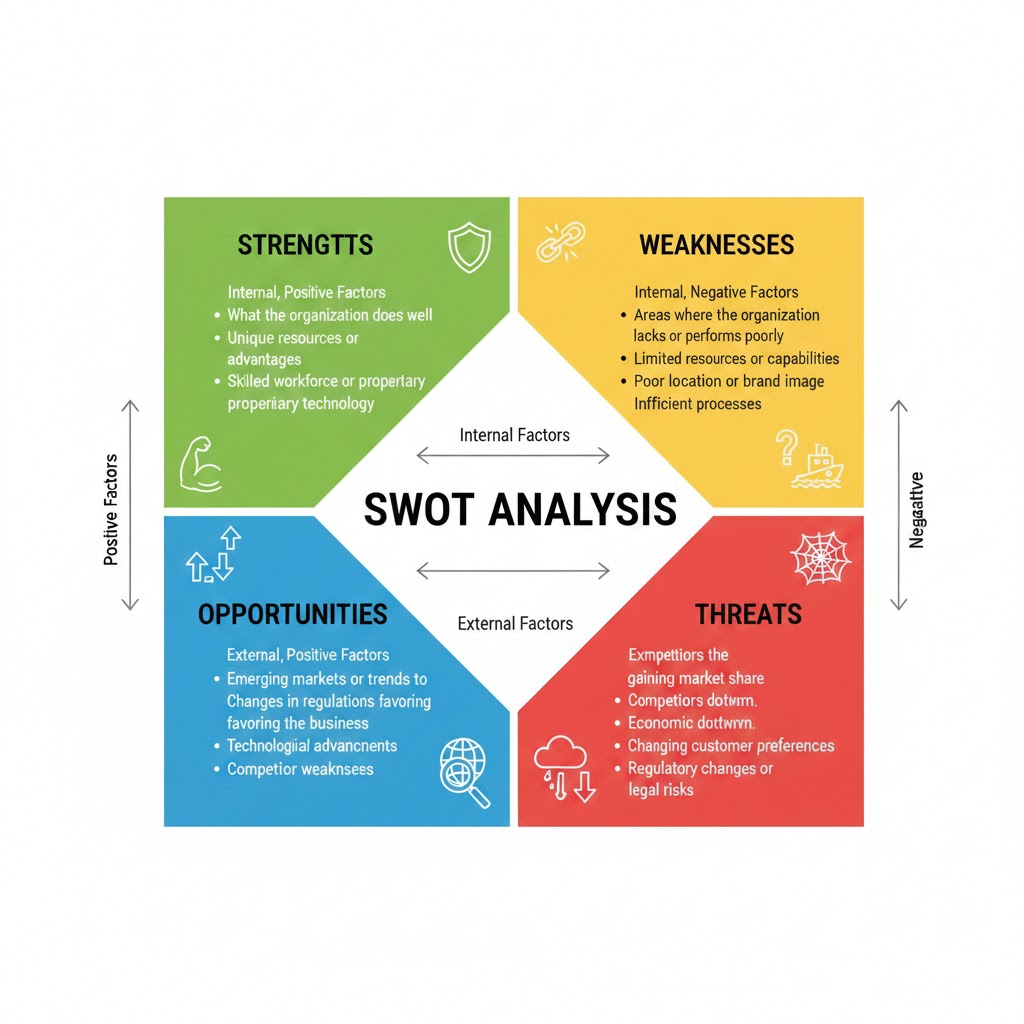
  • SWOT Analysis

    SWOT Analysis is a strategic planning tool used to identify and analyze the Strengths, Weaknesses, Opportunities, and Threats related to a business, project, or situation. It helps organizations understand internal and external factors that can impact their success.

    Purpose of SWOT Analysis

    • To help make informed decisions
    • To leverage strengths and opportunities
    • To identify and mitigate weaknesses and threats
    • To develop strategies that align with the internal and external environment

    How to Conduct a SWOT Analysis

    • Gather a team with diverse knowledge about the business
    • Brainstorm and list internal strengths and weaknesses
    • Identify external opportunities and threats through market research
    • Analyze the results to create actionable strategies
  • Legal Factor

    Legal factors refer to the laws and regulations that a business must comply with in the countries or regions it operates. These factors are crucial because they set the legal framework within which businesses must function, and non-compliance can lead to fines, legal actions, or damage to reputation.

    Key Aspects of Legal Factors:

    1. Employment and Labor Laws
      • Regulations on hiring and firing
      • Minimum wage laws
      • Working hours and overtime rules
      • Workplace safety and health standards
      • Anti-discrimination laws
      • Employee rights and benefits
    2. Consumer Protection Laws
      • Product safety standards
      • Truth-in-advertising regulations
      • Privacy and data protection laws (e.g., GDPR)
      • Warranties and refunds policies
      • Fair trading laws
    3. Health and Safety Regulations
      • Occupational safety requirements
      • Environmental health standards
      • Industry-specific safety protocols
      • Mandatory training and certification
    4. Intellectual Property Laws
      • Patents, copyrights, trademarks protection
      • Protection against infringement and piracy
      • Licensing and royalties regulations
    5. Competition and Antitrust Laws
      • Rules to prevent monopolies and promote fair competition
      • Regulations against price fixing, collusion, or abuse of market power
      • Mergers and acquisitions controls
    6. Industry-Specific Regulations
      • Compliance requirements for sectors like finance, healthcare, food, pharmaceuticals, telecommunications, and transportation
      • Licensing and permits
      • Reporting and audit obligations
    7. Taxation Laws
      • Corporate tax obligations
      • VAT and sales tax regulations
      • Tax incentives or penalties
    8. Environmental Laws
      • Compliance with pollution control laws
      • Waste disposal regulations
      • Emission limits and sustainability mandates

    Why Legal Factors Matter

    • They protect businesses and consumers by setting clear rules.
    • They influence business costs through compliance expenses.
    • They affect operational flexibility and strategic choices.
    • They can create barriers to entry or competitive advantages.
    • Non-compliance can lead to legal penaltieslawsuits, and reputational damage.
  • Environmental Factor

    The Environmental factor looks at ecological and environmental aspects that can impact a business or industry. It involves how environmental concerns, regulations, and sustainability issues influence operations and strategies.

    Key Elements of Environmental Factors:

    • Climate and Weather:
      Impact of climate change, extreme weather events, and seasonal variations on business continuity and supply chains.
    • Environmental Regulations:
      Laws and policies related to pollution control, waste management, emissions, and resource usage.
    • Sustainability Practices:
      Pressure to adopt eco-friendly processes, renewable energy use, and sustainable sourcing.
    • Carbon Footprint and Emissions:
      Monitoring and reducing greenhouse gas emissions in operations.
    • Natural Resource Availability:
      Access to water, minerals, and raw materials critical for production.
    • Waste Disposal and Recycling:
      Regulations and practices around handling and reducing waste.
    • Consumer Environmental Awareness:
      Growing demand for green products and corporate social responsibility.

    Why is the Environmental Factor Important?

    • Environmental concerns can lead to stricter regulations, increasing compliance costs.
    • Sustainability is becoming a key competitive differentiator.
    • Risks from environmental damage (floods, droughts) can disrupt business.
    • Positive environmental practices can improve brand image and customer loyalty.
  • Technological Factor

    The Technological factor involves how technological innovations, developments, and trends impact a business and industry. It covers the adoption of new technologies that can improve products, processes, or create new opportunities.

    Key Elements of Technological Factors
    • Innovation and R&D:
      Level of investment in research and development; pace of innovation in the industry.
    • Automation and Digitalization:
      Use of robotics, AI, data analytics, and digital tools to improve efficiency and reduce costs.
    • Technology Infrastructure:
      Availability and quality of internet, telecommunications, and IT infrastructure.
    • Emerging Technologies:
      Technologies such as blockchain, 5G, IoT, virtual reality, or renewable energy impacting the market.
    • Technology Lifecycle:
      Rate at which technologies become obsolete and replaced by new ones.
    • Intellectual Property:
      Protection of patents, copyrights, and trade secrets influencing competitive advantage.
    • Technology Access and Adoption:
      How quickly customers and competitors adopt new technology.

    Why is the Technological Factor Important?

    • Enables companies to improve products, reduce costs, and streamline operations.
    • Creates new product categories and disrupts existing markets.
    • Determines competitive advantage in fast-changing industries.
    • Helps assess threats from new entrants using advanced tech.
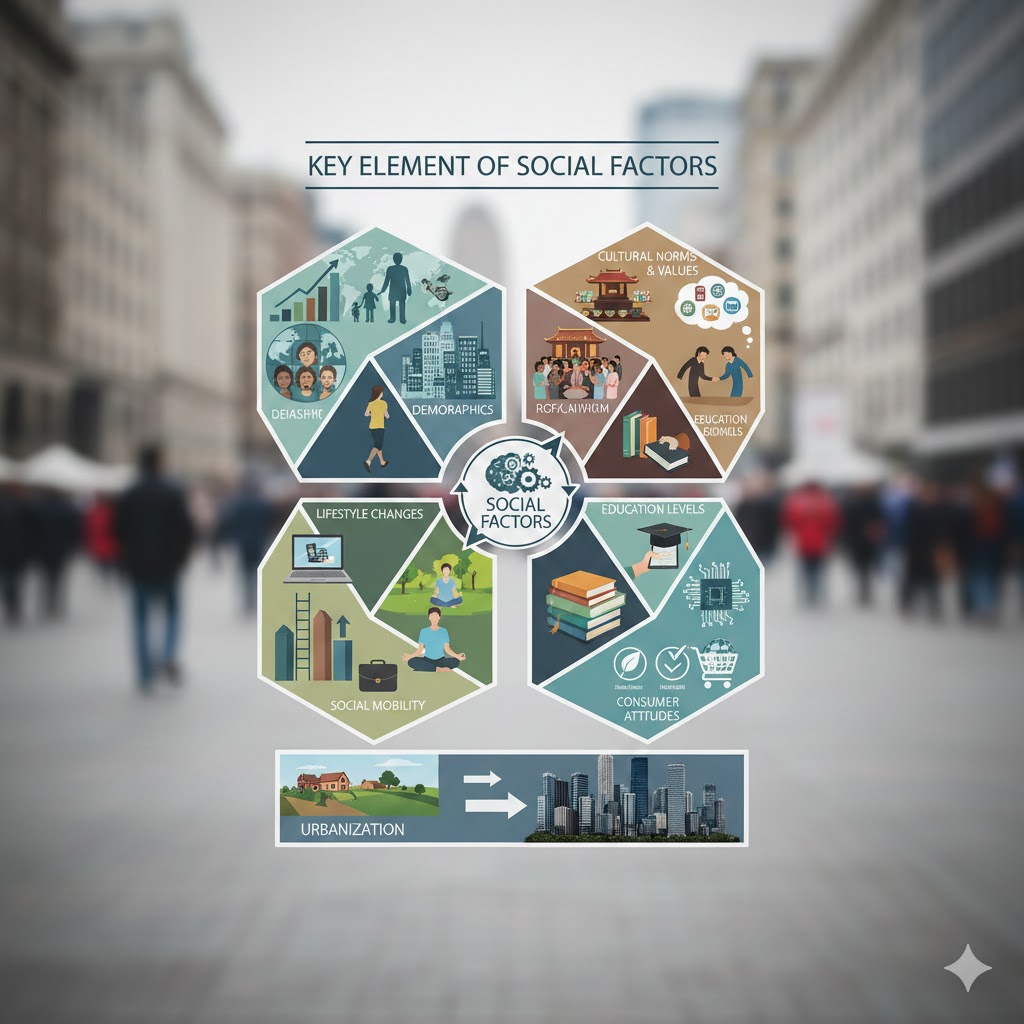
  • Social Factor

    The Social factor refers to the cultural, demographic, and societal aspects that affect consumer needs, behaviors, and market demand. It considers how society’s attitudes, values, and trends influence a business environment.

    Key Elements of Social Factors

    • Urbanization
      Migration trends from rural to urban areas influencing market demand and infrastructure.
    • Demographics
      Age distribution, population growth rate, family size, ethnicity, and population density.
    • Cultural Norms and Values
      Traditions, beliefs, social behaviors, and attitudes towards products or services.
    • Lifestyle Changes
      Shifts in how people live, work, and spend leisure time (e.g., health consciousness, remote work trends).
    • Education Levels
      Affects workforce skills, consumer awareness, and product/service complexity.
    • Social Mobility
      Opportunities for individuals to move within social strata, affecting consumption patterns.
    • Consumer Attitudes
      Toward health, environment, sustainability, brand ethics, and social responsibility.

    Why is the Social Factor Important?

    • Influences product development, marketing strategies, and customer service approaches.
    • Helps anticipate changing consumer needs and tailor offerings.
    • Social trends can create new market opportunities or threaten existing products.
  • Economic Factor

    The Economic factor examines how the overall economy and economic conditions impact businesses. It focuses on factors that influence consumer purchasing power, costs, and demand.

    Key Elements of Economic Factors
    • Economic Growth Rate
      GDP growth or contraction affects demand for products and services.
    • Inflation Rate
      Rising prices can reduce consumers’ spending power and increase costs.
    • Interest Rates
      Affect borrowing costs for businesses and consumers, influencing investment and spending.
    • Unemployment Levels
      High unemployment can reduce demand but may lower labor costs.
    • Exchange Rates
      Affect the cost of imports/exports and competitiveness internationally.
    • Disposable Income
      The amount of money consumers have available after taxes to spend or save.
    • Consumer Confidence
      How optimistic consumers feel about the economy affects their spending habits.
    • Fiscal and Monetary Policies
      Government spending and taxation, central bank policies impact overall economic conditions.

    Why is the Economic Factor Important?

    • Economic conditions directly influence sales volume, pricing strategies, and profitability.
    • Changes in interest or inflation rates affect business financing and consumer behavior.
    • Helps businesses forecast demand and adjust operations accordingly.
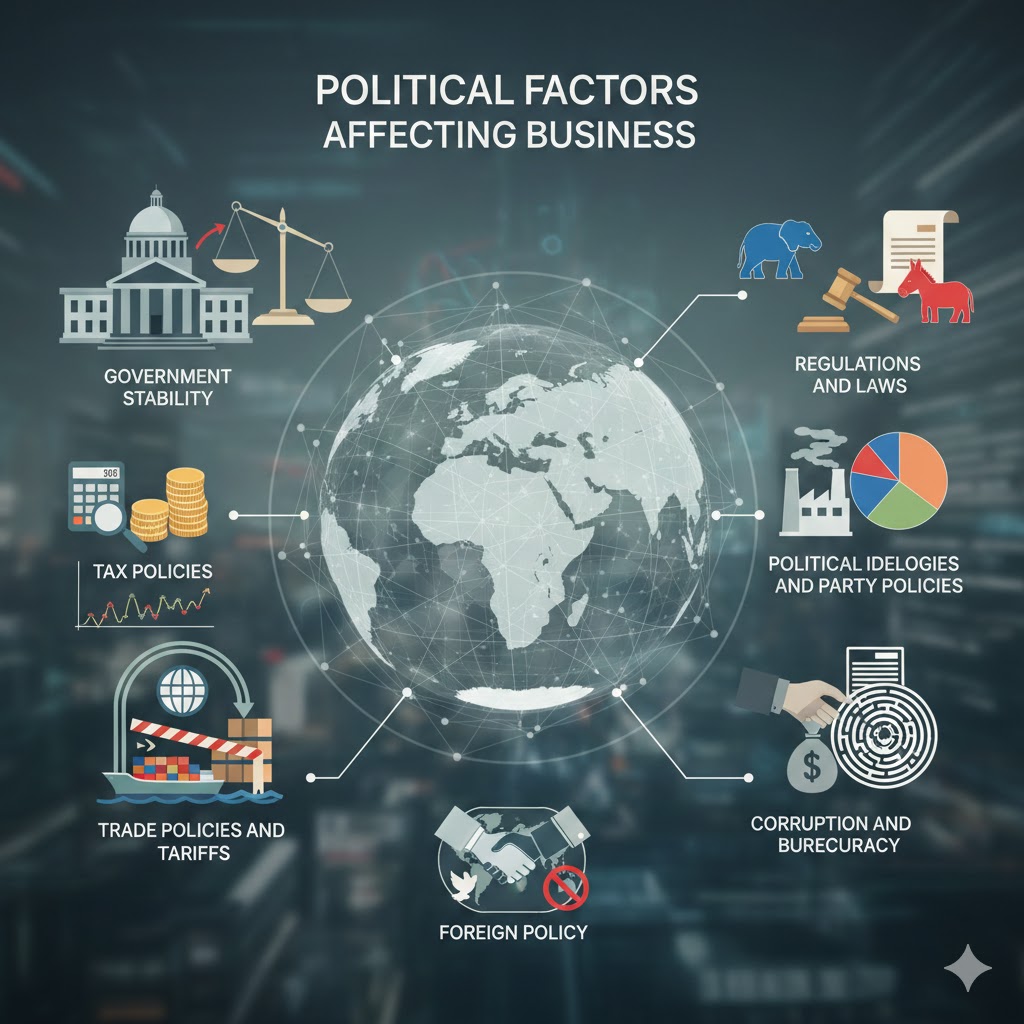
  • Political Factor

    The Political factor refers to how government actions, policies, and political stability affect businesses and the broader industry environment. It covers all aspects of the political environment that can influence organizational operations.

    Why is the Political Factor Important?

    • Political decisions can directly affect market conditions, operational costs, and the legal environment.
    • Businesses in unstable political climates may face risks like policy changes, nationalization, or conflict.
    • Understanding political factors helps companies mitigate risks and capitalize on favorable policies.
  • Open Economy

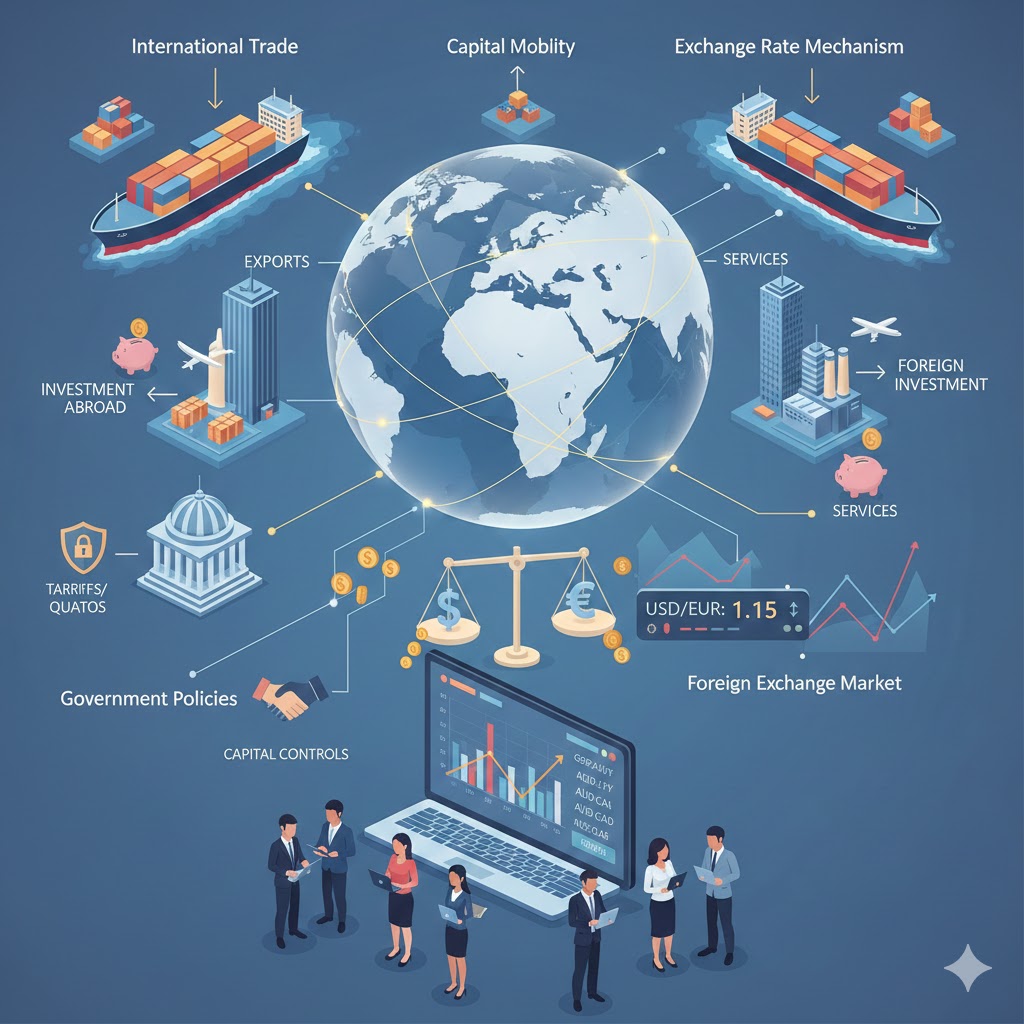
    An Open Economy is an economic system that allows for the free flow of goods, services, capital, and labor across its borders. Unlike a closed economy, which does not engage in international trade or financial exchanges, an open economy interacts with other countries through imports, exports, foreign investments, and currency exchange.

    Key Features of an Open Economy
    • International Trade: It buys and sells goods and services from and to other countries.
    • Capital Mobility: Investors can invest in foreign assets, and foreign investors can invest domestically.
    • Exchange Rate Mechanism: Currency values fluctuate based on trade and investment flows.
    • Foreign Exchange Market: A platform for trading different currencies.
    • Government Policies: May include tariffs, quotas, trade agreements, and capital controls to regulate or promote trade and investment.

    Why Open Economies Matter

    • They allow countries to specialize in producing goods and services where they have a comparative advantage.
    • They promote economic growth through access to larger markets and capital.
    • They can improve efficiency and innovation by exposing domestic firms to international competition.
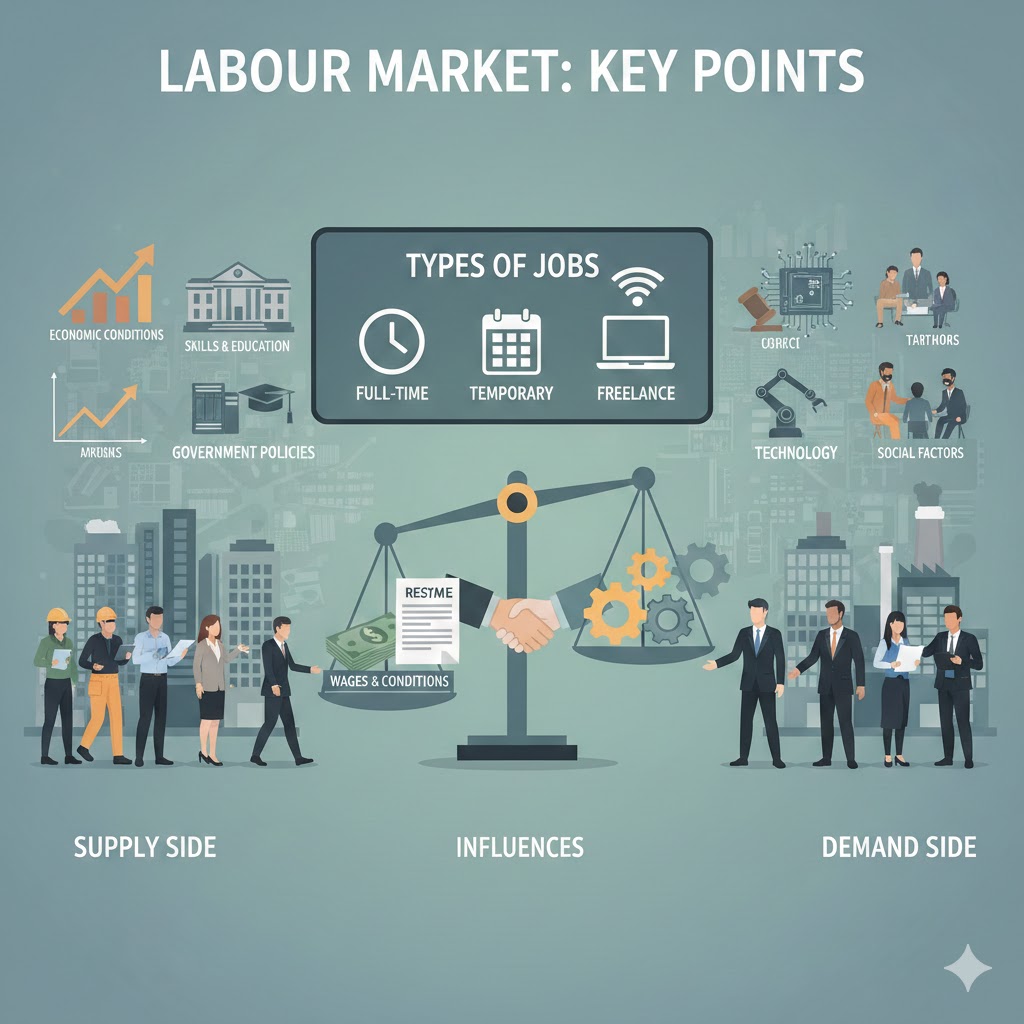
  • Labour Market

    The Labour Market (or job market) is the place or system where workers (labor supply) and employers (labor demand) interact. It’s where people offer their skills and work in exchange for wages or salaries, and where employers seek to hire employees to fill job positions.

    In short, the labour market is where the exchange of work for pay happens, balancing the needs of workers and employers.

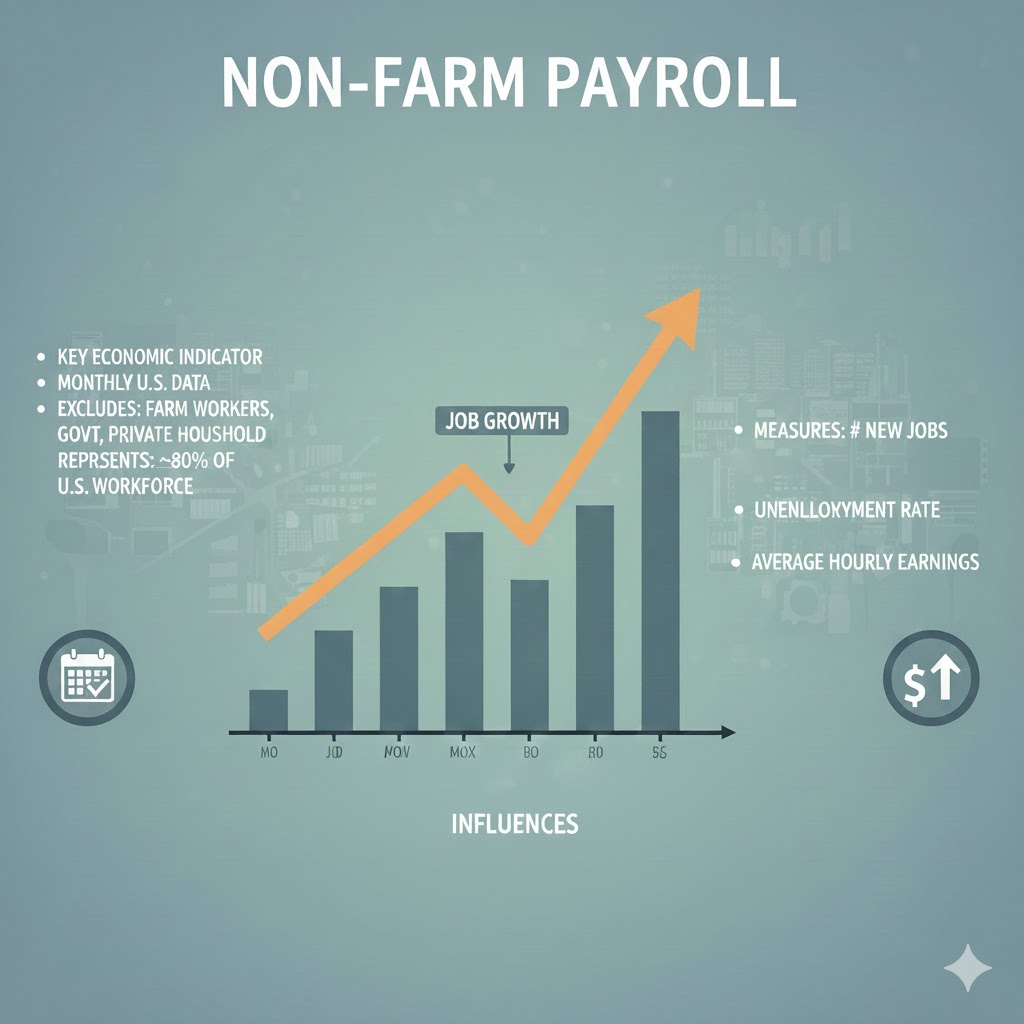
    What is Non-Farm Payroll (NFP)?

    • Non-Farm Payroll represents the total number of paid workers in the U.S. excluding those employed in the farming sector, private households, non-profit organizations, and government employees.
    • It reflects employment levels in all industries except agriculture.

    Why is Non-Farm Payroll Important?

    • It is released monthly by the U.S. Bureau of Labor Statistics (BLS) as part of the Employment Situation report.
    • The NFP data shows how many jobs were added or lost in the economy, giving insight into economic health.
    • It affects financial markets strongly because it signals labor market strength and can influence Federal Reserve monetary policy decisions.

    In short

    • Non-farm payment likely means non-farm payroll, which is the count of workers paid outside the farming sector.
    • It’s a major indicator of employment trends and economic performance.
  • Money Market

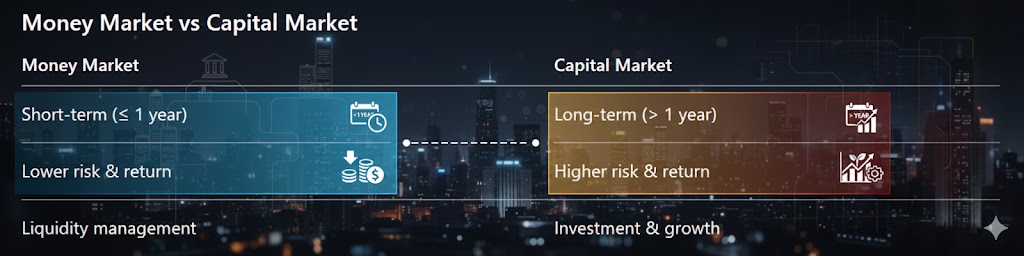
    Money Market is a segment of the financial market where short-term funds are borrowed and lent, usually for periods of less than one year. It is mainly used to manage liquidity and meet short-term financing needs, rather than for long-term investment.

    Key characteristics

    • Short maturity: Overnight to under 1 year
    • Low risk & high liquidity
    • Large transaction sizes
    • Lower returns compared to capital markets

    Main participants
    • Central banks
    • Commercial banks
    • Financial institutions
    • Corporations
    • Governments

    Common money market instruments

    • Treasury Bills (T-Bills): Short-term government securities
    • Commercial Paper (CP): Unsecured short-term corporate debt
    • Certificates of Deposit (CDs): Time deposits issued by banks
    • Repurchase Agreements (Repos): Short-term borrowing using securities as collateral
    • Interbank loans: Loans between banks

    Functions of the money market

    In short, the money market keeps the financial system running smoothly by ensuring that cash is available where and when it’s needed.

  • Public Finance

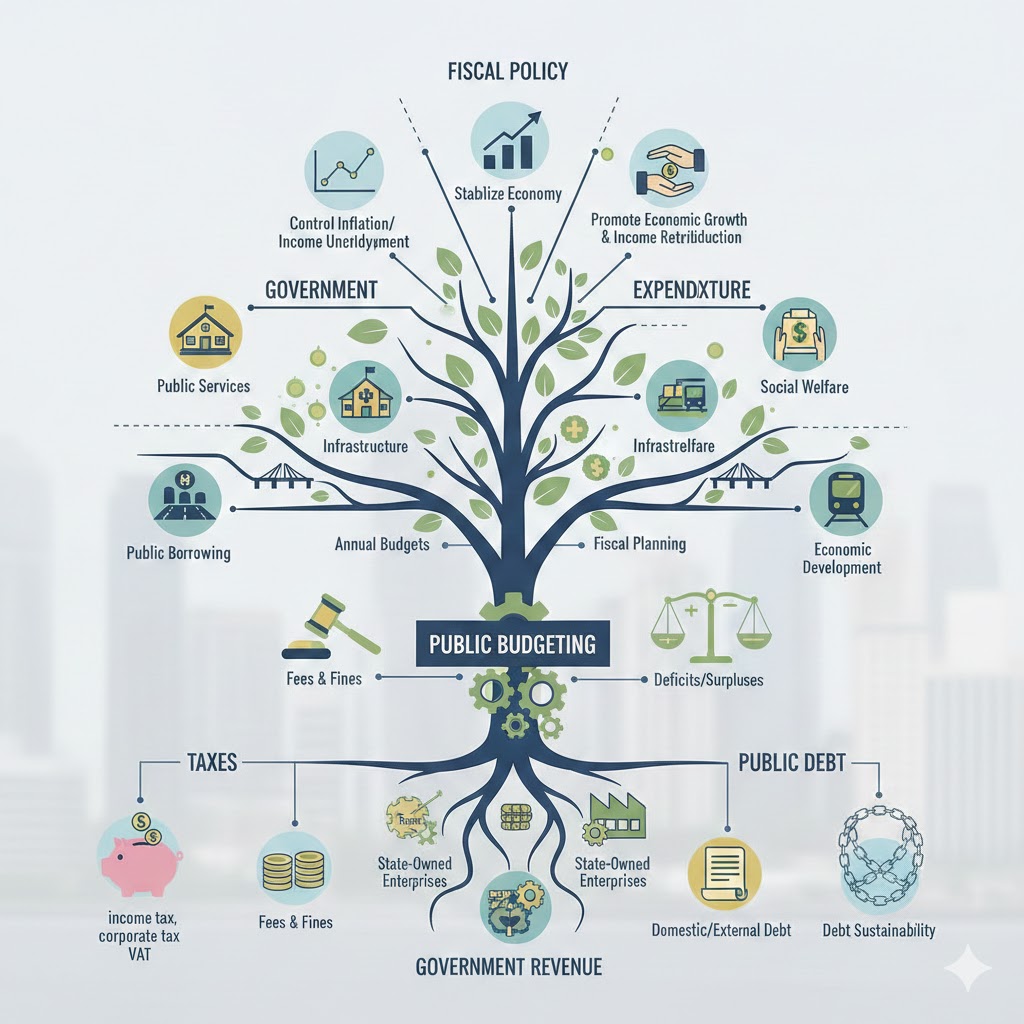
    Public Finance is a branch of economics that studies how governments raise, allocate, and manage financial resources to support public services and achieve economic and social objectives.

    Why Public Finance matters

    Public Finance helps ensure:

    • Efficient allocation of resources
    • Fair income distribution
    • Macroeconomic stability
    • Provision of public goods that the private sector cannot efficiently supply

    In short

    Public Finance explains how governments get money, how they spend it, and how those decisions affect the economy and society.

  • Balance of Payments (BoP)

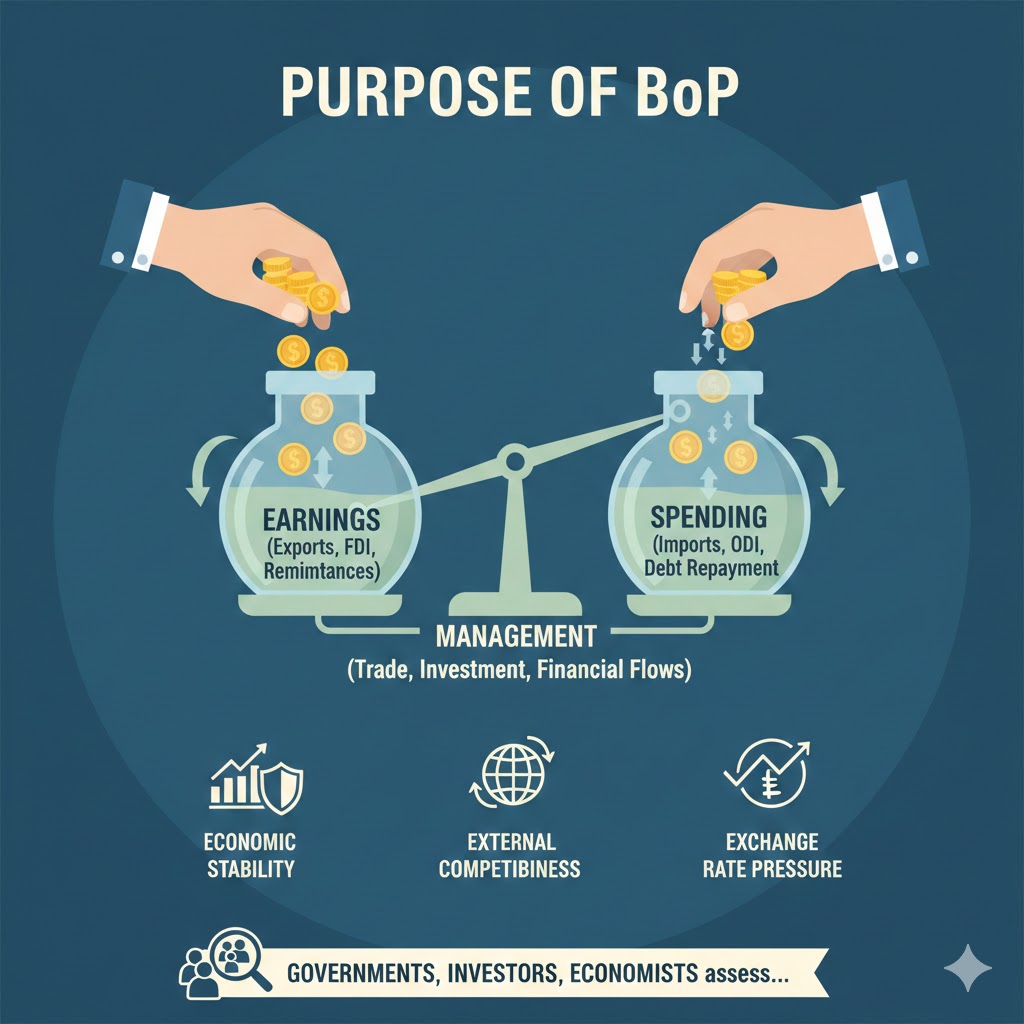
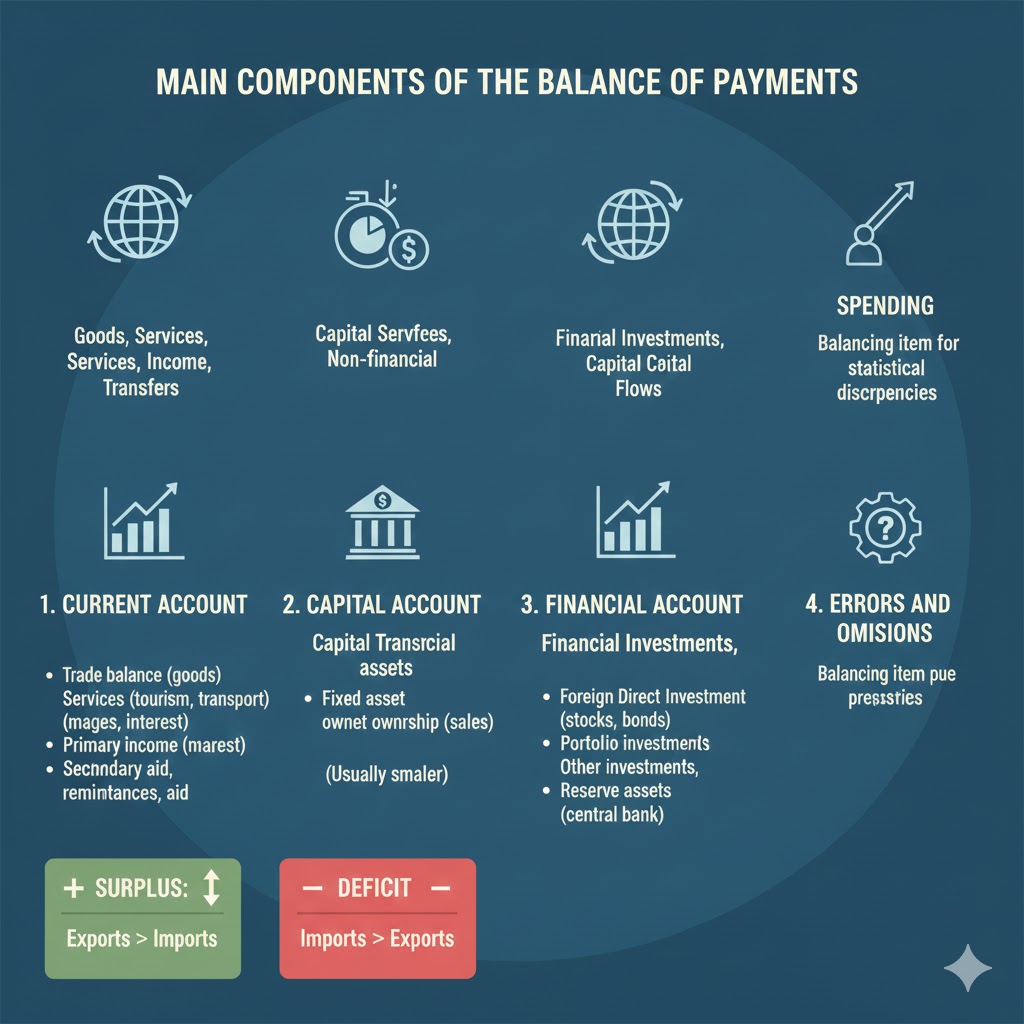
    Balance of Payments (BoP) is a comprehensive record of all economic transactions between a country and the rest of the world over a specific period (usually a quarter or a year).

    Key Rule of BoP

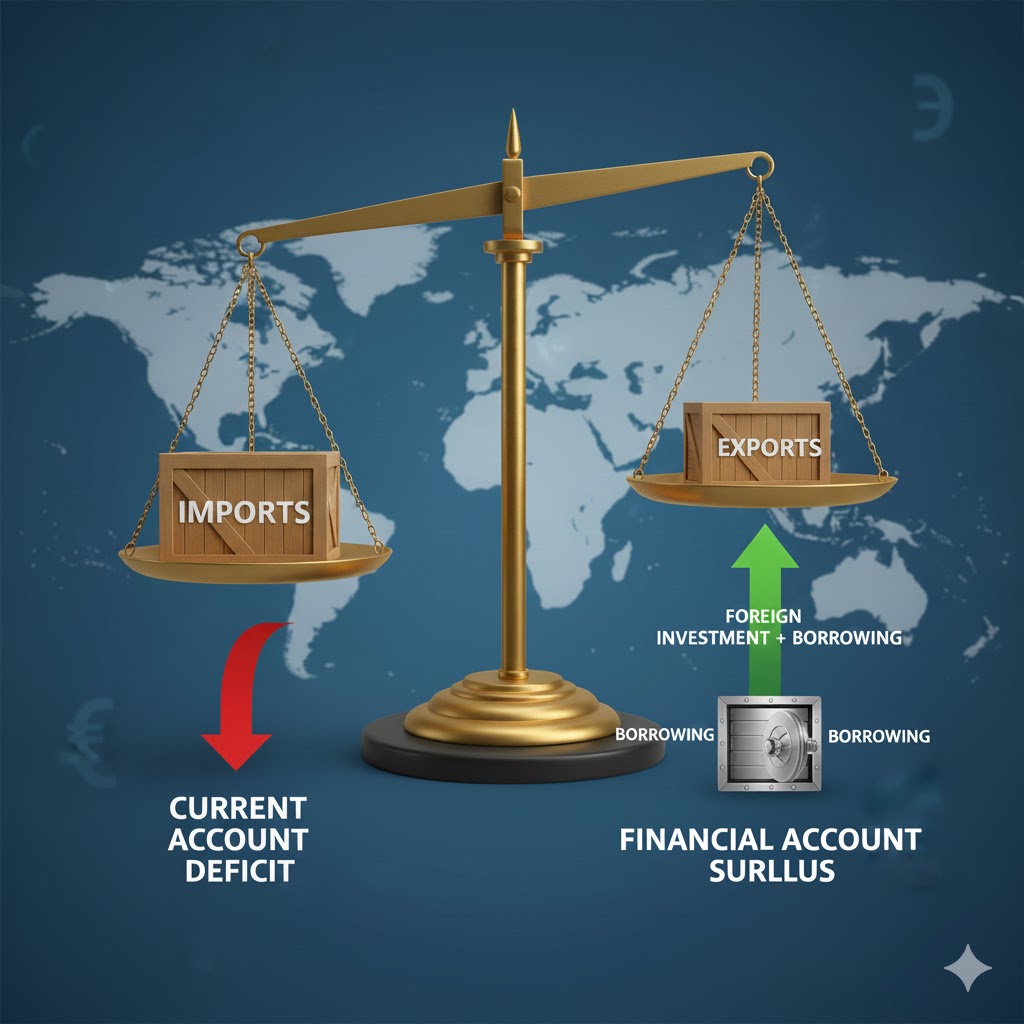
    In theory, the Balance of Payments always balances

    Any deficit or surplus in one account must be offset by changes in other accounts or reserves.


    Why BoP Matters

    • Influences exchange rates
    • Signals economic strength or vulnerability
    • Guides monetary and fiscal policy
    • Important for foreign investors and international trade decisions

    Example

  • Exchange Rate

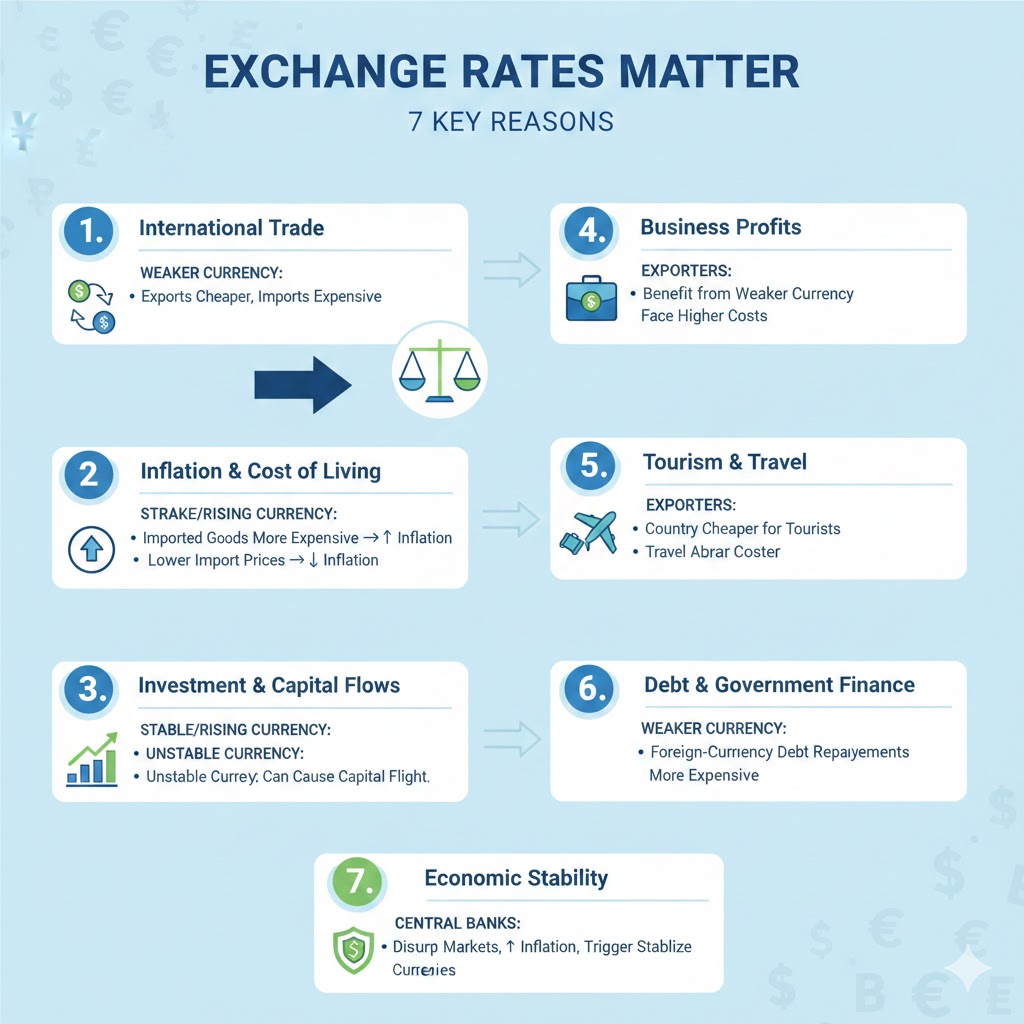
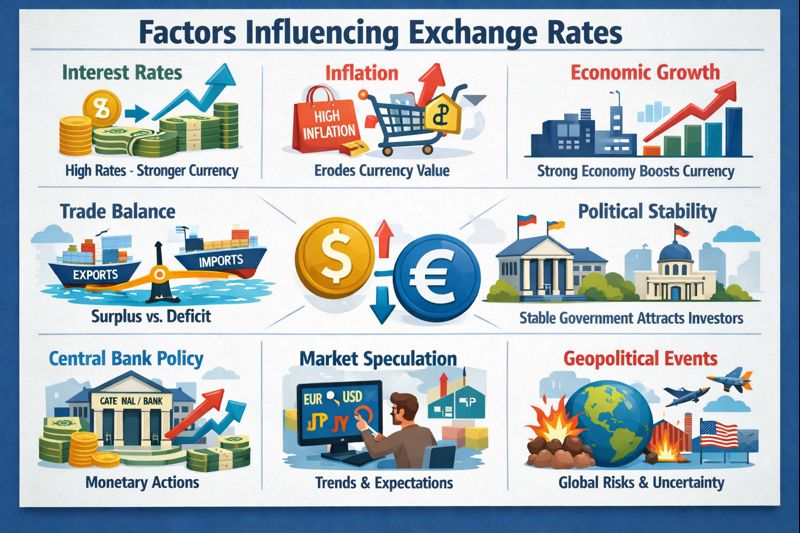
    An exchange rate is the price of one country’s currency in terms of another country’s currency. It tells you how much of one currency you need to exchange for another.

    Exchange rate = value of one currency expressed in another currency
    Foreign Exchange rate (Forex)

    Types of exchange rate systems

    1. Floating exchange rate
      • Determined by supply and demand in the market
      • Example: USD, EUR, JPY
    2. Fixed (pegged) exchange rate
      • Currency is pegged to another currency or a basket
      • Central bank intervenes to keep it stable
    3. Managed float
      • Mostly market-driven, but central bank intervenes when needed
      • Vietnam uses this system

    Appreciation vs Depreciation

    • Currency appreciation: Currency becomes stronger
    • Currency depreciation: Currency becomes weaker
  • Interest Rate

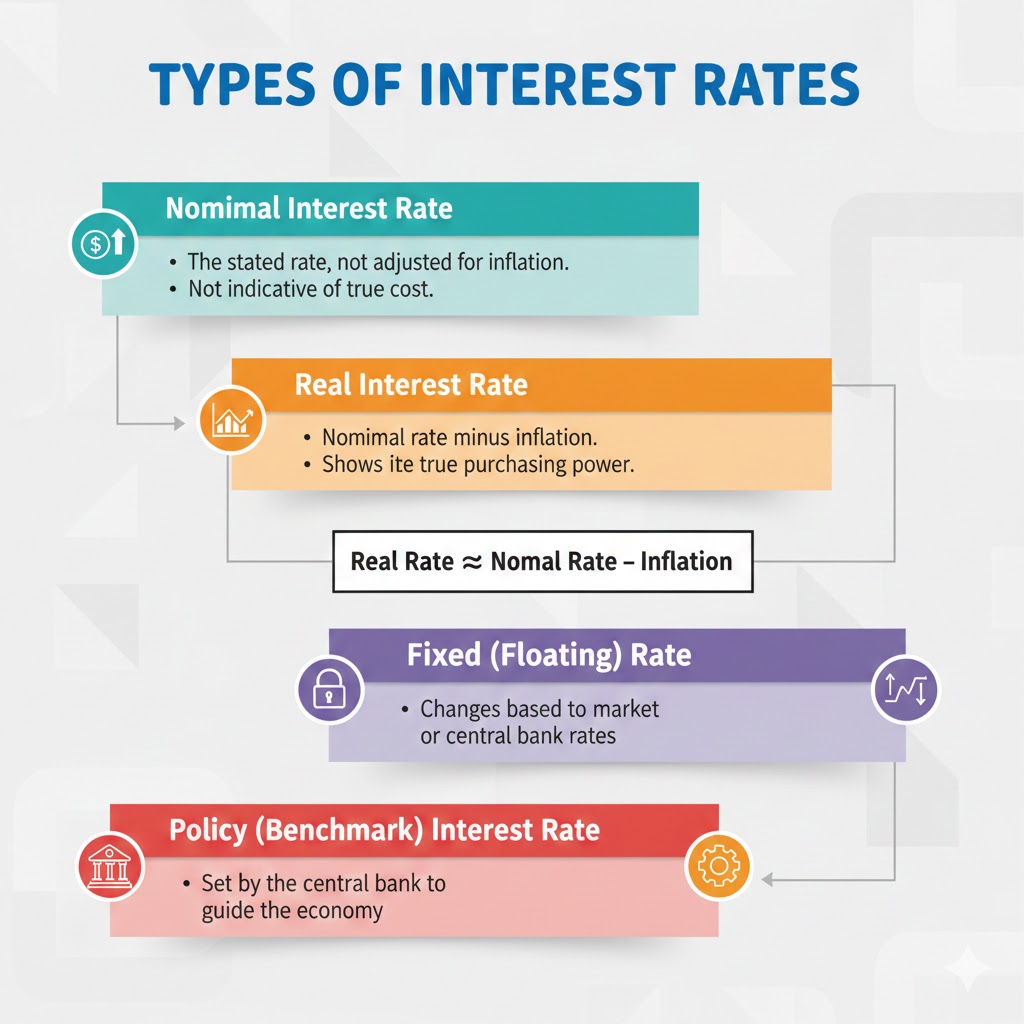
    Interest Rate is the cost of borrowing money or the return on saving/investing money, usually expressed as a percentage per year.

    • For borrowers: Interest rate is the price you pay to use someone else’s money (e.g. loans, mortgages).
    • For savers/investors: Interest rate is the income you earn from lending money (e.g. bank deposits, bonds).

    Why Interest Rates Matter

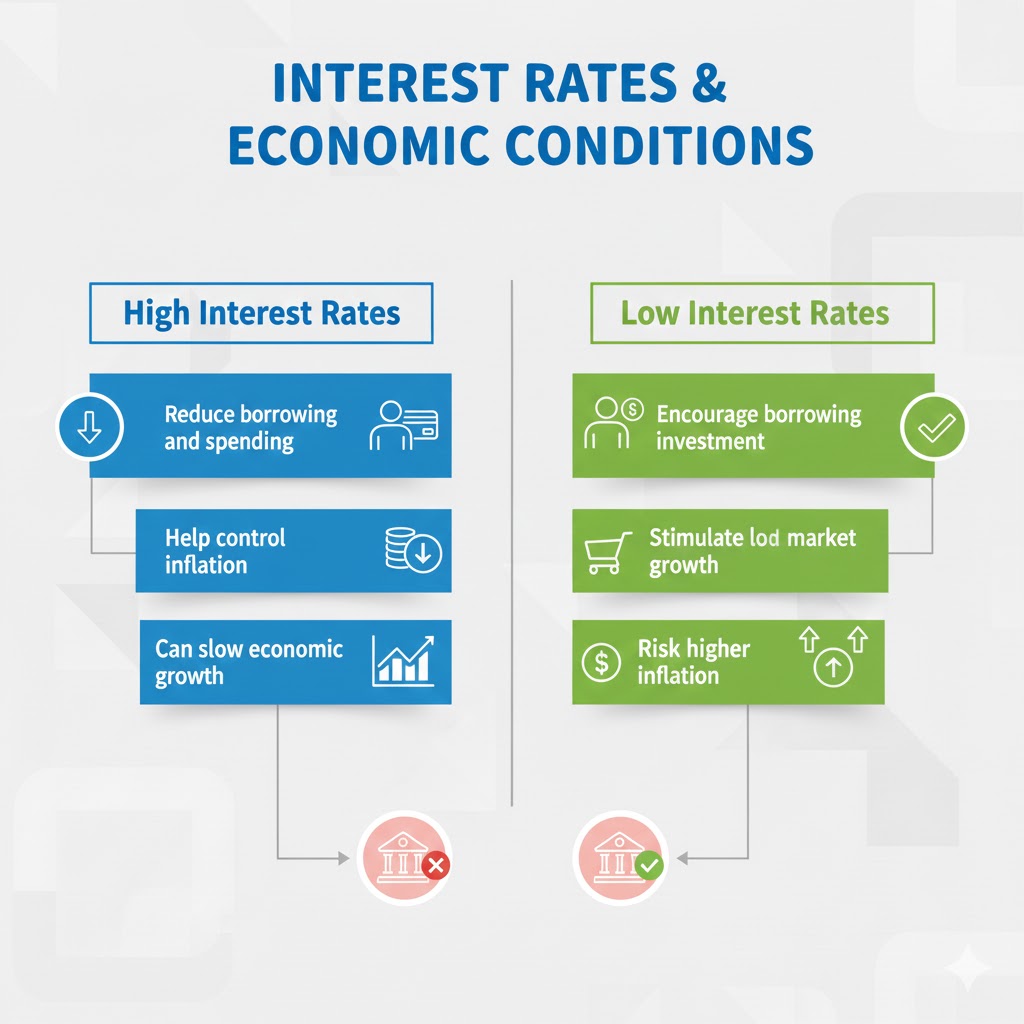
    Interest rates affect almost every part of the economy:

    • Consumers: borrowing, spending, saving decisions
    • Businesses: investment and expansion costs
    • Financial markets: stocks, bonds, currencies
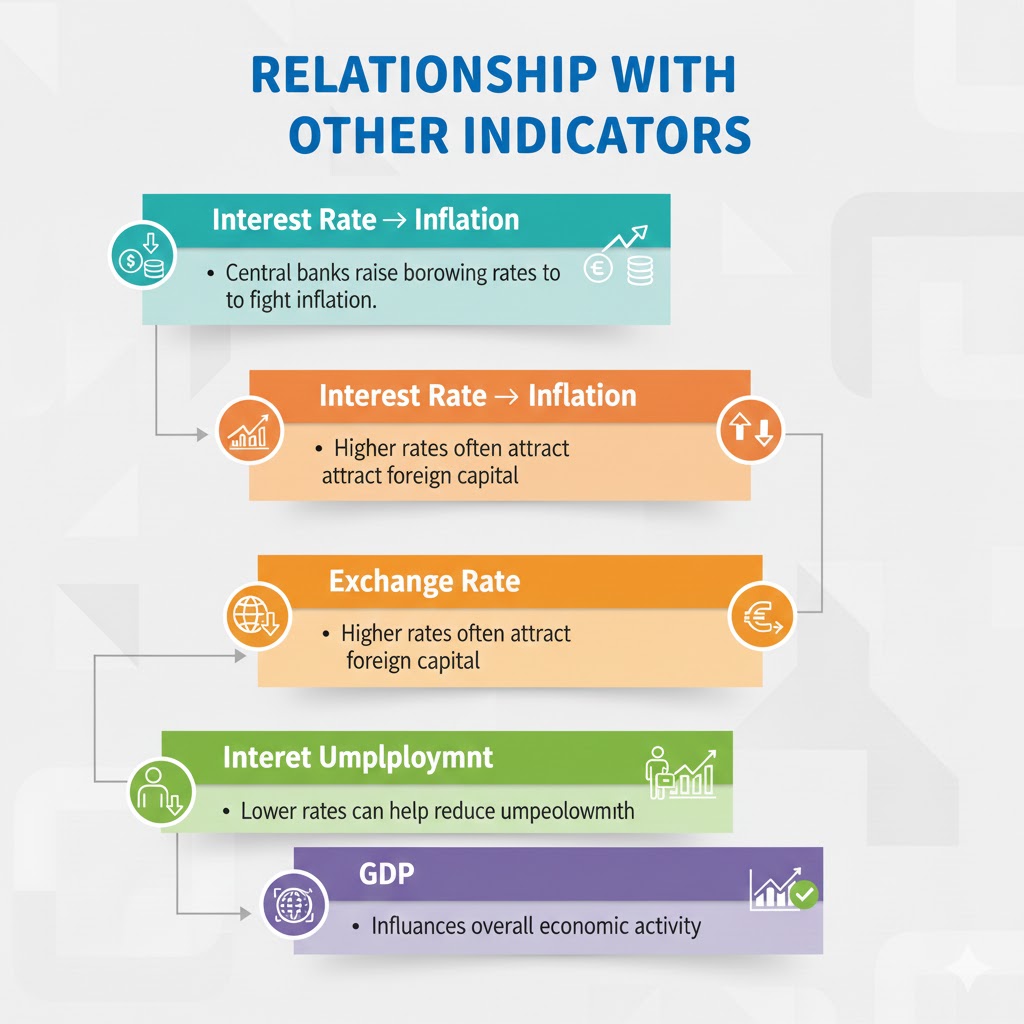
    • Inflation: controlling price stability
    • Economic growth: encouraging or slowing activity

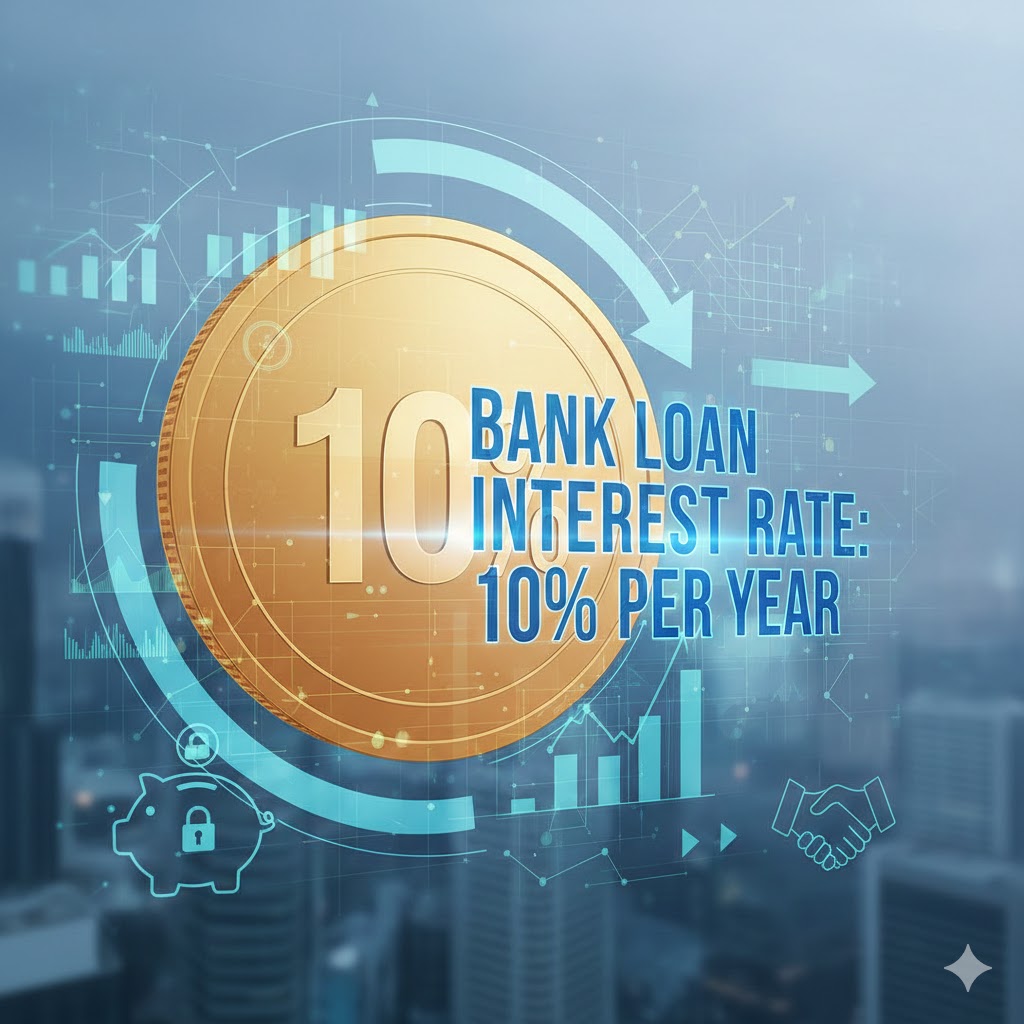
    Simple Example

  • Unemployment Rate

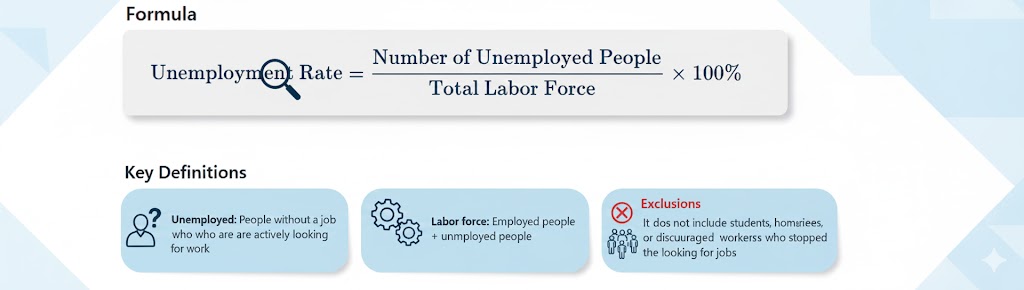
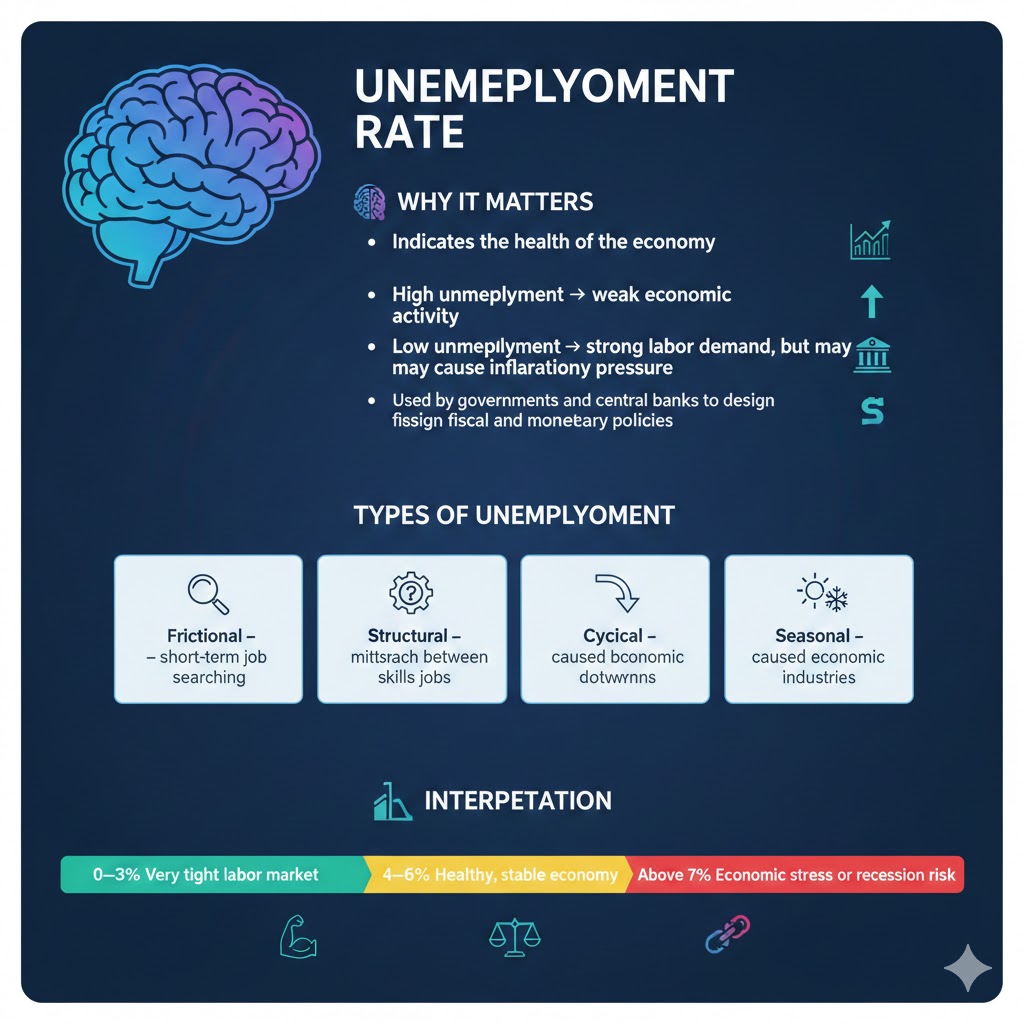
    Unemployment Rate is a key macroeconomic indicator that measures the share of people in the labor force who are able and willing to work but cannot find a job.

    The unemployment rate shows how efficiently an economy is using its labor resources.

    In practice

    • Investors watch unemployment data to anticipate interest rate changes
    • Businesses use it to plan hiring and expansion
    • Educators and policymakers use it to assess workforce readiness
  • Inflation Rate

    Inflation Rate is the percentage change in the general price level of goods and services over a specific period, usually measured year-over-year (YoY) or month-over-month (MoM).

    Key points

    • 📈 Positive inflation: Prices rise → purchasing power falls
    • 📉 Negative inflation (deflation): Prices fall
    • 🎯 Moderate inflation (around 2%) is often considered healthy for economic growth

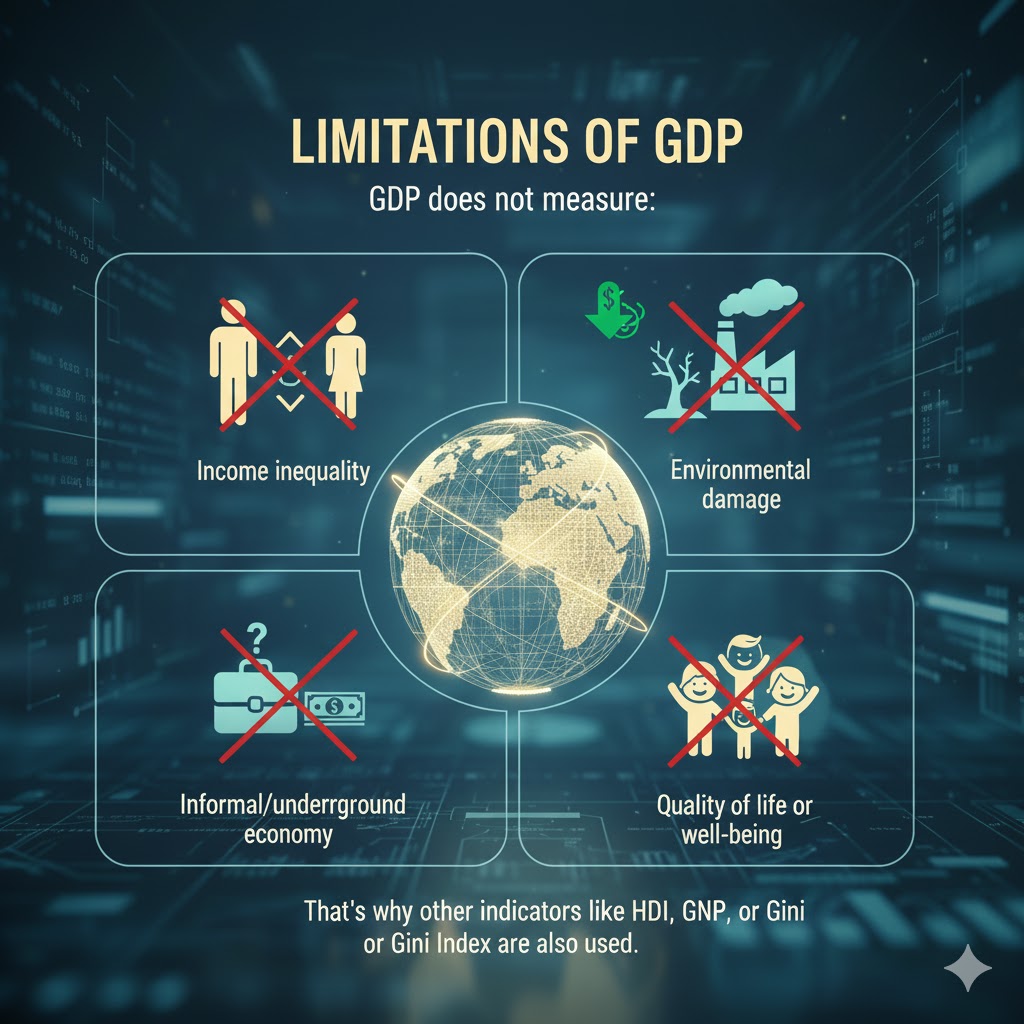
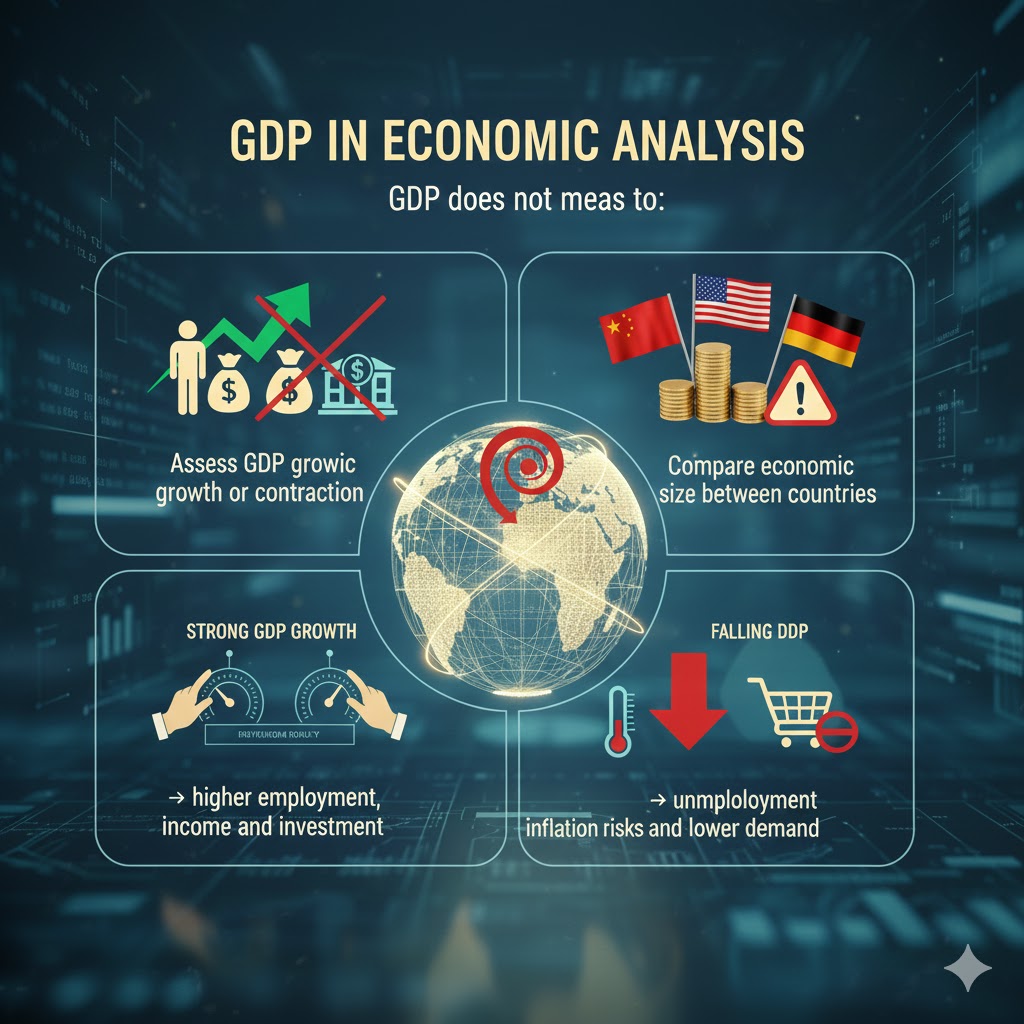
  • Gross Domestic Product (GDP)

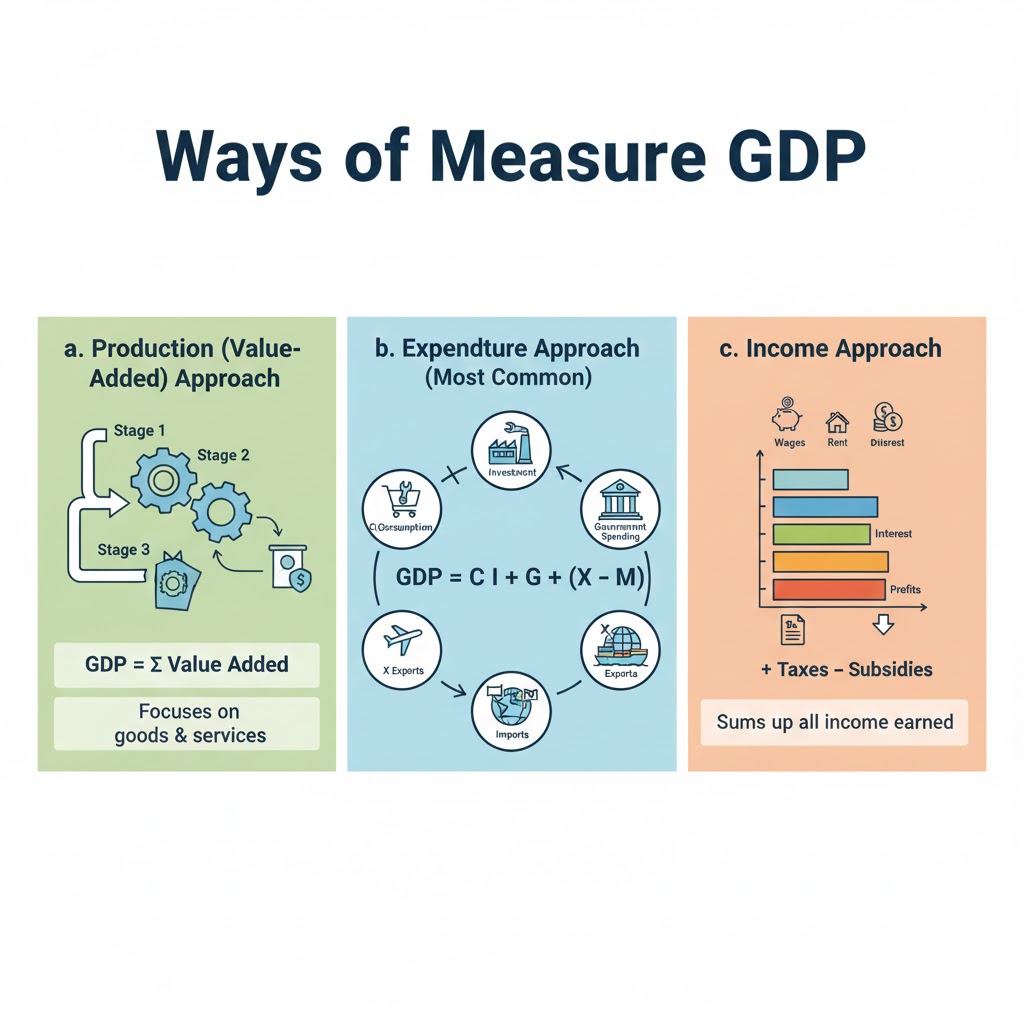
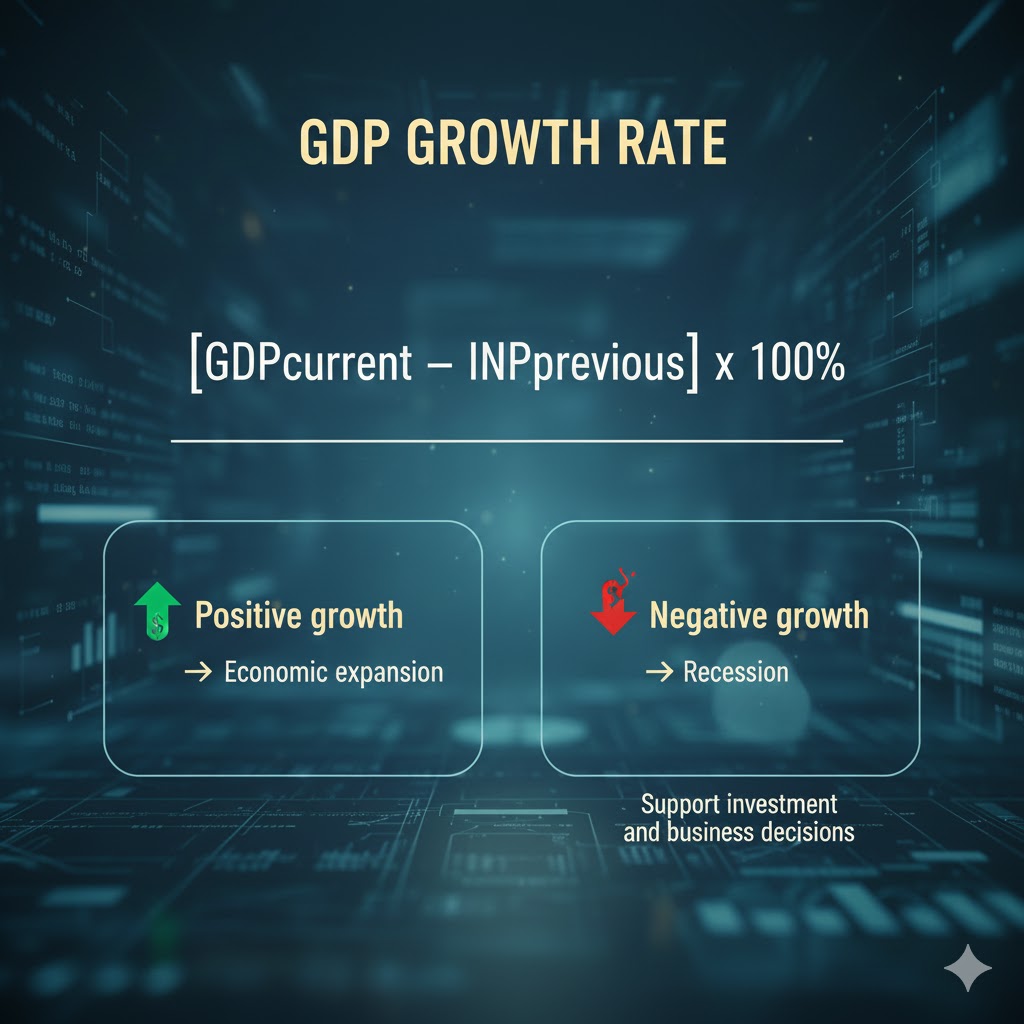
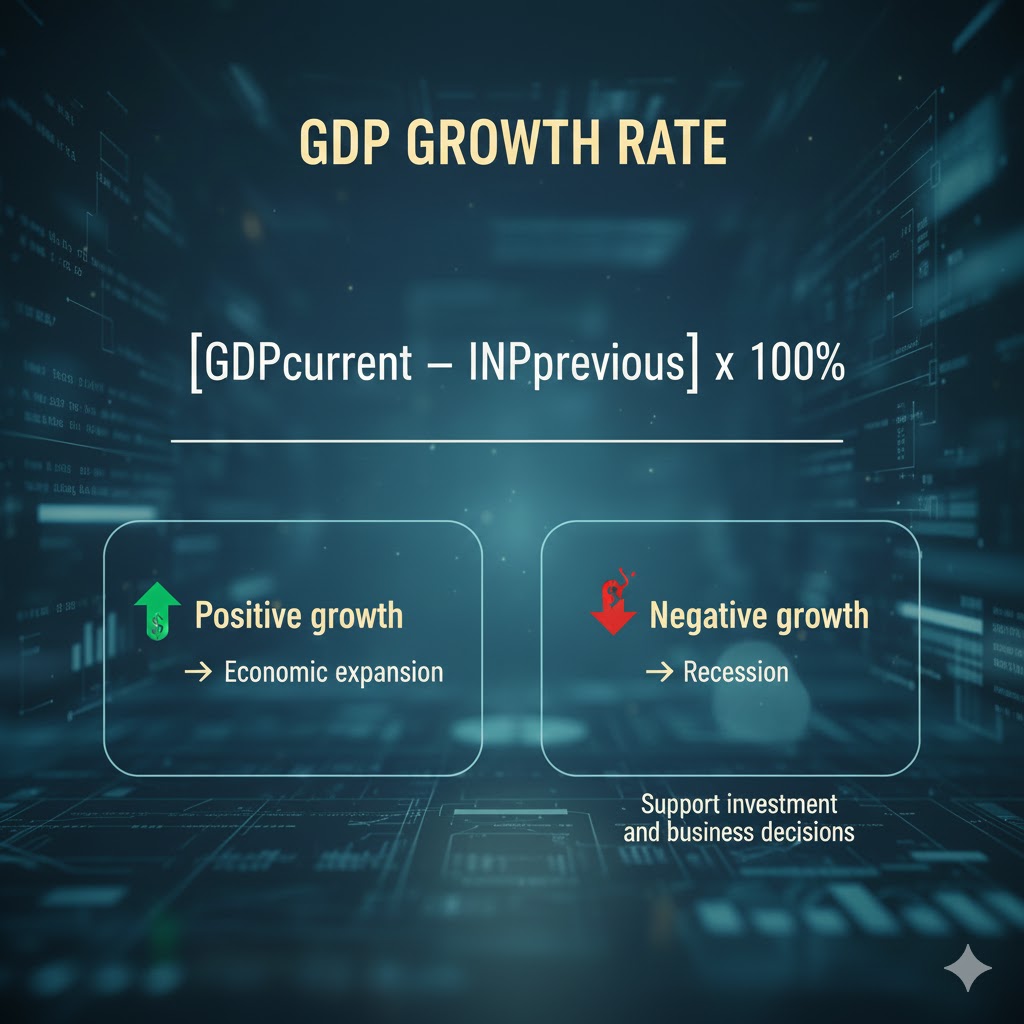
    GDP is the total market value of all final goods and services produced within a country’s borders during a specific period (usually quarterly or annually).

    “Final goods” means products sold to end users (to avoid double counting).

    Types of GDP

    • Nominal GDP – Measured at current prices (affected by inflation)
    • Real GDP – Adjusted for inflation (shows real economic growth)
    • GDP per Capita – GDP ÷ Population (standard of living indicator)

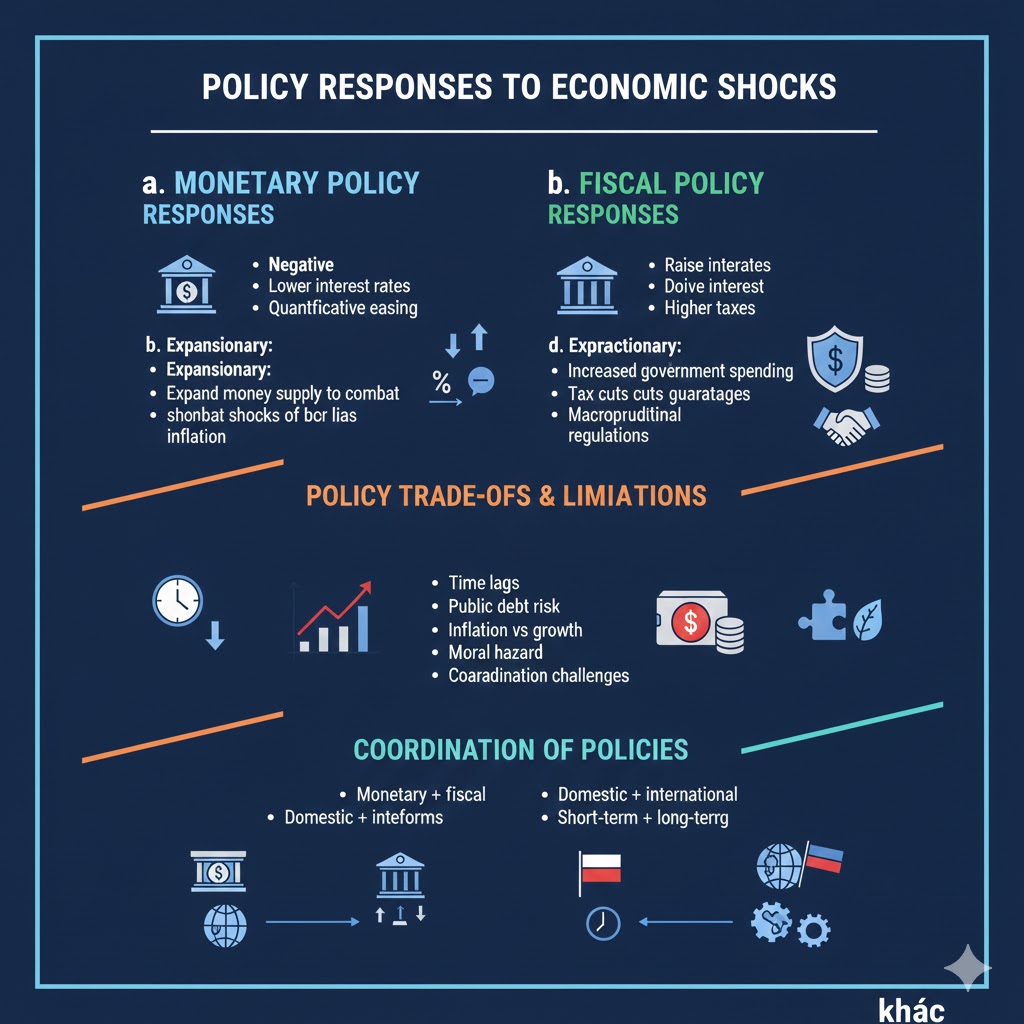
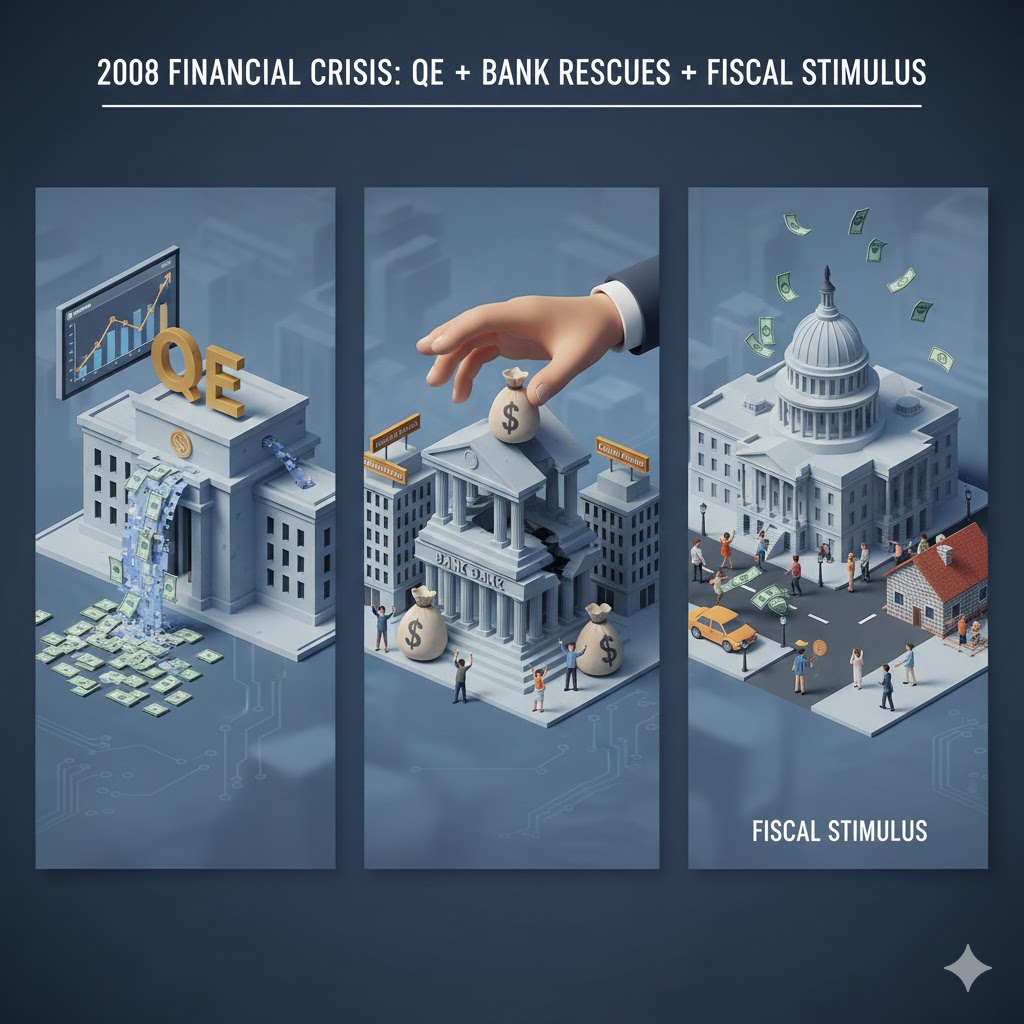
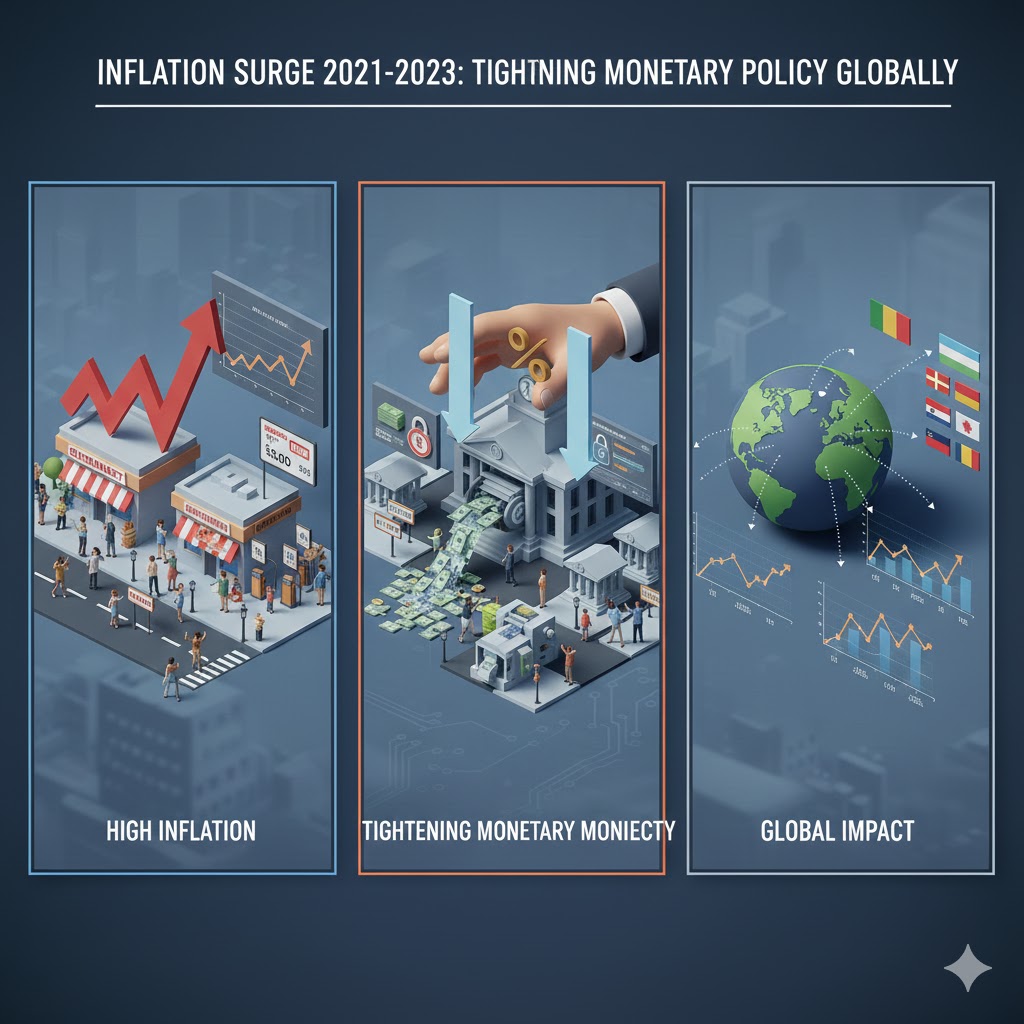
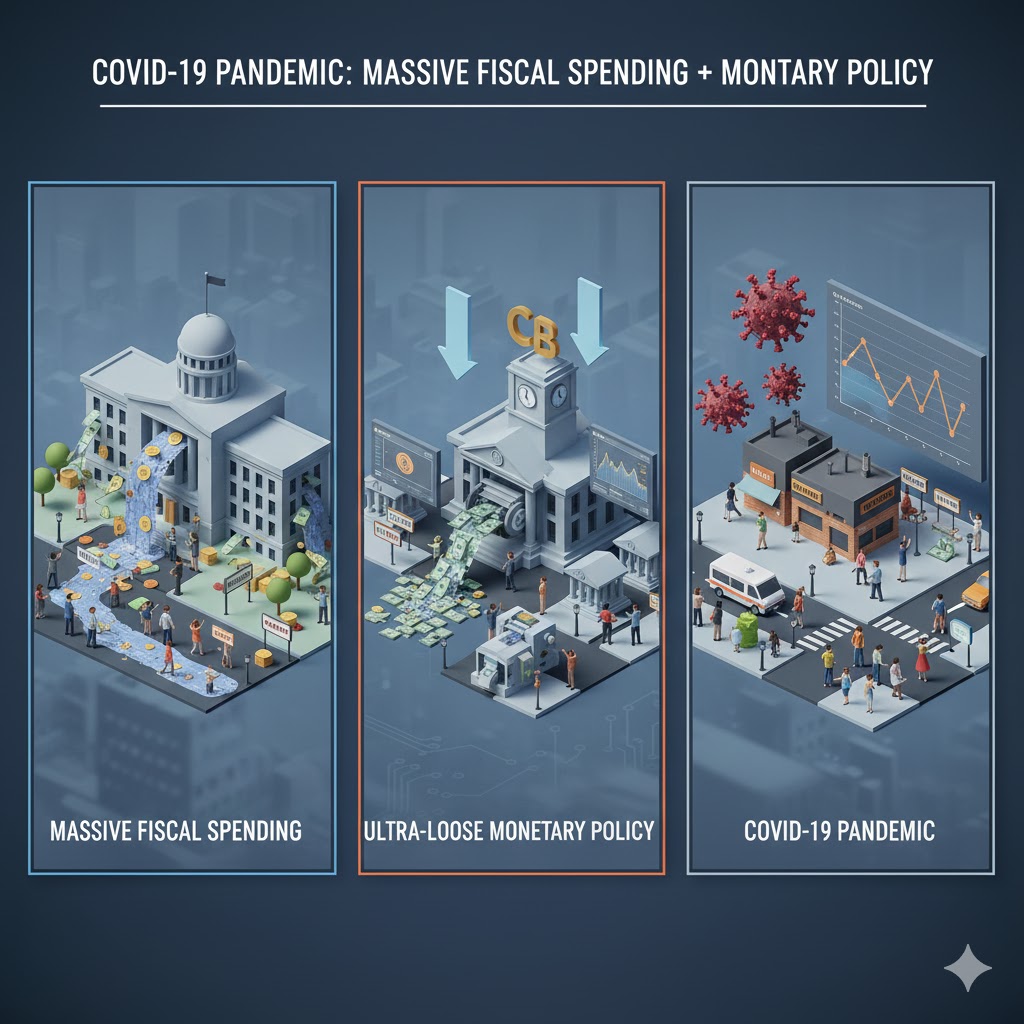
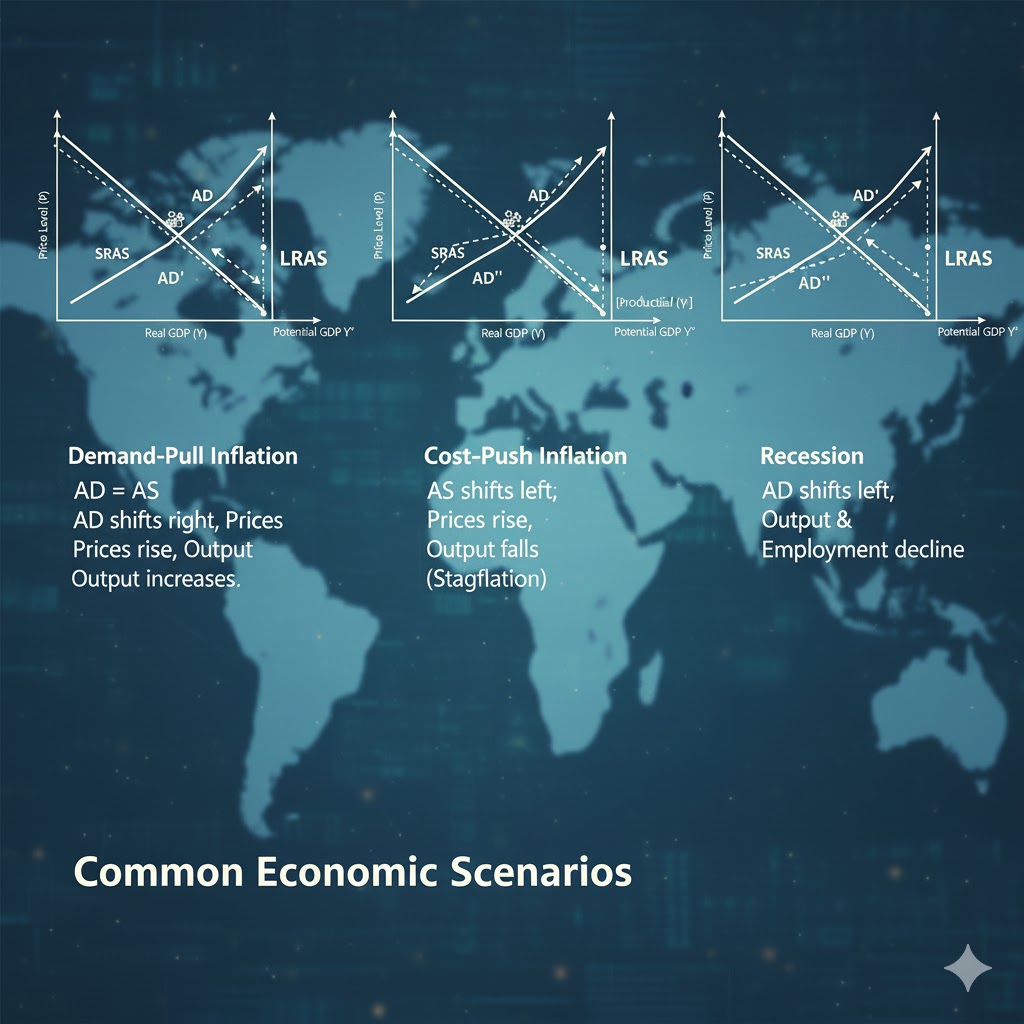
  • Economic Shocks & Policy Responses

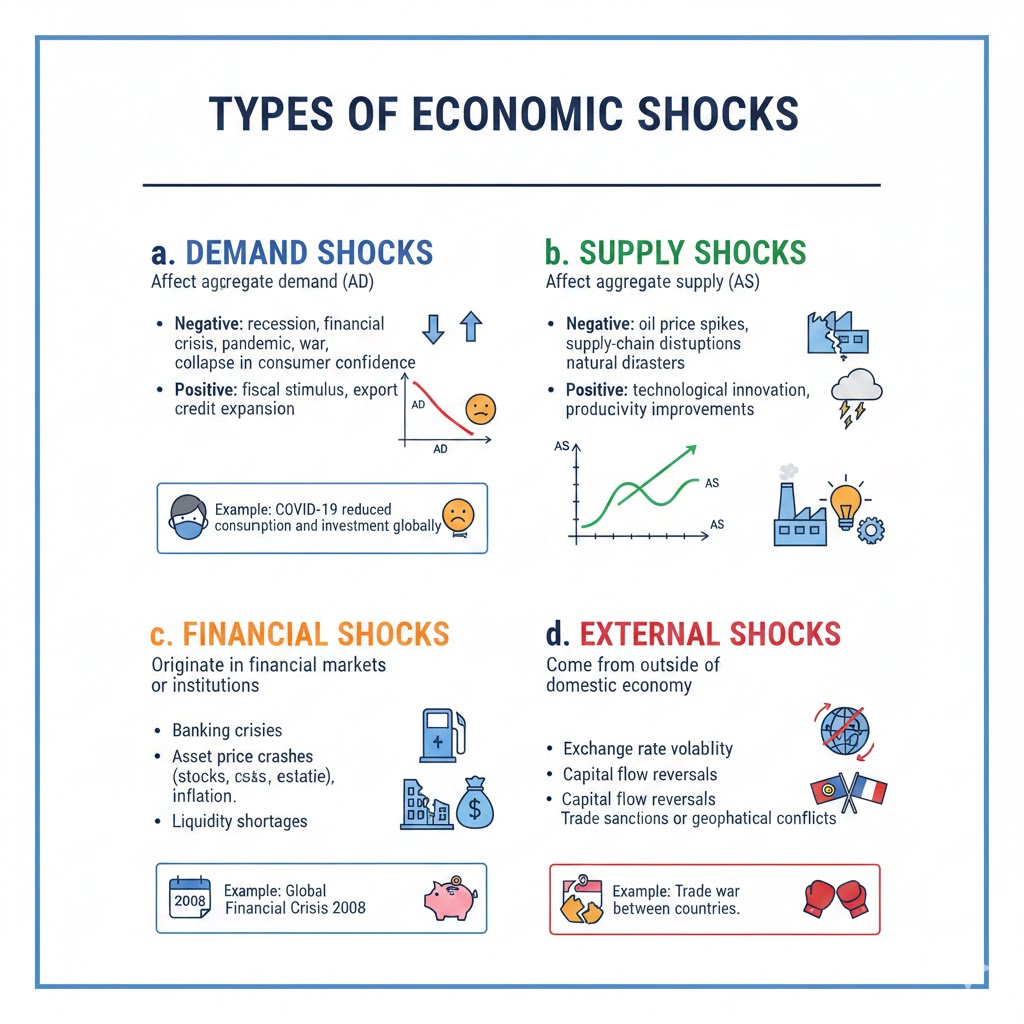
    Economic shocks are sudden, unexpected events that disrupt the normal functioning of an economy, causing sharp changes in output, employment, prices, or financial markets. Shocks can be short-term or long-lasting, domestic or global.
    Economic Impact of Shocks

    Economic shocks typically lead to:

    • GDP contraction or overheating
    • Rising unemployment
    • Inflation or deflation pressures
    • Exchange rate instability
    • Increased market volatility and uncertainty

    Real-world Examples

    Key Takeaway

    Economic shocks are unavoidable, but timely, flexible, and well-coordinated policy responses can significantly reduce economic damage and speed up recovery.

  • Aggregate Demand & Supply (AD & AS)

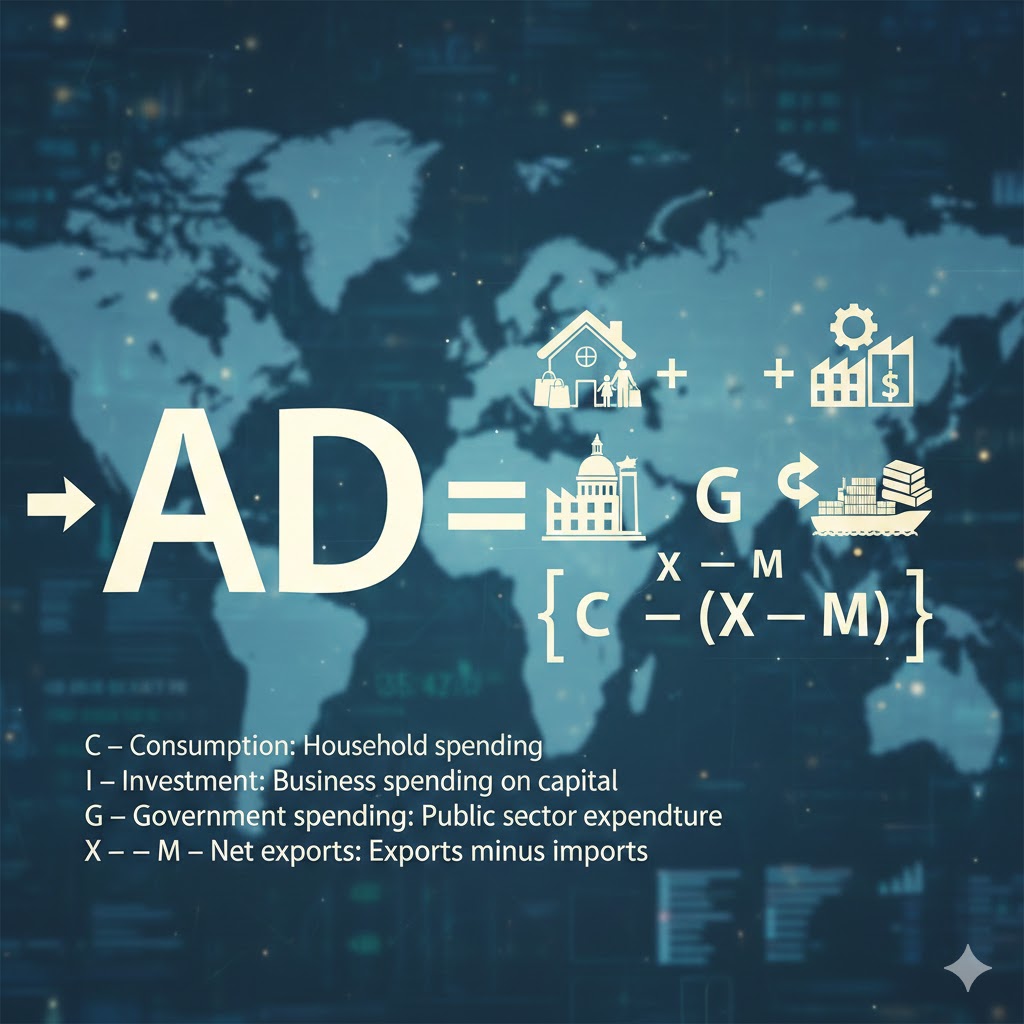
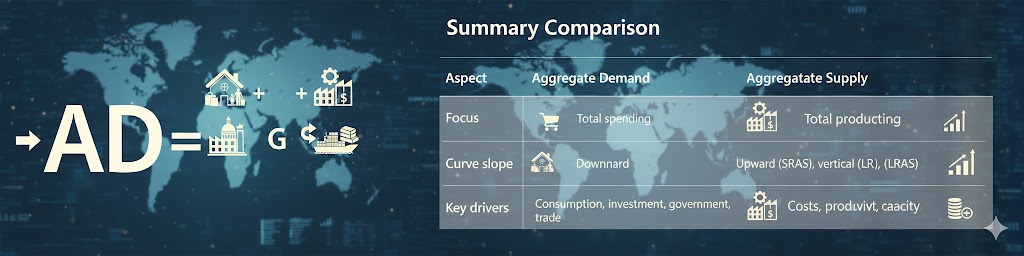
    Aggregate Demand (AD) and Aggregate Supply (AS) are core macroeconomic concepts used to explain overall price levels, output, and economic fluctuations in an economy.

    Aggregate Demand (AD)

    Aggregate Demand is the total demand for all final goods and services in an economy at a given price level and during a specific period.

    Why AD slopes downward:

    • Interest rate effect
    • Wealth effect
    • Exchange rate effect

    Aggregate Supply (AS)

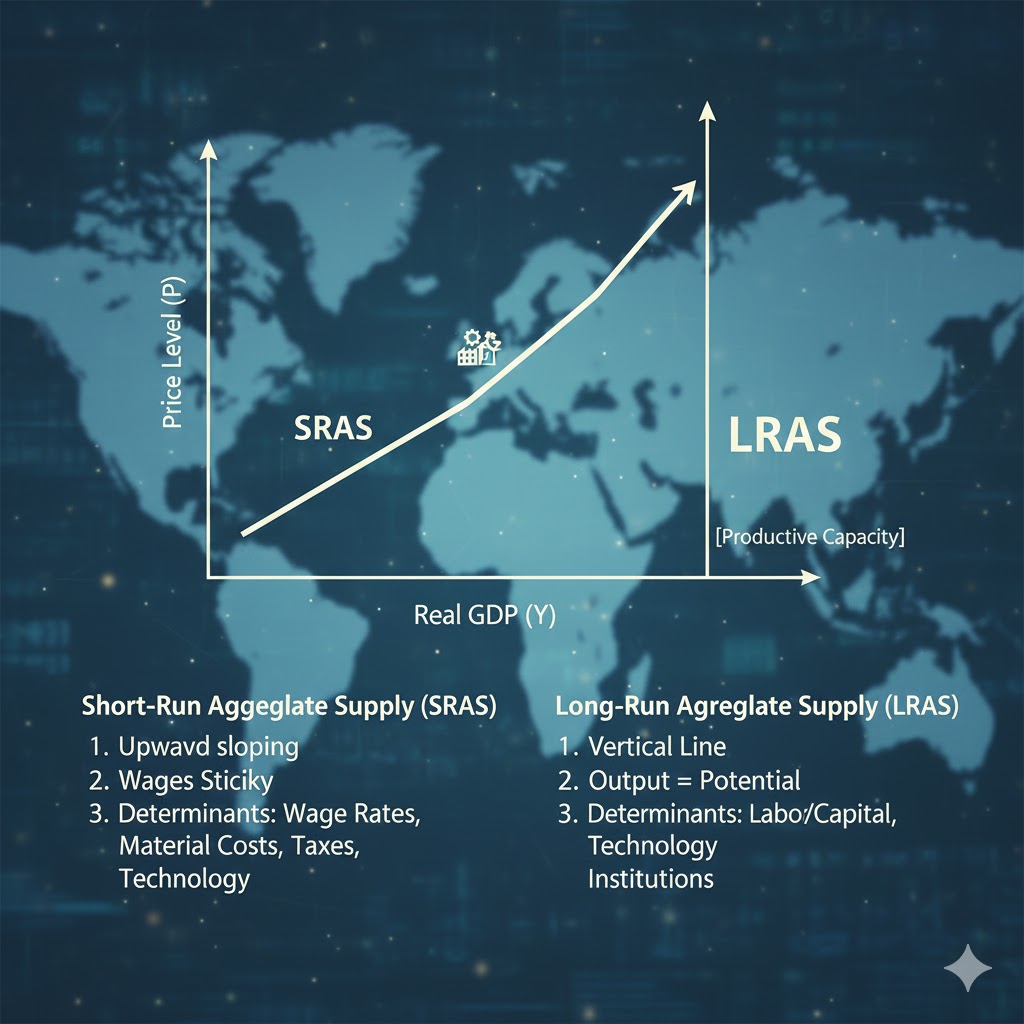
    Aggregate Supply shows the total output firms are willing to produce at different price levels.


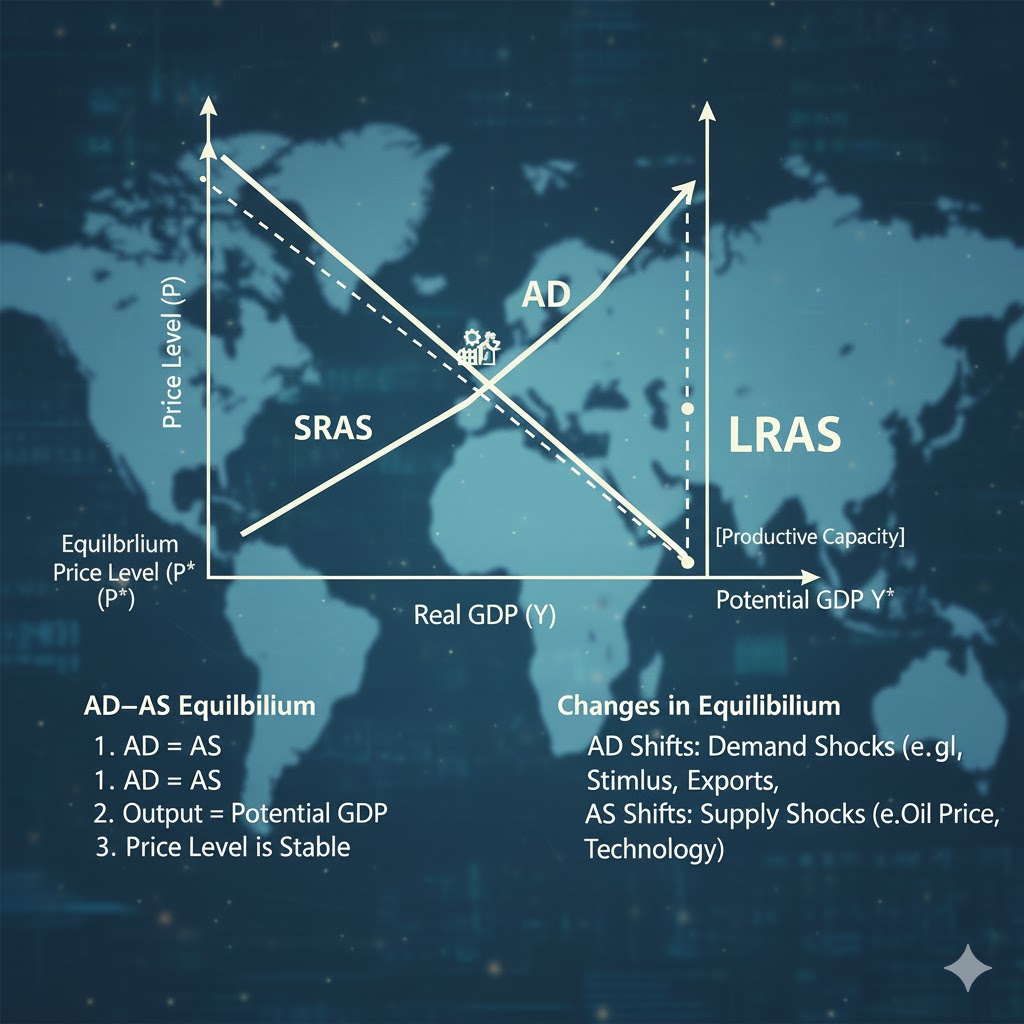
    AD–AS Equilibrium

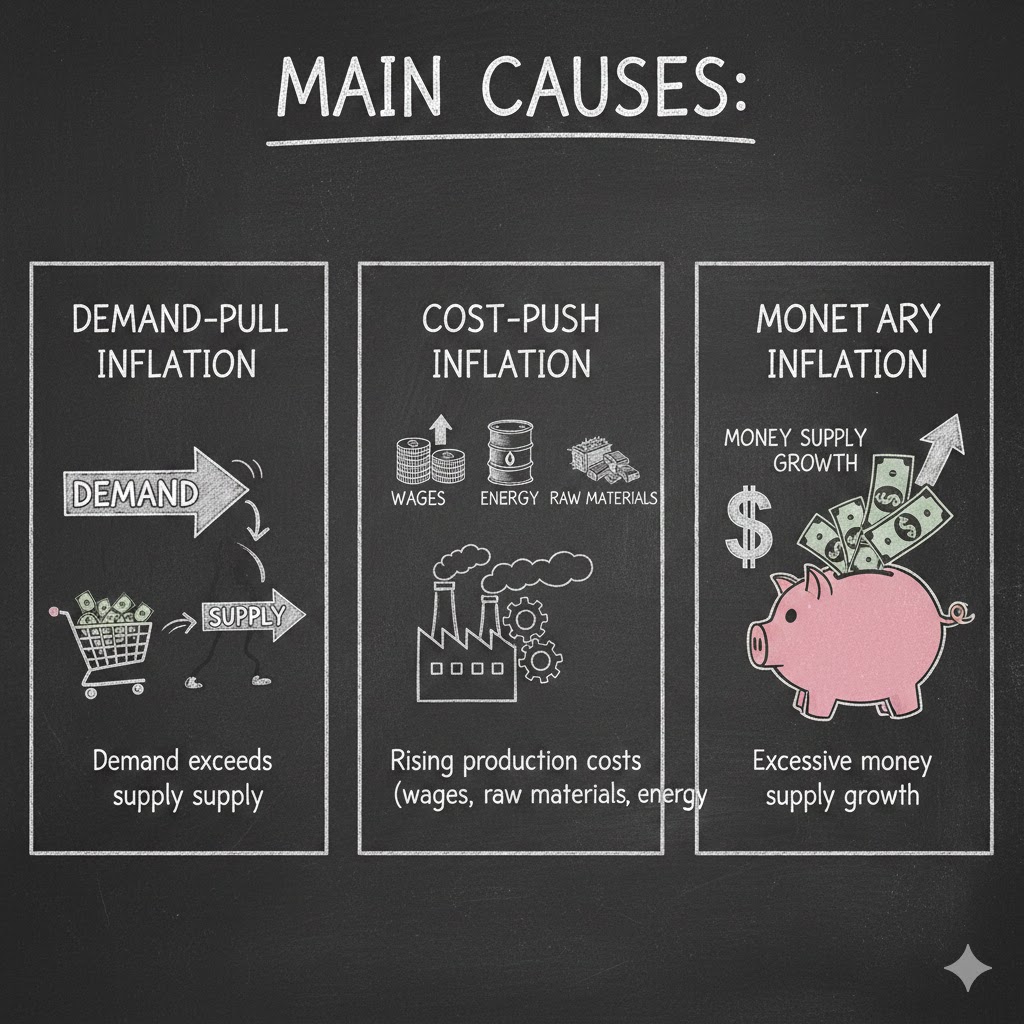
  • Inflation vs Deflation

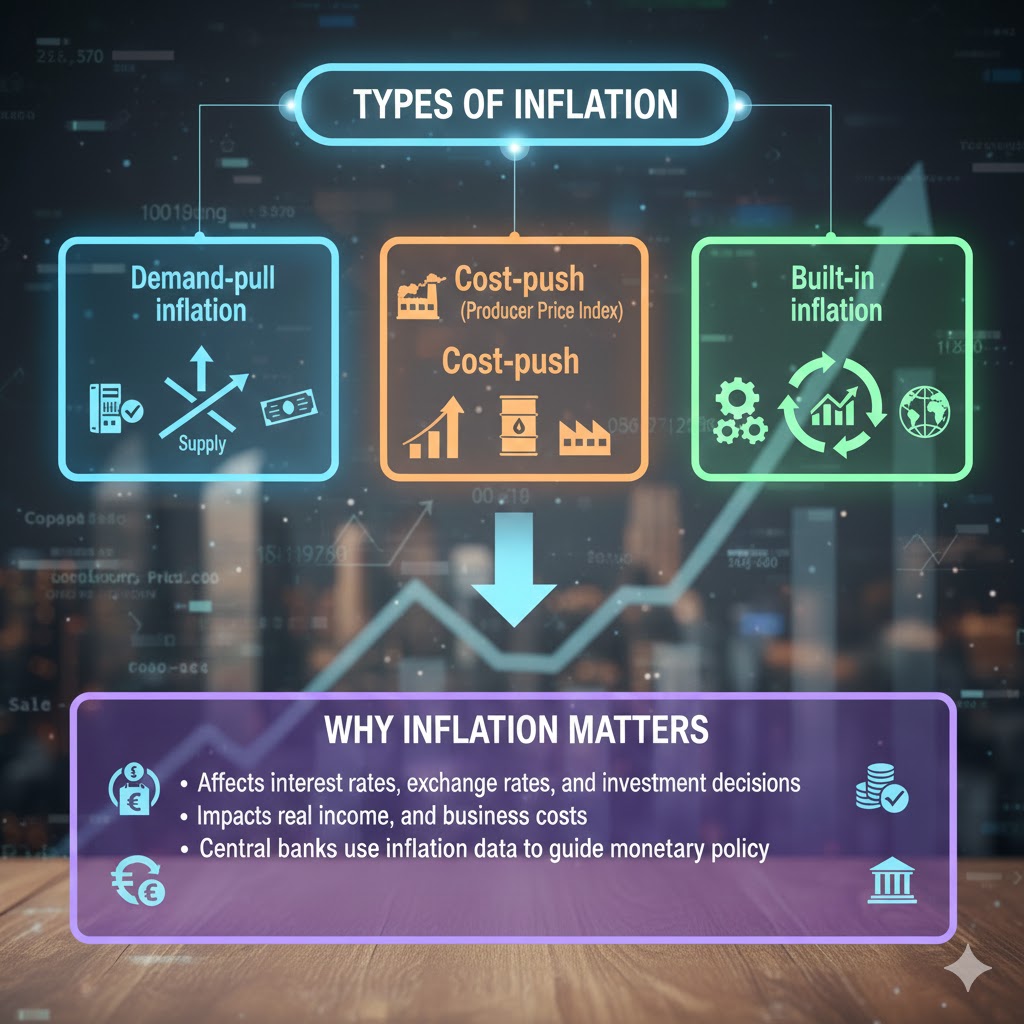
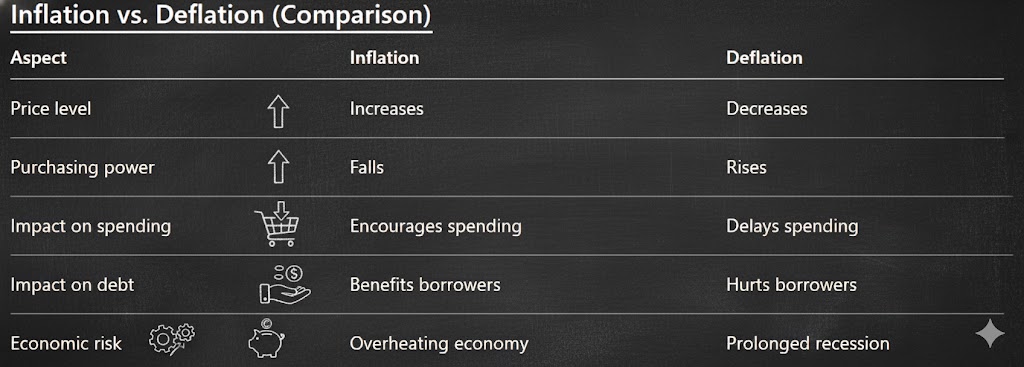
    Inflation and deflation describe opposite movements in the general price level of goods and services in an economy, and both have significant impacts on economic activity, businesses, and individuals.

    Inflation

    Inflation is a sustained increase in the general price level over time, which reduces the purchasing power of money.

    Key characteristics:

    • Money buys less over time
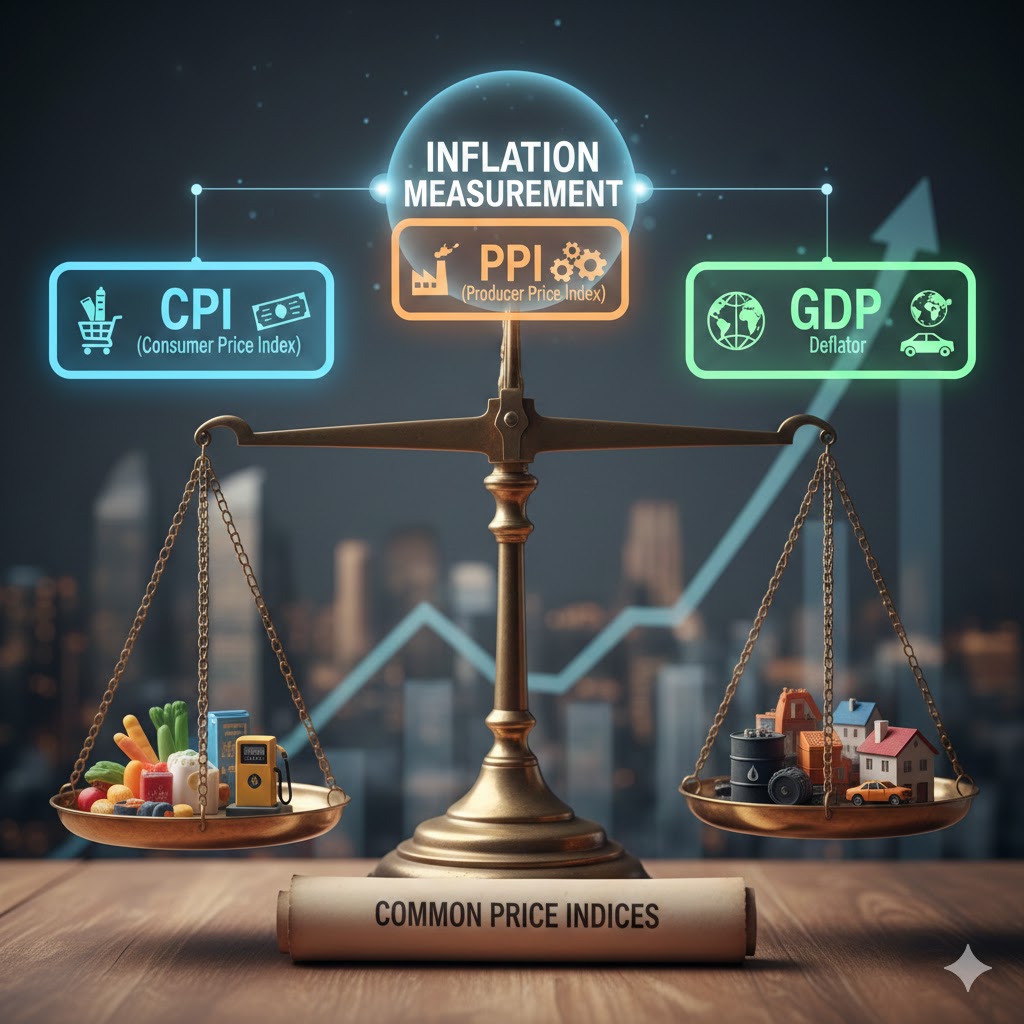
    • Usually measured by indicators like the Consumer Price Index (CPI)
    • Moderate inflation is considered normal in growing economies

    Effects

    • Higher living costs
    • Borrowers benefit, savers lose purchasing power
    • Can encourage spending and investment if inflation is stable and predictable

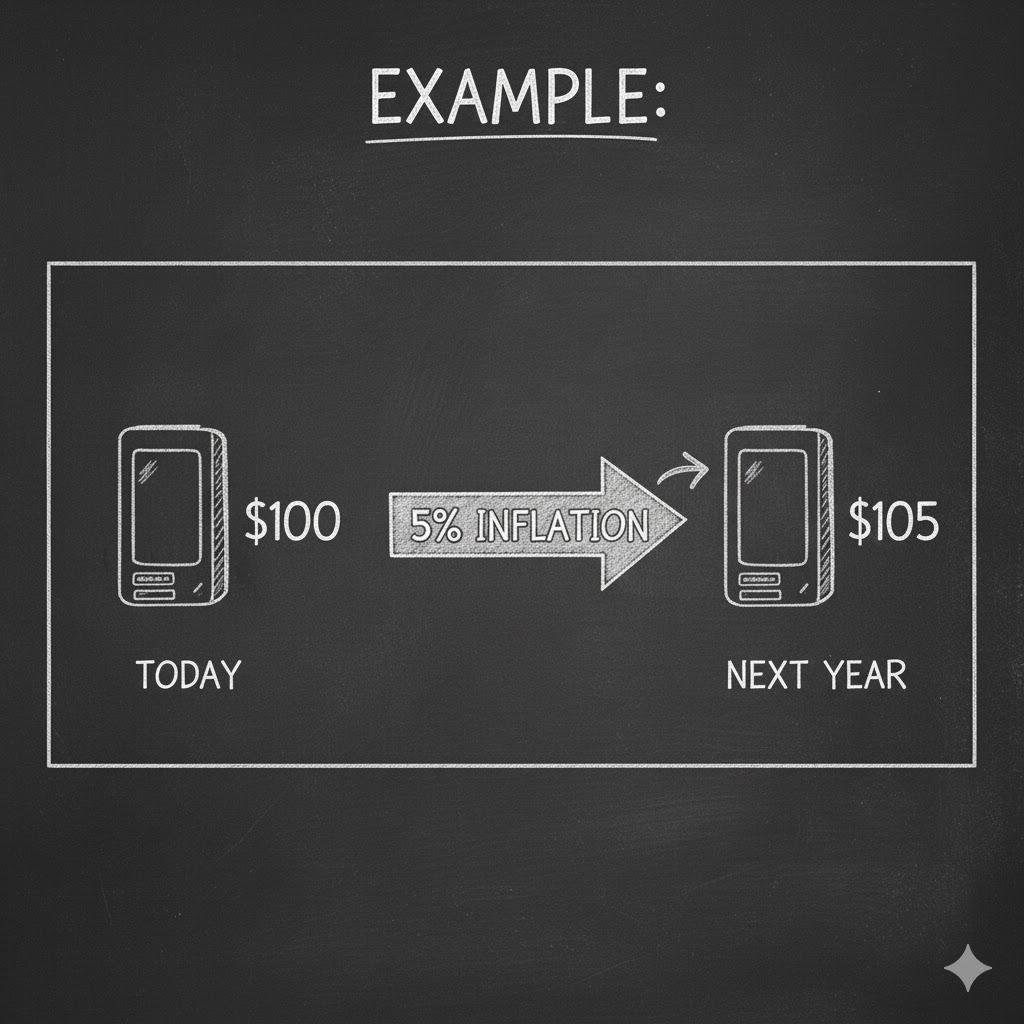
    If inflation is 5% per year, an item costing $100 today will cost $105 next year.

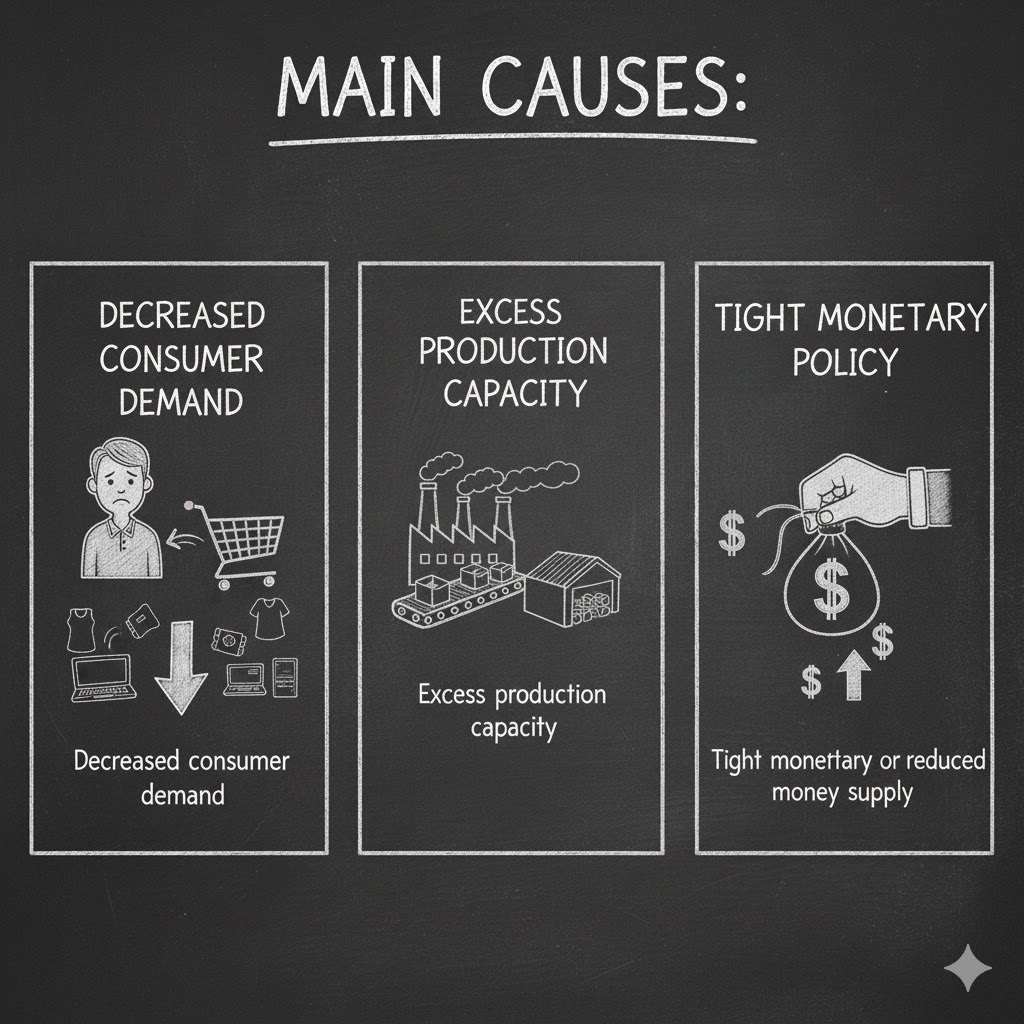
    Deflation

    Deflation is a sustained decrease in the general price level, increasing the purchasing power of money.

    Key characteristics

    • Money buys more over time
    • Often associated with economic slowdowns or recessions

    Effects

    • Consumers delay spending, expecting lower prices
    • Business revenues and profits decline
    • Higher real value of debt, harming borrowers
    • Can lead to rising unemployment

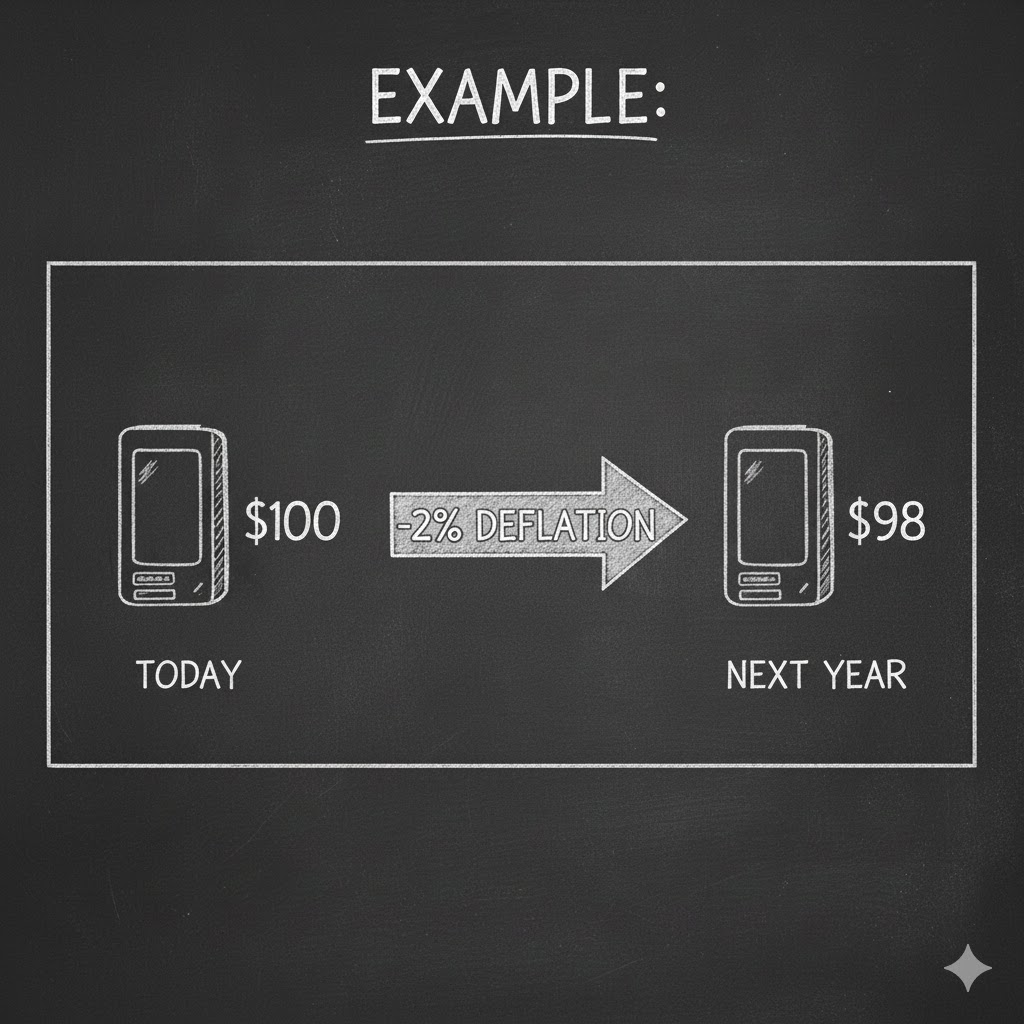
    If deflation is −2%, an item costing $100 today will cost $98 next year.

    Which is More Dangerous?

    • Moderate inflation is generally manageable and often preferred by policymakers.
    • Deflation is considered more dangerous because it can create a deflationary spiral—lower prices → lower profits → layoffs → lower demand → even lower prices.
  • Business Life Cycle

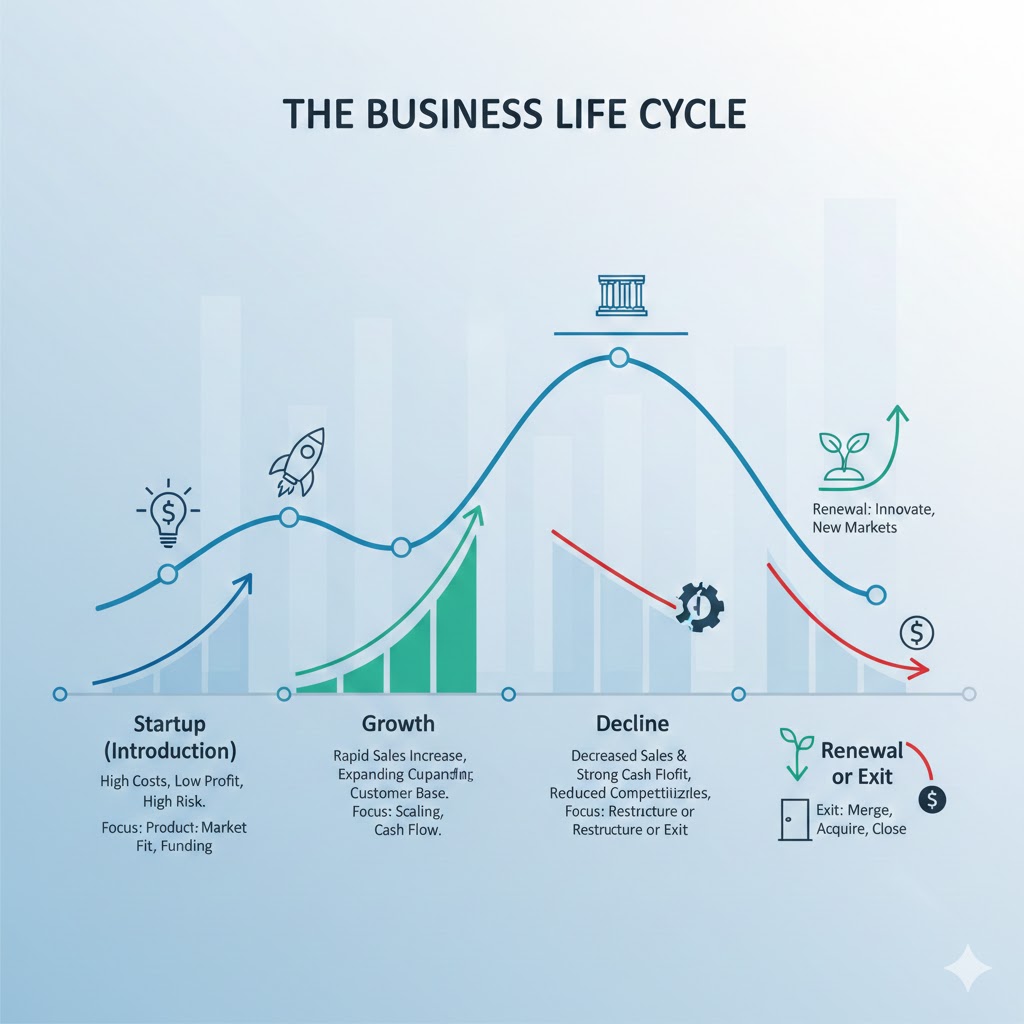
    The Business Life Cycle describes the stages a business typically goes through from its creation to possible decline or renewal. Understanding this cycle helps entrepreneurs, investors, and managers make better strategic decisions at each phase.

    Why the Business Life Cycle Matters

    • Helps align strategyinvestment decisions, and risk management.
    • Investors can assess risk and return potential at each stage.
    • Managers can anticipate challenges and prepare appropriate responses.
  • Market Structure

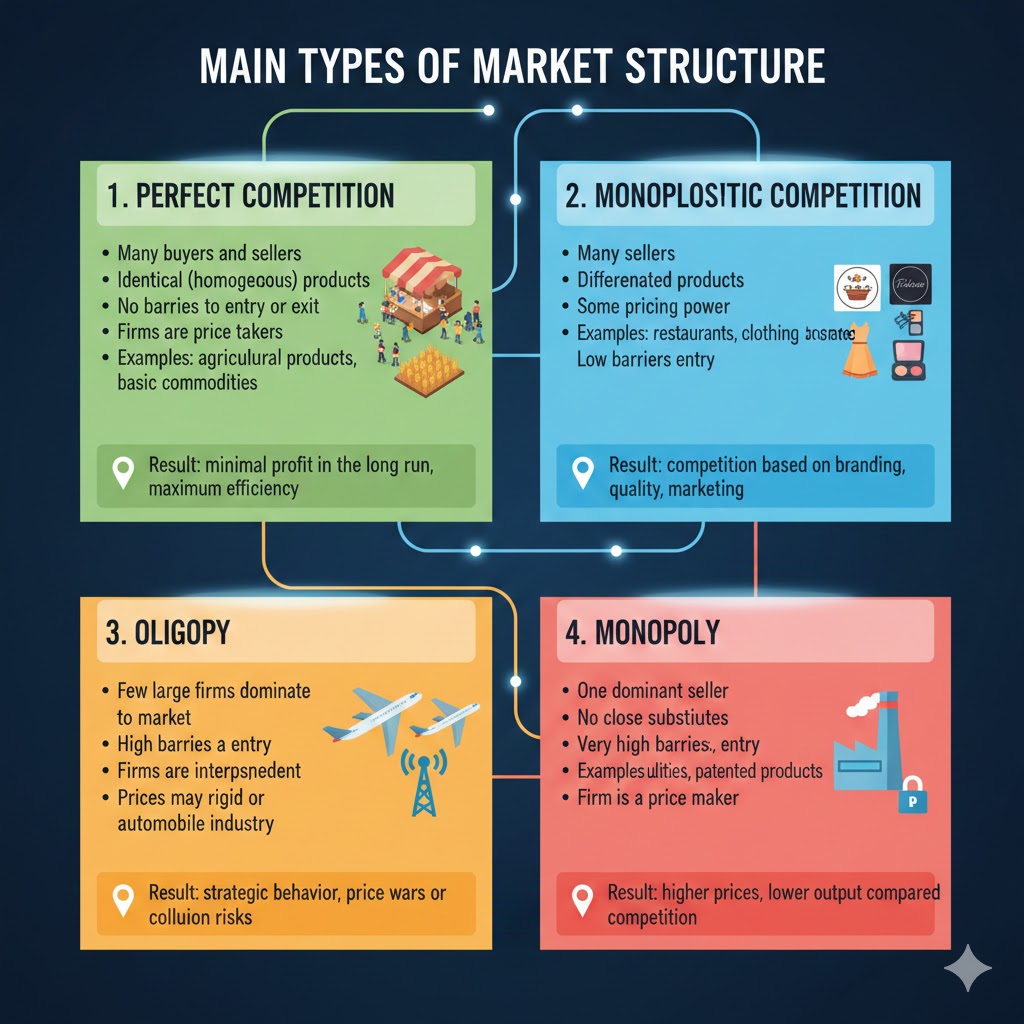
    Market structure describes the organization and characteristics of a market, especially how firms compete, set prices, and produce goods or services.

    It explains how a market works and how much power firms have.

    Market structure and firm behavior

    Market structure affects:

    • Pricing strategies
    • Output decisions
    • Innovation and R&D
    • Efficiency and consumer welfare

    Key takeaway

    Market structure determines competition intensity, pricing power, and economic efficiency.

    Understanding market structure helps businesses, investors, and policymakers make better decisions.

  • Production and Cost

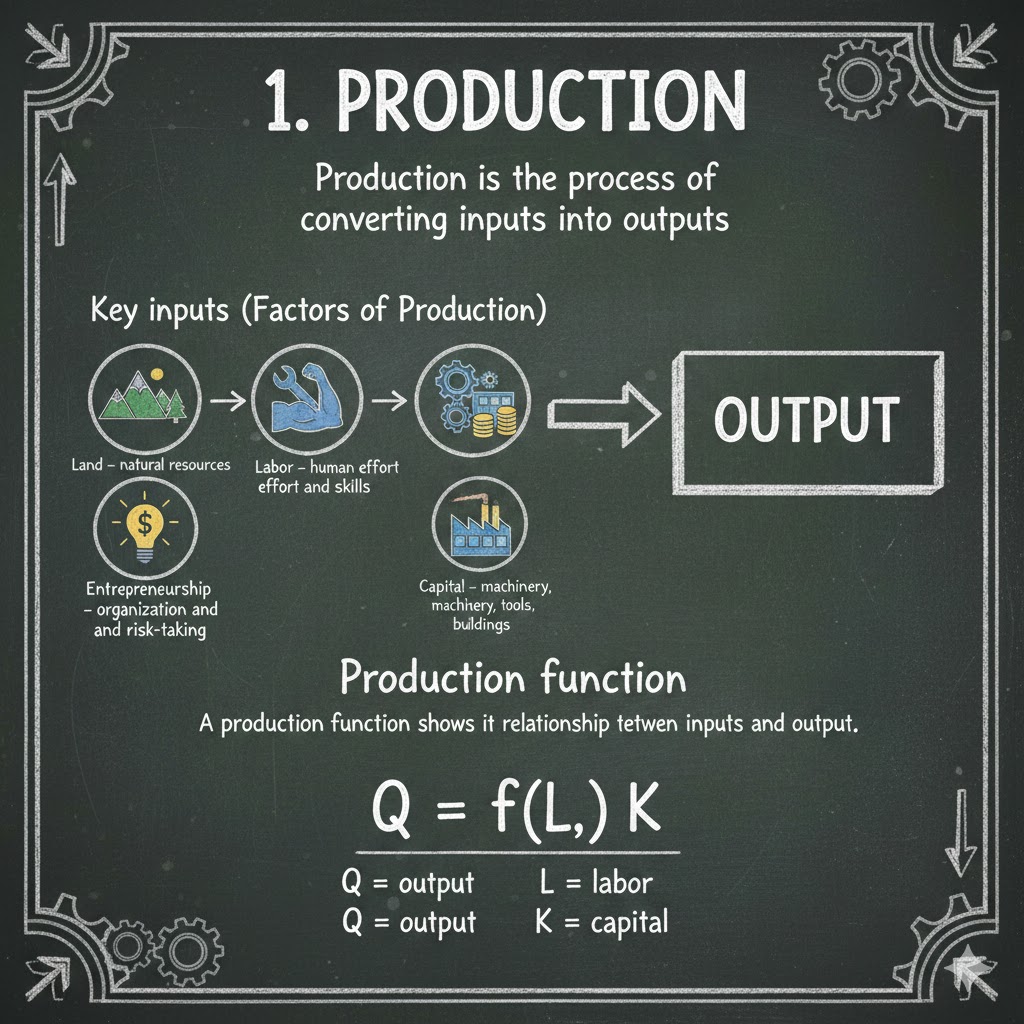
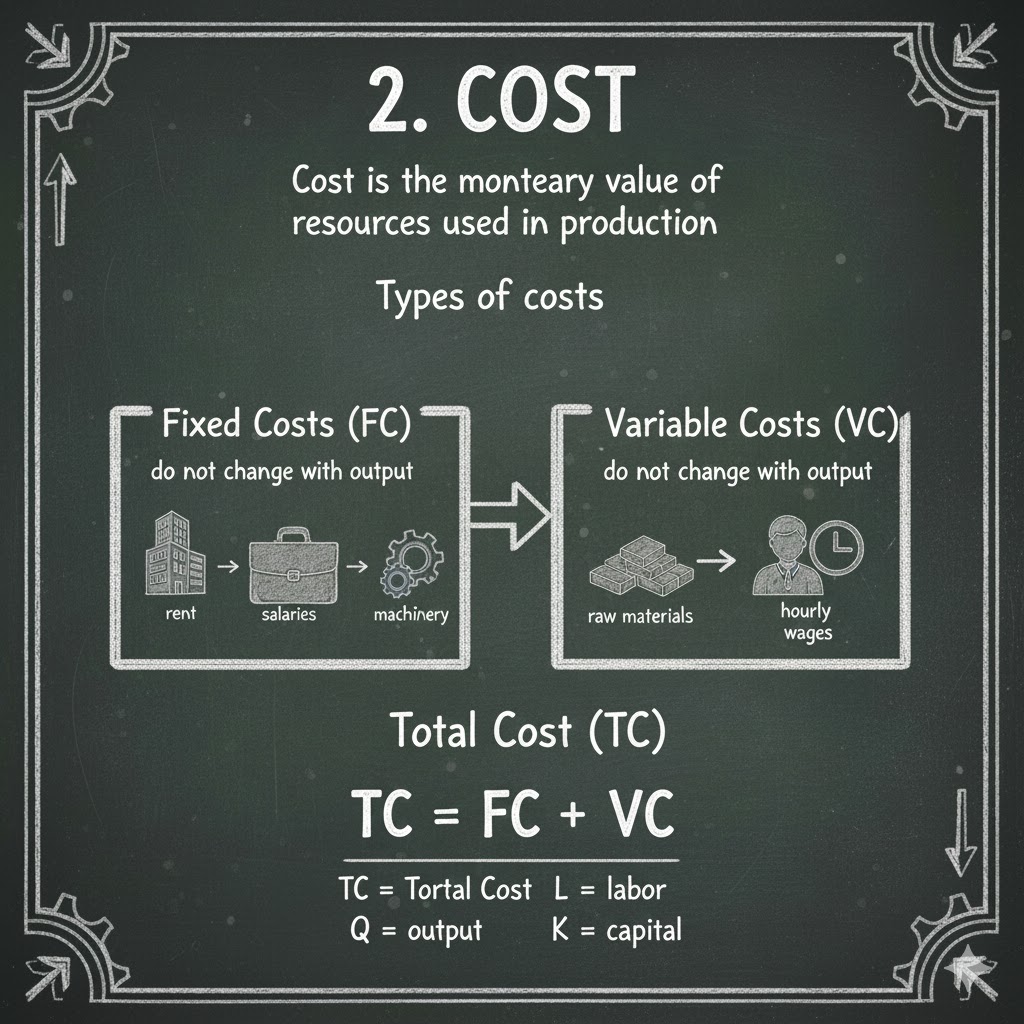
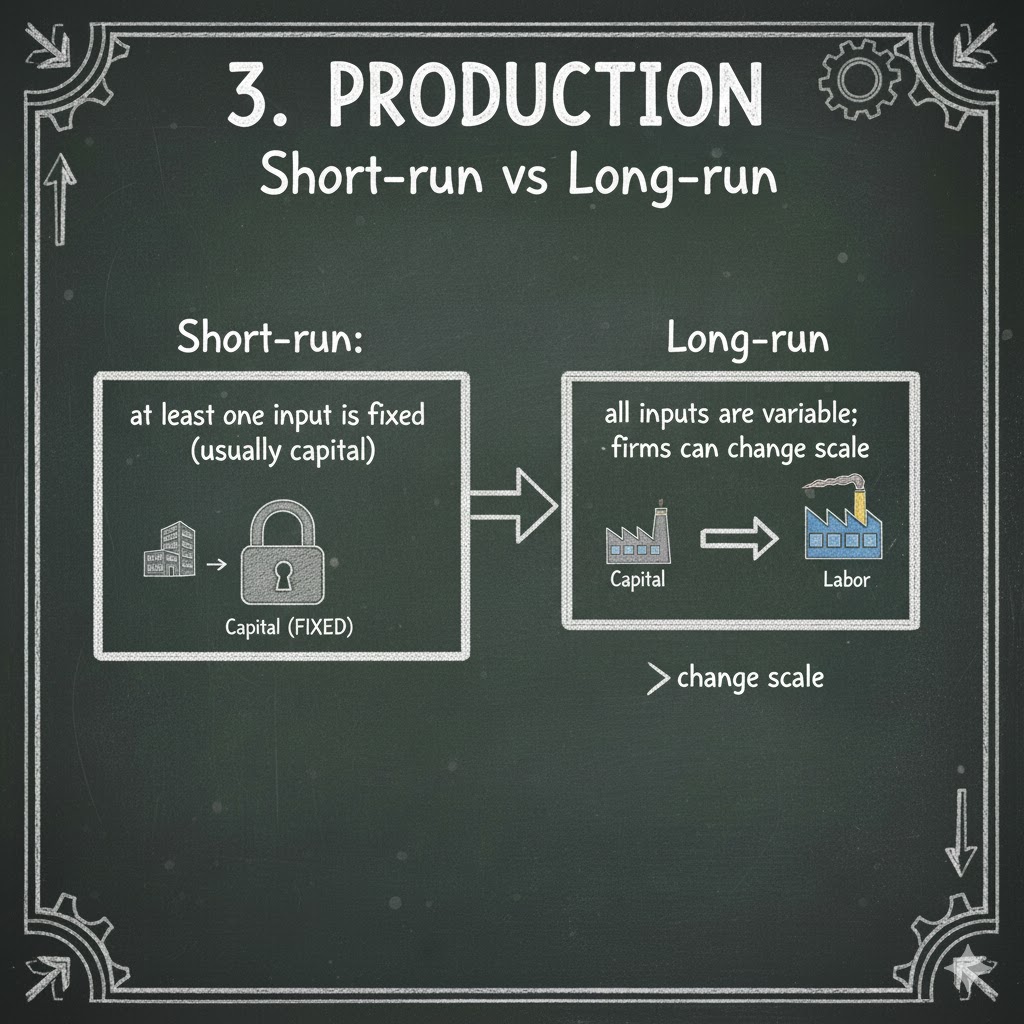
    Production and cost describe how firms transform inputs into goods or services and the expenses incurred in that process. Understanding this relationship helps explain pricing, profitability, efficiency, and business decisions.

    Cost measures

    • Average Cost (AC)AC=TCQAC=QTC​
    • Marginal Cost (MC): cost of producing one more unit:MC=ΔTCΔQMC=ΔQΔTC​

    📌 Marginal cost is crucial for production decisions and pricing.


    Production, cost, and profit

    • Profit = Total Revenue (TR) − Total Cost (TC)
    • Firms maximize profit where:

    MR=MCMR=MC

    (Marginal Revenue equals Marginal Cost)


    Key takeaway

    Efficient production minimizes cost and maximizes profit.
    Understanding cost structures helps firms decide how much to produce, at what price, and at what scale.

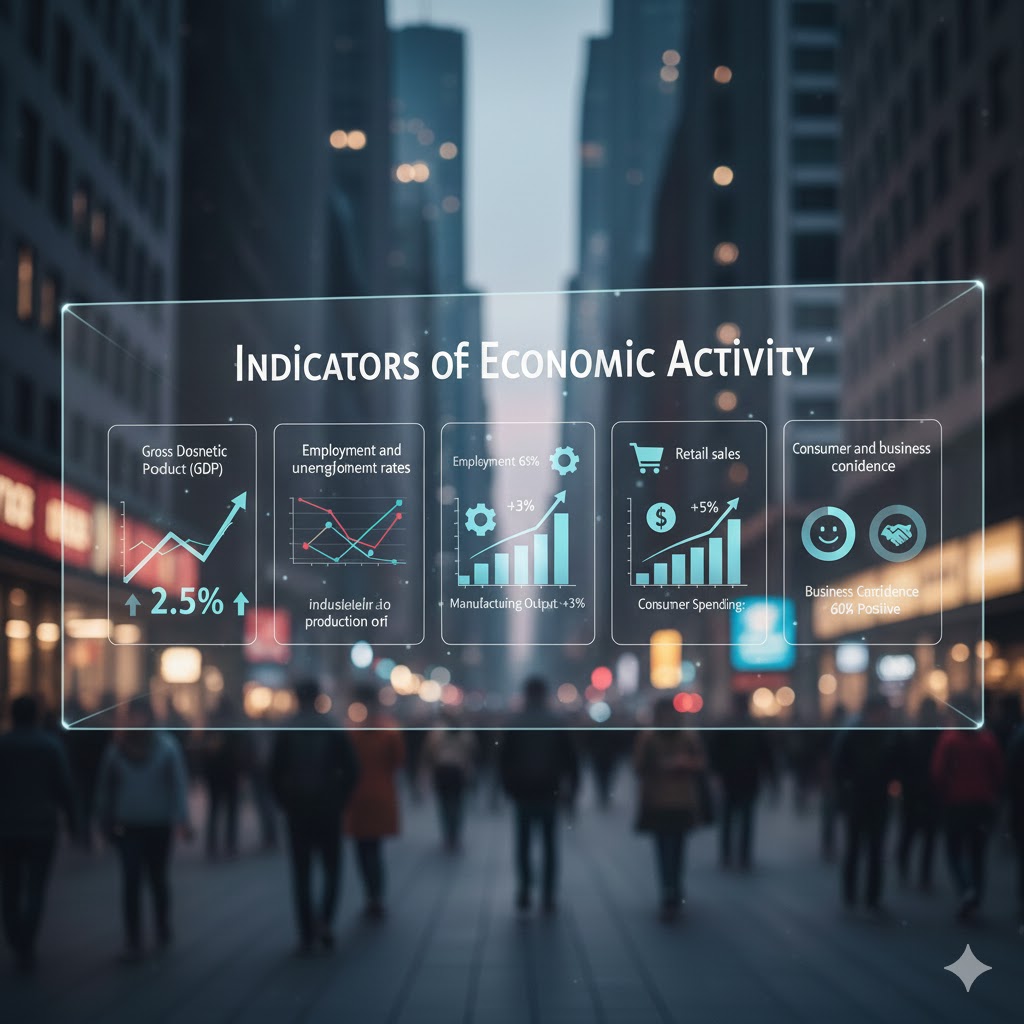
  • Economic Activity

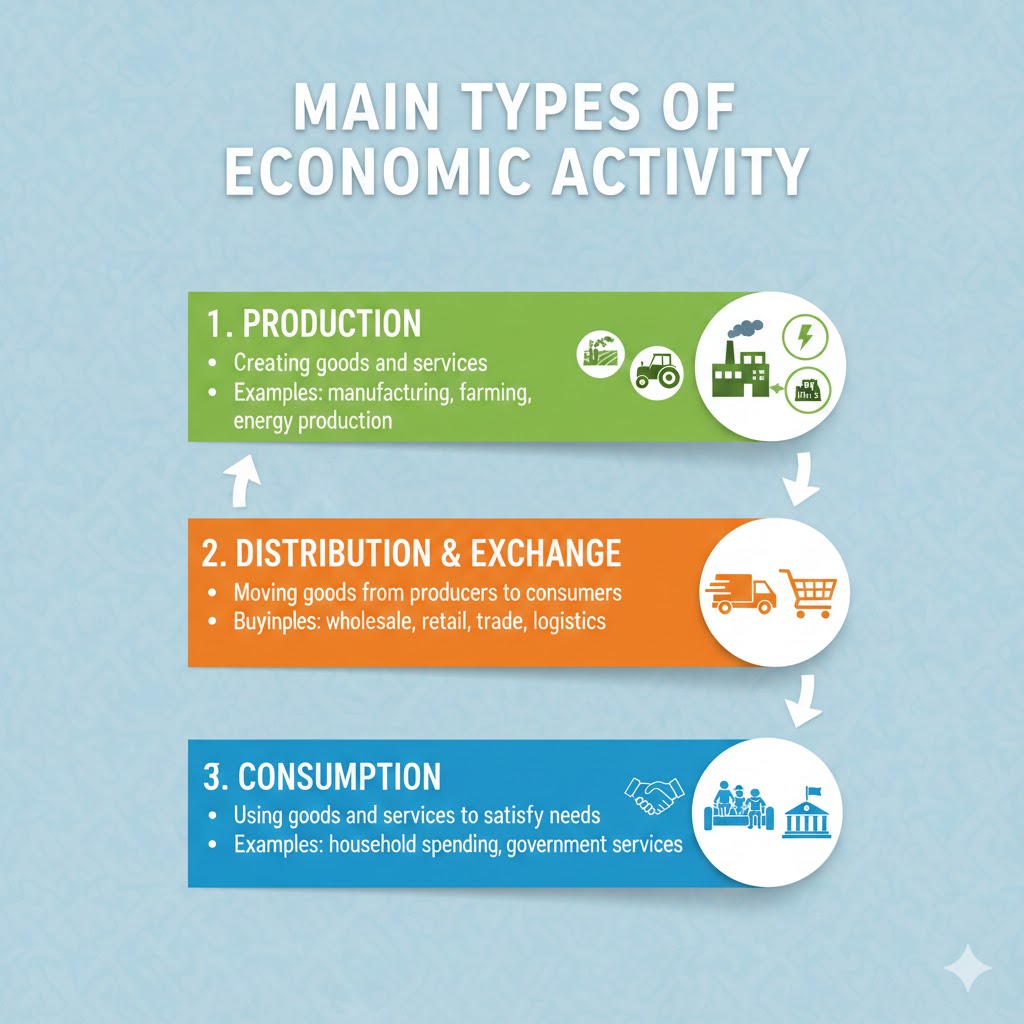
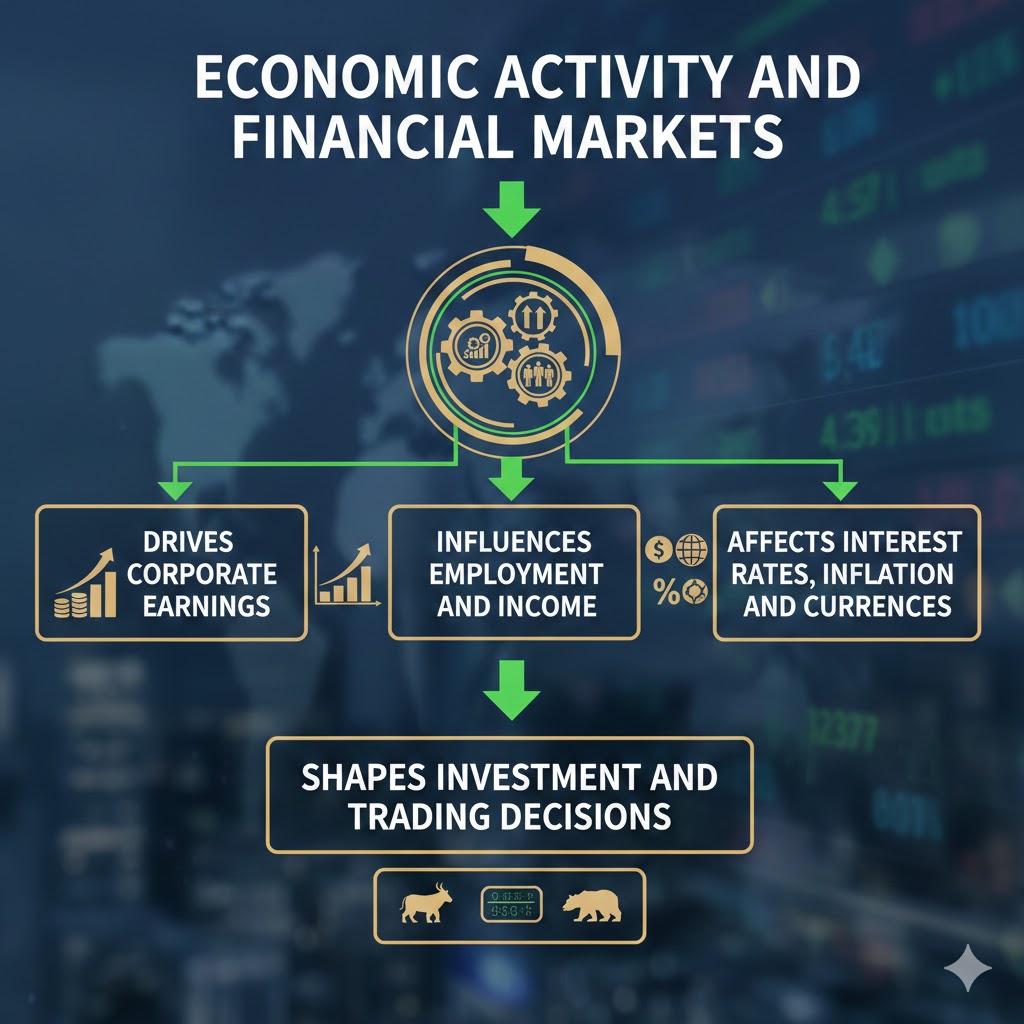
    Economic activity refers to all actions involved in the production, distribution, exchange, and consumption of goods and services within an economy.

    It is everything people and businesses do to create, buy, sell, and use economic value.

    Sectors of economic activity

    1. Primary sector – natural resources
      (agriculture, mining, fishing)
    2. Secondary sector – manufacturing and processing
      (factories, construction)
    3. Tertiary sector – services
      (finance, education, healthcare, tourism)
    4. Quaternary sector – knowledge & technology
      (IT, R&D, data, innovation)


    Key takeaway

    Strong economic activity supports growth and investment,
    while weak activity may signal slowdown or recession.

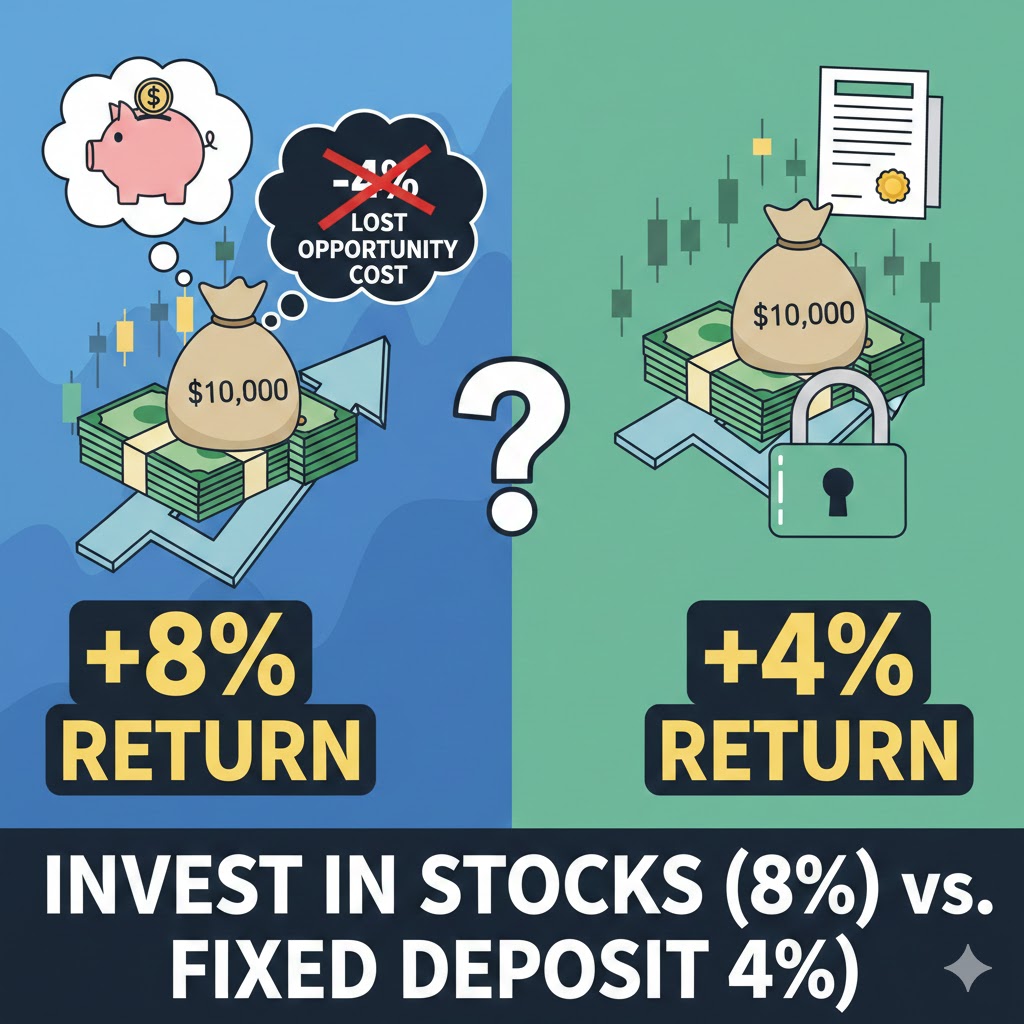
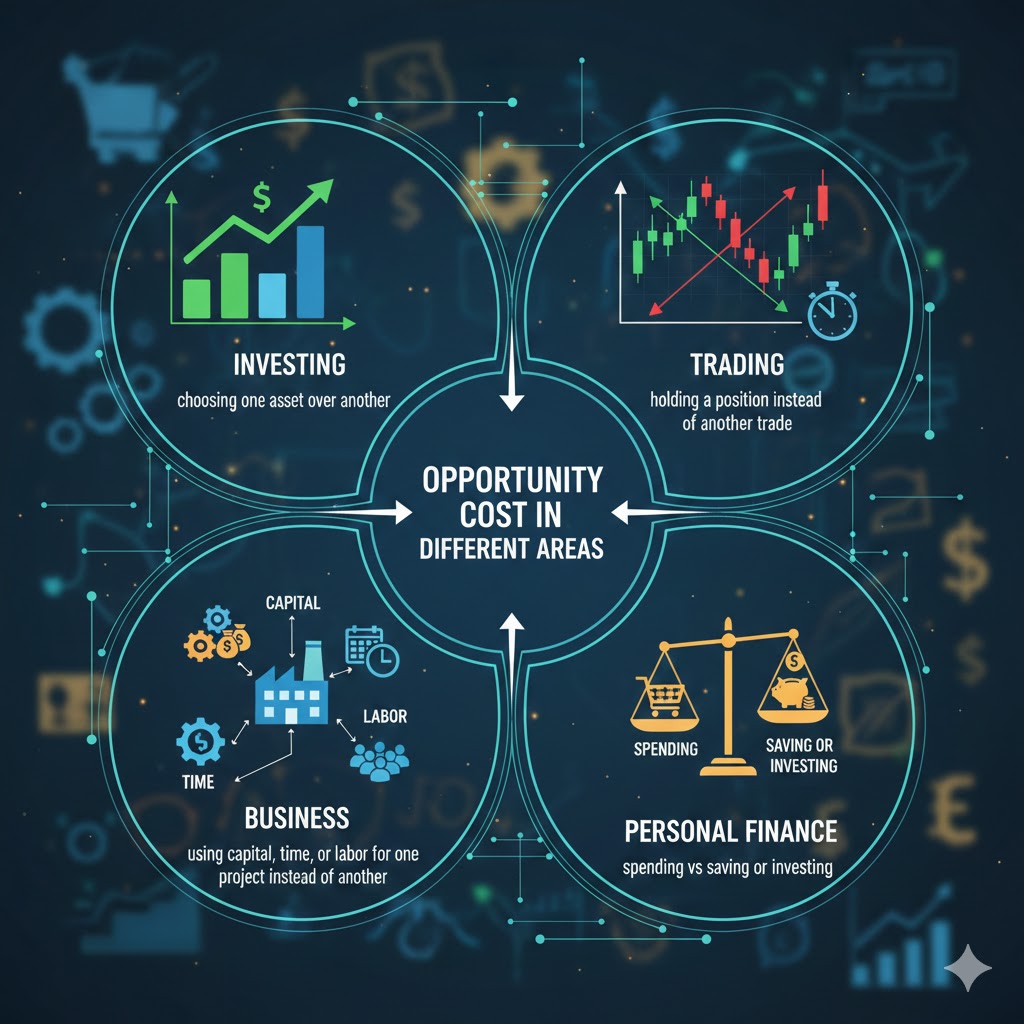
  • Opportunity Cost

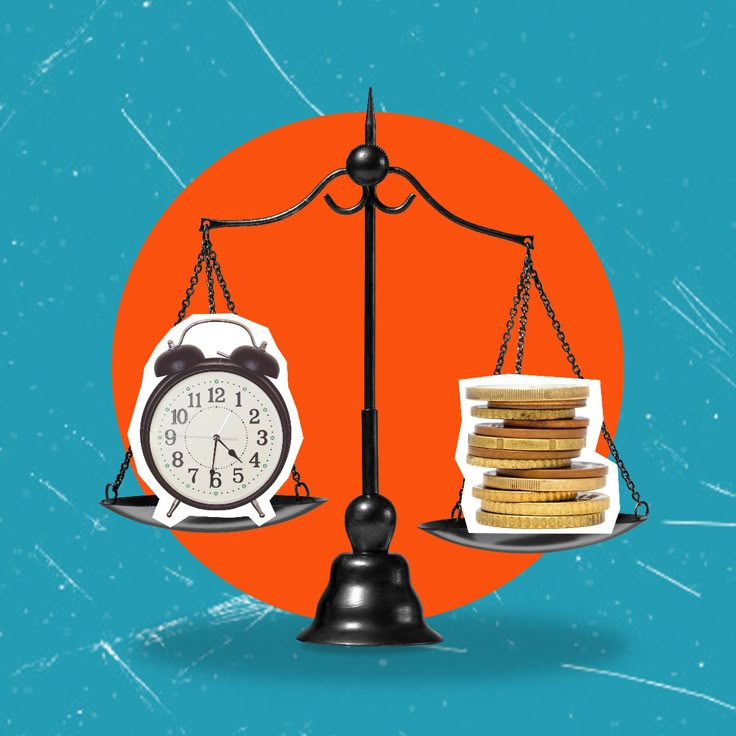
    Opportunity cost is the value of the next best alternative you give up when you choose one option over another.

    It is what you lose by not choosing the best alternative option.

    Why opportunity cost matters

    • Helps make better financial and business decisions
    • Forces comparison between available alternatives
    • Highlights hidden costs beyond money
    • Essential in investment, trading, and resource allocation

    Opportunity cost vs Sunk cost

    • Opportunity cost: future value you give up
    • Sunk cost: past cost that cannot be recovered (should not affect decisions)

    Key takeaway

    Every decision has a cost—even if no money is paid.
    The true cost of any choice is the value of the best alternative forgone.

  • Scarcity

    Scarcity is a fundamental concept in economics that refers to the limited availability of resources relative to the unlimited wants and needs of people.

    Key Points

    • Limited Resources: Resources such as land, labor, capital, and raw materials are finite and cannot meet all human desires.
    • Unlimited Wants: Human wants and needs are virtually infinite and constantly evolving.
    • Economic Problem: Scarcity forces individuals, businesses, and governments to make choices about how to allocate resources efficiently.
    • Trade-offs: Because resources are scarce, choosing one option means giving up another (opportunity cost).
    • Basis of Economic Study: Economics exists primarily to address scarcity and understand how societies manage resource allocation.

    Example of Scarity

    Implications of Scarcity

    • Necessitates prioritization and decision-making at all levels of the economy.
    • Drives the study of efficiency and optimization in production and consumption.
    • Leads to the development of markets and prices as mechanisms to allocate scarce resources.
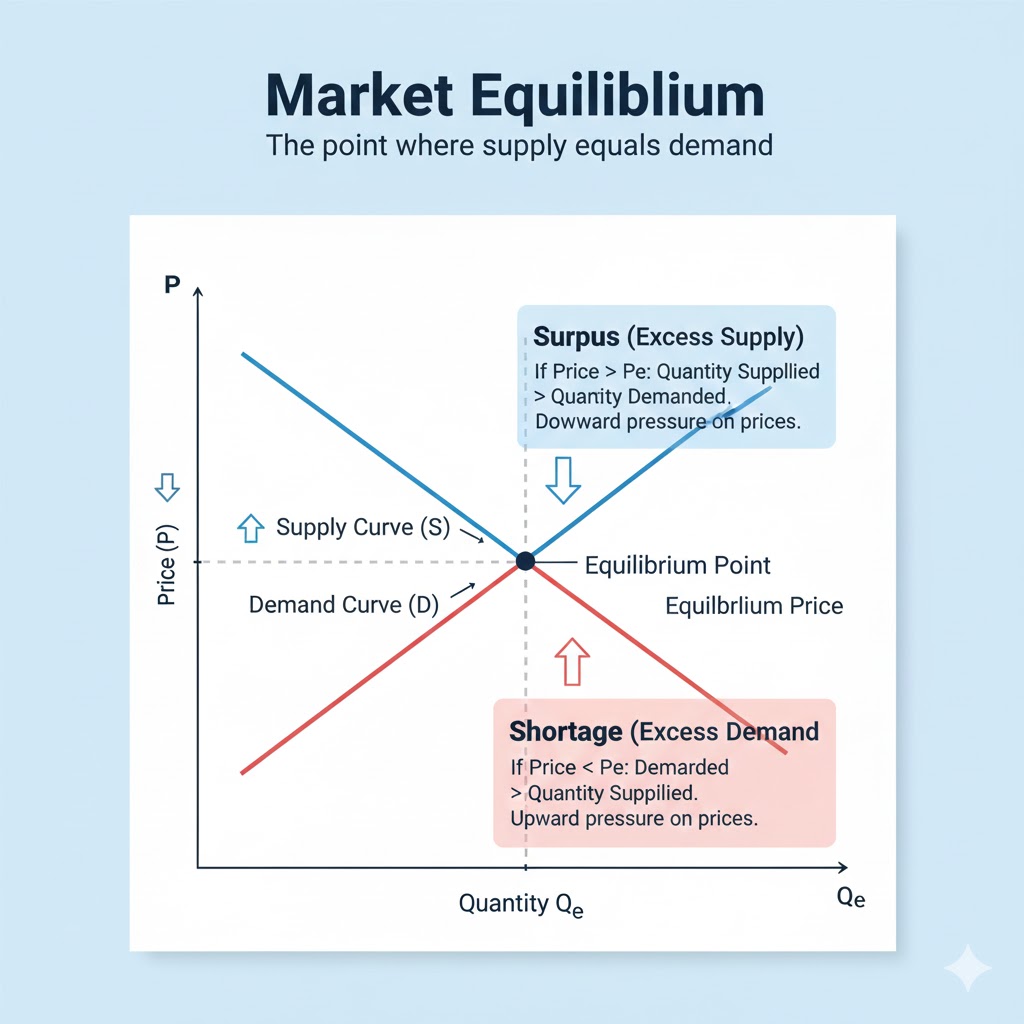
  • Supply and Demand

    Supply and Demand is a fundamental concept in economics that describes how prices and quantities of goods and services are determined in a market.

    Demand

    • Definition: Demand is the quantity of a product or service that consumers are willing and able to buy at different prices over a certain period.
    • Law of Demand: There is an inverse relationship between price and quantity demanded — as price decreases, demand usually increases, and vice versa.
    • Demand Curve: A downward-sloping curve that shows the relationship between price and quantity demanded.

    Supply

    • Definition: Supply is the quantity of a product or service that producers are willing and able to offer for sale at different prices over a certain period.
    • Law of Supply: There is a direct relationship between price and quantity supplied — as price increases, supply usually increases, and vice versa.
    • Supply Curve: An upward-sloping curve showing the relationship between price and quantity supplied.

    Factors Affecting Supply and Demand

    Factors Affecting Demand

    • Consumer income
    • Preferences and tastes
    • Prices of related goods (substitutes and complements)
    • Expectations about future prices
    • Number of buyers

    Factors Affecting Supply

    • Production costs
    • Technology
    • Prices of related goods
    • Expectations about future prices
    • Number of sellers

    Importance of Supply and Demand

    • Helps explain how prices are set in competitive markets
    • Provides insights into how changes in market conditions affect prices and quantities
    • Forms the basis for economic policy and business strategy decisions
  • Economics

    Economics is the social science that studies how individuals, businesses, governments, and societies make choices about allocating scarce resources to satisfy their unlimited wants and needs.

    Purpose of Economics

    • To understand and predict economic behavior.
    • To develop policies that improve economic welfare.
    • To allocate resources efficiently.

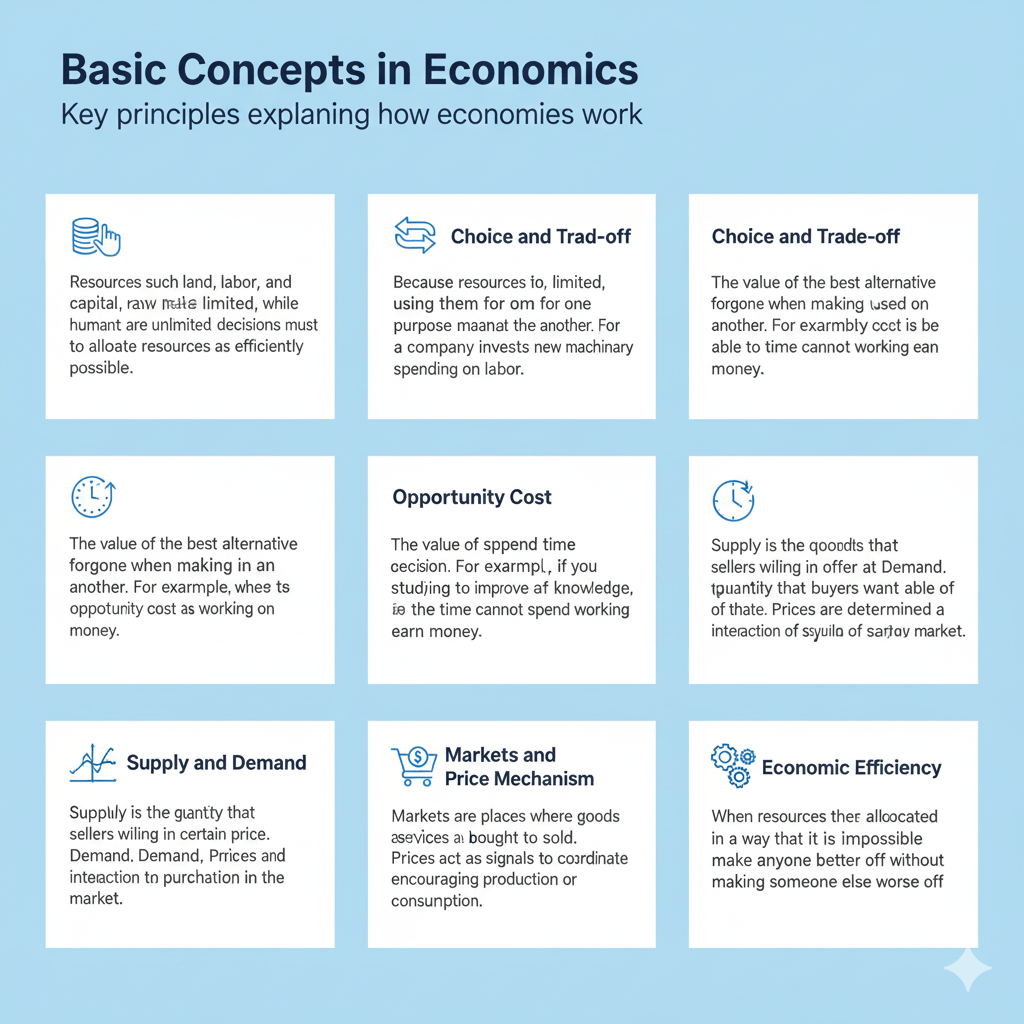
    Basic Concepts in Economics

    Main Fields of Economics

    • Microeconomics
      Studies the behavior of individuals, households, and firms and how they make decisions in specific markets.
    • Macroeconomics
      Studies the overall economy, including economic growth, unemployment, inflation, monetary and fiscal policies.

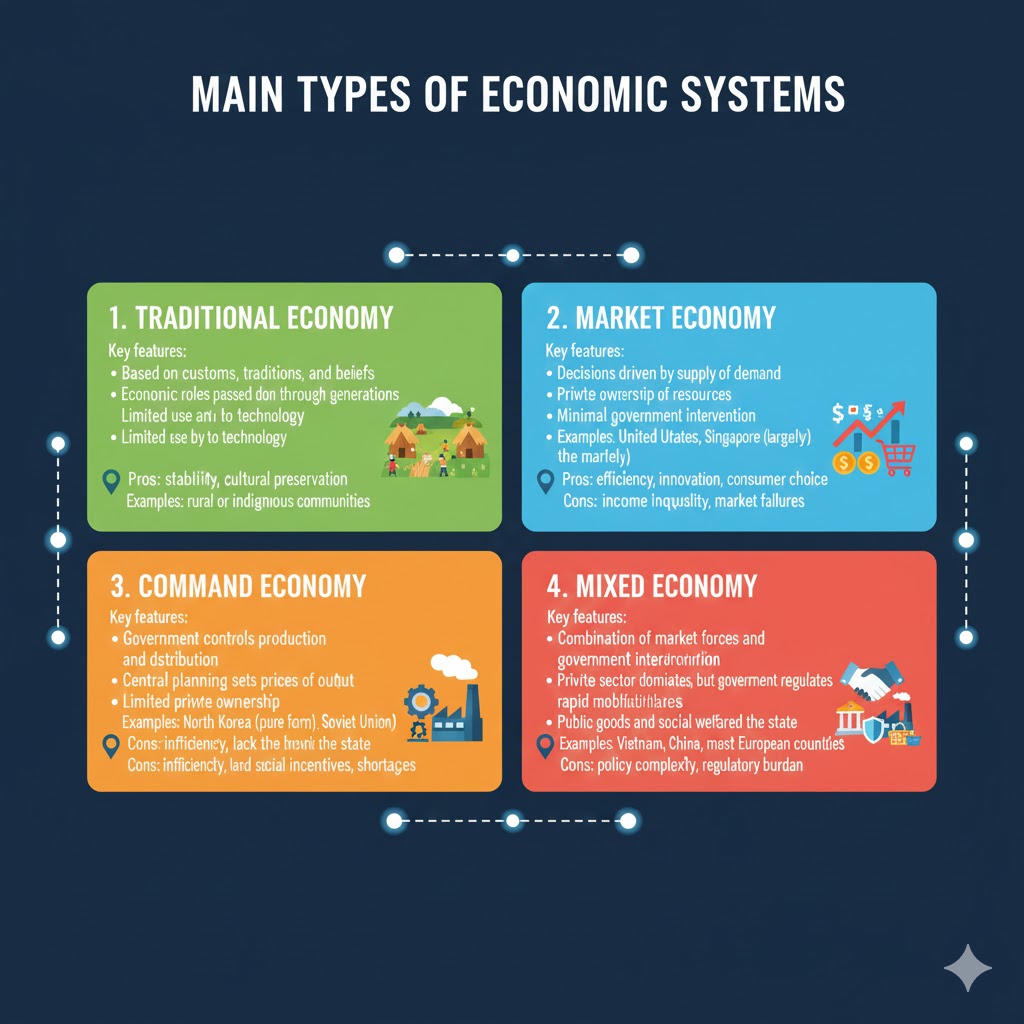
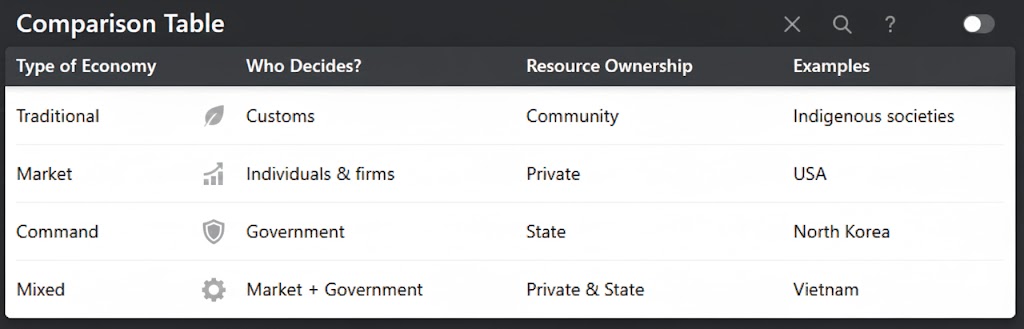
    Types of economies describe how a society organizes production, distribution, and consumption of goods and services—specifically, who makes economic decisions and how resources are allocated.

    Key takeaway

    Most modern economies are mixed economies, combining market efficiency with government regulation to promote stability and social welfare.

  • 5 Effective Market Volatility Strategies to Protect and Grow Your Long-Term Wealth

    Market volatility often feels personal. One week, your investment portfolio appears stable; the next, it drops, headlines turn alarming, and every conversation sounds like a prediction. This emotional rollercoaster is normal, but panic selling can turn temporary market swings into lasting financial damage.

    For high-net-worth families and business owners, the stakes are even higher. Investments are not for entertainment—they serve real financial goals like retirement income, business transitions, philanthropy, and preserving long-term wealth.

    The good news is, successful investing doesn’t require perfect timing. Instead, it demands a consistent process that withstands diverse market conditions, volatile periods, and unforeseen events. The most effective market volatility strategies emphasize preparation, discipline, and risk management, all geared toward sustainable long-term growth.

    Key Takeaways

    • Market volatility is a normal part of investing; having a rules-based plan helps minimize panic selling and costly mistakes.
    • Effective risk management begins with clear asset allocation, defined investment horizons, and practical guardrails.
    • Portfolio diversification works best when intentional and based on asset class exposure—not simply by increasing the number of holdings.
    • Regular rebalancing reinforces the discipline of “selling high” and helps reduce volatility over time.
    • Maintaining a steady investment psychology keeps investors focused on long-term performance rather than daily market fluctuations.

    What Market Volatility Really Means in the Stock Market

    Market volatility reflects shifting expectations. Stock prices fluctuate, bond yields change, and the market continuously reprices risk as economic conditions evolve. Factors such as inflation risk, interest rate changes, and unexpected news can quickly alter market values.

    Volatility is not limited to equities. When interest rates rise, bond prices typically fall, often surprising investors who expect fixed-income assets to provide stability. In the bond market, price fluctuations are driven by interest rate risk, credit risk, and credit quality—especially in high-yield bonds and certain bond funds.

    Not every market downturn signals a crisis, but each one tests whether your portfolio aligns with your risk tolerance and investment objectives.

    Investment Psychology: Why Many Investors Make Costly Moves

    During volatile periods, investment psychology can undermine sound judgment. Loss aversion makes market declines feel unbearable, while recency bias convinces investors that recent events will dictate future outcomes. Coupled with constant commentary on indices like the Dow Jones and “potential winners,” investors face emotional pressure from all sides.

    Risk-averse investors are particularly vulnerable. When fear peaks, many abandon their original plans and move to cash at inopportune moments. Hesitation to re-enter the market thereafter can significantly harm long-term returns.

    The solution is not bravado but structure. A well-designed, rules-based investment plan reduces the likelihood of reactive decisions during turbulent times.


    Practical Risk Management Strategies for a Diversified Portfolio

    During periods of market turbulence, the objective isn’t to predict headlines but to manage risk effectively and keep your balanced portfolio aligned with your long-term financial goals.

    1. Start With Asset Allocation and Risk Tolerance

    Asset allocation is one of the most important factors driving long-term investment performance. A well-designed allocation reflects both your risk tolerance—the level of risk you are comfortable with—and your risk capacity, which is more practical and considers your time horizon, liquidity needs, and how much additional risk your financial plan can realistically withstand without forcing unwanted changes.

    If a market downturn would compel you to sell assets to cover life expenses, your portfolio’s overall risk might be too high for your situation. This is especially critical for business owners nearing liquidity events or investors approaching retirement, who need to ensure their allocation aligns with their unique financial circumstances.

    2. Build Portfolio Diversification That Holds Up Across Market Conditions

    Portfolio diversification is effective when your assets respond differently under the same market conditions. Simply owning multiple mutual funds tracking similar benchmarks can still expose you to a single dominant risk factor.

    A truly diversified portfolio includes exposure to multiple asset classes, such as:

    • Equities across various sectors
    • International stocks for broader geographic exposure
    • Fixed income securities selected by credit quality and duration
    • Cash or short-term instruments to manage liquidity risk

    This approach reduces overall portfolio volatility by not relying on a single market narrative. It also preserves long-term growth potential by avoiding overconcentration in any one area.

    3. Use Fixed Income Investments With Eyes Open

    Bonds can provide portfolio stability, but selecting the right bonds is crucial. Government and high-quality bonds often behave differently from corporate or high-yield bonds, especially during economic stress. Credit risk and duration significantly impact bond performance.

    Rising interest rates typically cause bond prices to fall, particularly for longer-duration bonds. Bond funds may also experience unexpected market value fluctuations, and selling during market stress can lock in losses. Understanding interest rate risk, credit quality, and bond price sensitivity across economic cycles is essential.

    Fixed income investments play an important role but should be tailored to your time horizon and investment objectives—not based on assumptions or market noise.

    4. Rebalancing With Discipline to Manage Risk

    Rebalancing is a disciplined approach to managing risk and maintaining a balanced portfolio. It helps prevent emotional trading by systematically adjusting your holdings back to your target asset allocation.

    Over time, rebalancing reinforces the “sell high” discipline by trimming assets that have grown disproportionately and adding to those that have lagged behind. While it’s not a guarantee of gains, this method effectively controls risk and reduces portfolio drift during volatile market conditions.

    5. Plan Liquidity to Reduce Forced Selling

    Liquidity risk becomes a critical concern when cash is needed during a market downturn. Having a clear cash plan, maintaining an emergency reserve, and carefully timing large expenses can help minimize the risk of being forced to sell investments at unfavorable prices.

    This strategy is especially vital for investors with irregular cash flows, upcoming tax obligations, or significant business expenses. A well-structured liquidity plan safeguards your long-term investment goals by preventing your portfolio from being tapped as an emergency fund.

    Sources: Investing