Category: economic calendar

  • Week Ahead: Jobs and CPI Data May Reset March Fed Expectations

    As a polar vortex brings arctic conditions across the U.S., the economic calendar is set to heat up. The week ahead features two of the most consequential data releases for shaping Federal Reserve policy expectations: the January employment report and the Consumer Price Index (CPI).
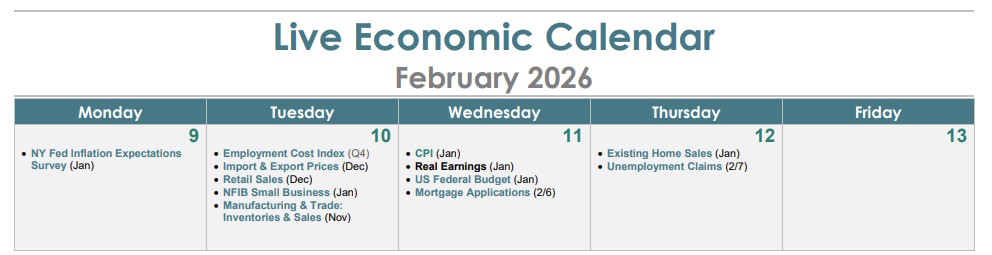
    Owing to recent government shutdowns, the January employment report (Wednesday) and CPI release (Friday) will be published unusually close together. The labor report is particularly significant, as January data typically incorporates annual revisions to employment figures, raising the possibility of notable downward adjustments for the year through March 2025.

    A key reference point will be the Federal Reserve’s own assessment of potential overstatement in jobs growth. In December, Fed Chair Jerome Powell noted that internal research suggested official figures may have overstated monthly job gains by as much as 60,000 since April. Given that reported job growth averaged just under 40,000 per month over that span, the scope of upcoming revisions could have meaningful implications for the FOMC’s March policy decision.

    The week also features remarks from several Fed officials, including Governors Christopher Waller (Monday), Stephen Miran (Monday and Thursday), and Michelle Bowman (Wednesday). Among voting Fed presidents this year, Cleveland Fed President Beth Hammack and Dallas Fed President Lorie Logan are both scheduled to speak on Tuesday.

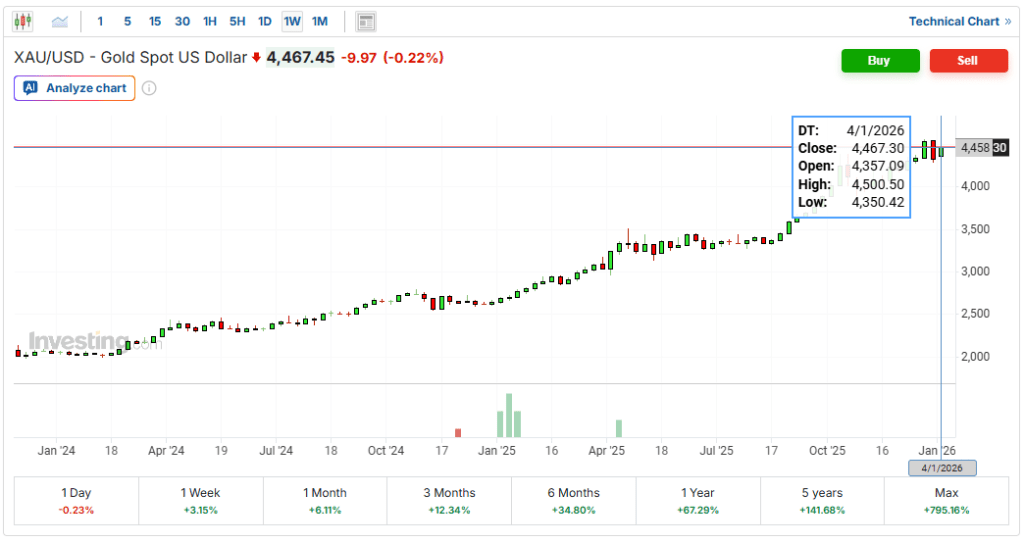
    Markets will also be watching price action on Wall Street following last week’s record close for the Dow Jones Industrial Average above 50,000. The ongoing AI-led shakeout among major technology stocks bears close scrutiny, as does the renewed “old economy” rotation bringing previously sidelined sectors—such as oil and gas, chemicals, transportation, and regional banks—back into focus. Adding to the cross-currents is gold’s continued rally, occurring alongside a sharp pullback in bitcoin.

    The following data releases carry the greatest potential to move markets and shape the Federal Reserve’s assessment of whether further rate cuts are warranted:

    Employment

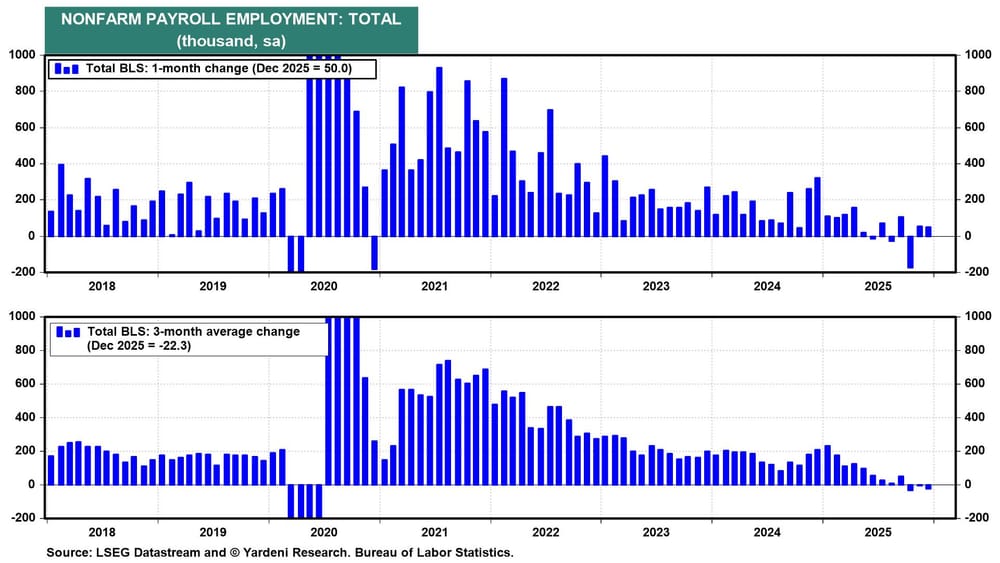
    We expect nonfarm payrolls to rise by 60,000 in January, following a 50,000 increase in December (see chart). Markets will be closely focused on the size and direction of revisions to prior data. A meaningful downside surprise could increase pressure on Chair Powell to consider a rate cut later this month, even though we do not believe monetary policy can directly address the underlying weaknesses in the labor market.
    CPI 

    Markets are seeking further confirmation that inflation continued to ease in January. December’s 2.6% year-over-year reading matched a four-year low in core CPI inflation (see chart). The Cleveland Fed’s Inflation Nowcasting model currently projects a 0.22% month-over-month increase in core inflation, translating to a 2.45% annual rate. Additional insight on inflation pressures will come from the Q4 2025 Employment Cost Index and December import and export prices, both due Tuesday, as well as the New York Fed’s January inflation expectations survey on Monday.

    Retail sales

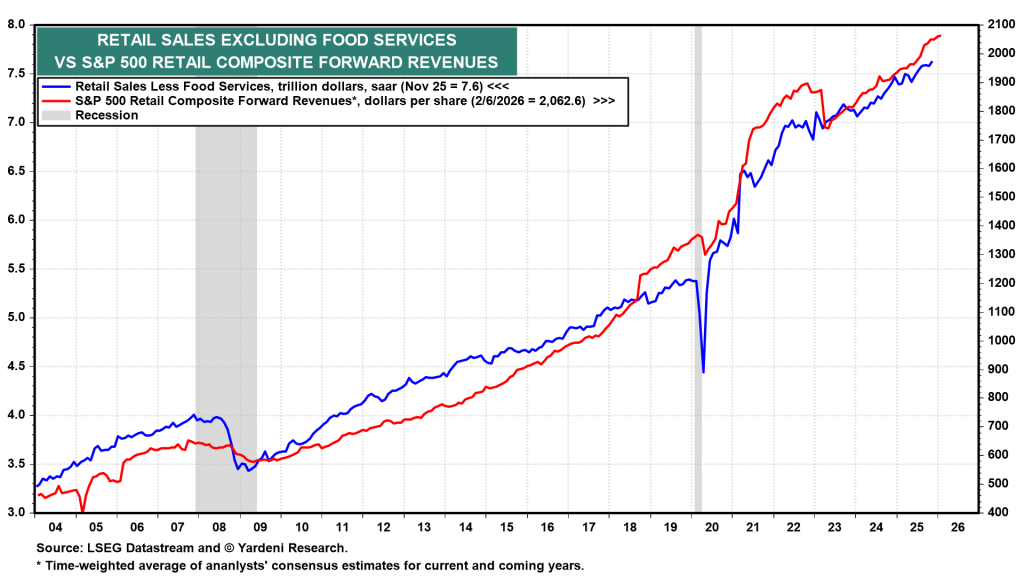
    Despite ongoing concerns about the cost of living and a fragile labor market, household spending continues to show resilience. Retail sales in December, due Tuesday, are expected to post another solid gain following November’s 0.6% month-over-month increase. Looking ahead, larger annual tax refunds should help sustain consumer spending momentum. Reflecting this strength, forward earnings for the S&P 500 Retail Composite climbed to a record high during the week of February 6 (see chart).
    Jobless claims

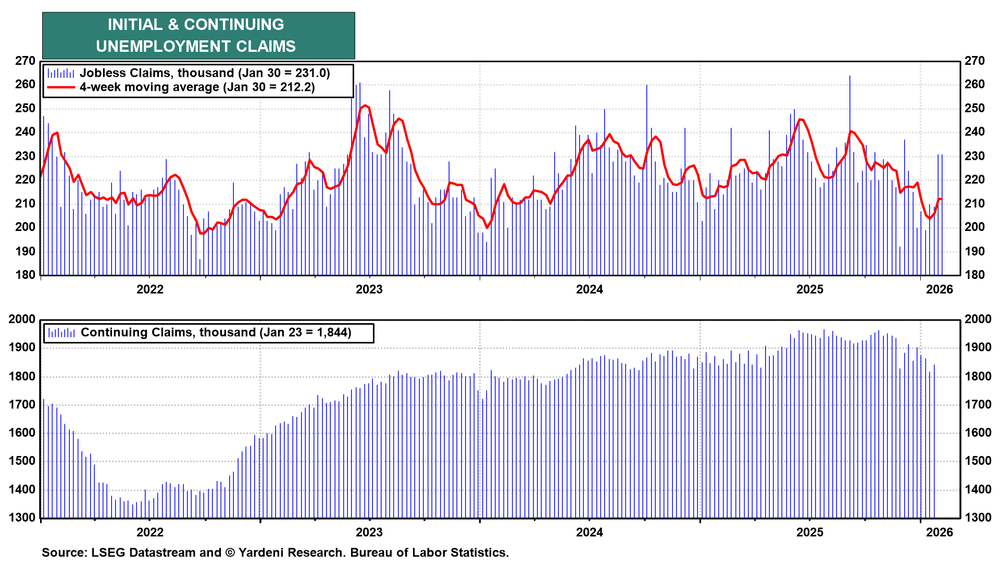
    Initial jobless claims due Thursday will draw heightened scrutiny as investors look to determine whether last week’s jump to 231,000 was driven by severe winter storms rather than a broader acceleration in layoffs. The balance of evidence points to a weather-related distortion, which would likely reassure the Fed that the labor market remains on relatively stable footing.
    Sources: Ed Yardeni
  • Week Ahead: Tech volatility weighs on markets ahead of jobs, CPI and retail sales data

    Key Highlights

    Japan equities rally: Japanese stocks surged after Prime Minister Sanae Takaichi’s landslide election victory, boosting expectations of higher government spending on defense and AI. The Nikkei jumped as much as 4.2% to a record high, while the Topix rose up to 2.6%, led by gains in electronics and banking stocks.

    Gold rebounds: Gold climbed above $5,000 an ounce, rising as much as 1.6% early on as dip buyers returned following a volatile week. The move was supported by Japan’s election outcome, which fueled expectations of looser fiscal policy and a weaker yen—both supportive for bullion. Gold remains about 11% below its Jan. 29 peak but is still up roughly 15% year to date.

    Oil slips: Oil prices edged lower as easing Middle East tensions reduced near-term supply disruption risks. Talks between Iran and the U.S. in Oman on Tehran’s nuclear program were described by Iran as “a step forward.”

    Asia markets higher: Asian equities opened higher, tracking Friday’s rebound on Wall Street. Stocks jumped in Japan and South Korea, with the Kospi—popular among AI-linked trades—surging 4%. U.S. futures were firmer after the S&P 500 closed about 2% higher on Friday amid dip-buying and improved consumer sentiment.

    Algo-driven risks flagged: Goldman Sachs warned that trend-following algorithmic funds could accelerate U.S. equity selling this week. A renewed decline could trigger around $33 billion in automated sales immediately, with a break below 6,707 on the S&P 500 potentially unleashing up to $80 billion more over the next month. Thin liquidity and short-gamma positioning may keep volatility elevated.

    AI fears spark selloff: Concerns over AI’s economic impact intensified after Anthropic unveiled new tools, triggering a broad selloff that erased $611 billion in market value across 164 software, financial services, and asset management stocks. Despite the selloff, fundamentals remain intact, with S&P 500 software and services earnings expected to grow 19% in 2026 and valuations becoming more attractive.

    Wall Street rebound: U.S. equity futures ticked higher late Sunday after a strong rebound on Friday. Bitcoin jumped following steep losses, the Dow hit a fresh record above 50,000, and the S&P 500 reclaimed its 50-day moving average. The Nasdaq, however, remained below that key level and ended the week notably weaker.

    U.S. Economic Data and Corporate Earnings Schedule

    Investors are set to focus on the delayed January labor market data, alongside upcoming consumer inflation (CPI) and retail sales releases. The jobs and CPI reports were postponed due to a brief government shutdown last week, while December retail sales figures were also delayed following the 2025 shutdown.

    The Federal Reserve continues to view inflation as “somewhat elevated,” with January’s CPI report, due Friday, expected to provide further clarity. As the central bank assesses risks to both inflation and employment as having eased, markets are pricing in no additional rate cuts before the June meeting. By then, Kevin Warsh—President Trump’s nominee for Fed chair—could be in office.

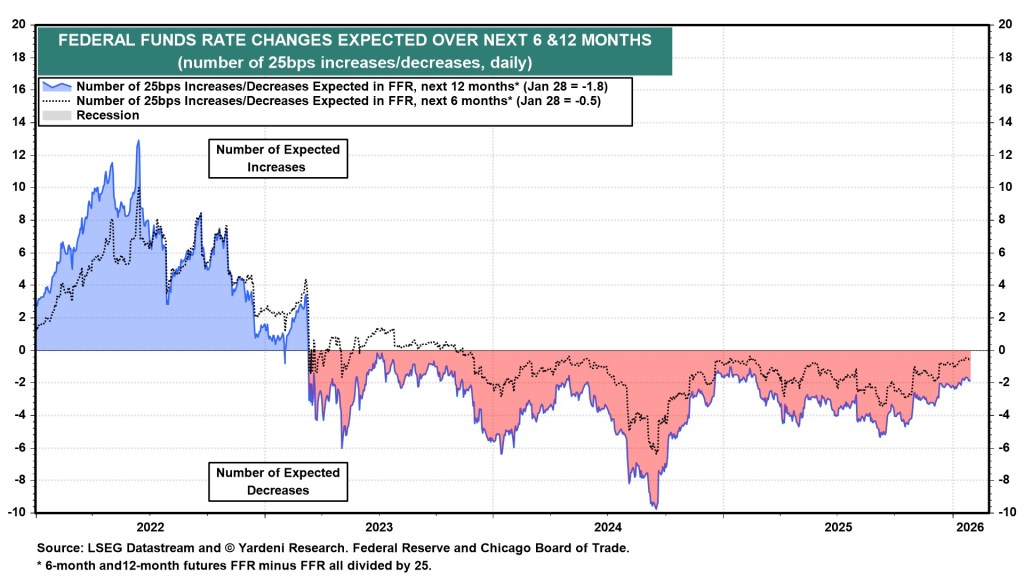
    Despite the Fed’s year-end rate cut, futures markets still anticipate roughly two additional 25-basis-point cuts by December, a pricing stance that has remained largely unchanged since Warsh’s nomination last month.

    Economic calendar:

    Monday, Feb 9
    Remarks from Fed officials including Governors Stephen Miran and Christopher Waller, along with Atlanta Fed President Raphael Bostic.

    Tuesday, Feb 10
    Key U.S. data releases include December retail sales, NFIB Small Business Optimism, the Q4 Employment Cost Index, December import prices, and November business inventories.
    Cleveland Fed President Beth Hammack is also scheduled to speak.

    Wednesday, Feb 11
    The January U.S. employment report is due, alongside remarks from Vice Chair for Supervision Michelle Bowman.
    The monthly U.S. federal budget for January will also be released.

    Thursday, Feb 12
    Data highlights include January existing-home sales and weekly initial jobless claims for the week ending Feb 7.
    Governor Stephen Miran is scheduled to speak.

    Friday, Feb 13
    The January Consumer Price Index (CPI) will be released.

    Earnings Calendar:

    Monday, Feb. 9
    Earnings are due from Apollo Global Management, Onsemi, Loews, and Principal Financial.

    Tuesday, Feb. 10
    A heavy earnings slate includes Coca-Cola, AstraZeneca, Gilead Sciences, BP, CVS Health, Spotify, Duke Energy, Marriott, Ferrari, Ecolab, Robinhood, Cloudflare, Ford, Honda Motor, and Barclays.

    Wednesday, Feb. 11
    Reports are expected from Cisco, McDonald’s, T-Mobile, AppLovin, and Shopify.

    Thursday, Feb. 12
    Applied Materials, Arista Networks, Unilever, Vertex Pharmaceuticals, Brookfield, Airbnb, and Coinbase Global are scheduled to report.

    Friday, Feb. 13
    Enbridge and Moderna round out the week.

    Cisco is set to report fiscal Q2 results after Wednesday’s close. Consensus estimates call for adjusted EPS of $1.02, up 9% year over year, on revenue of $15.1 billion, an 8% increase. Product orders are expected to soften slightly following 13% growth last quarter, while AI-related orders may cool after reaching $1.3 billion in Q1. Investors will be watching for upside tied to Cisco’s AI-networking partnership with Nvidia and signs of a recovery in its security segment following a weak prior quarter despite the Splunk acquisition.

    AstraZeneca reports Q4 results early Tuesday, with analysts forecasting flat adjusted EPS and roughly 4% sales growth. The company’s recent move from Nasdaq to the NYSE has helped propel shares sharply higher, up around 108% in February.

    Robinhood is expected to post a roughly 38% decline in EPS to $0.63, even as revenue is seen rising nearly 34% to $1.36 billion on stronger options, equities, and transaction activity. Crypto revenue is projected to fall about 28% to $259 million. The company has recently faced regulatory scrutiny related to prediction markets, including halting sports-related contracts in Nevada, contributing to a sharp pullback in the stock last week.

    Elsewhere, McDonald’s earnings are expected to show about 8% EPS growth—its strongest quarter since late 2023—while Coca-Cola is forecast to report modest slowing growth, despite shares gaining around 8% since breaking out in January.

    By the end of the week, more than 80% of Dow Jones Industrial Average constituents will have reported earnings.

    Technical Analysis:

    DJIA Index
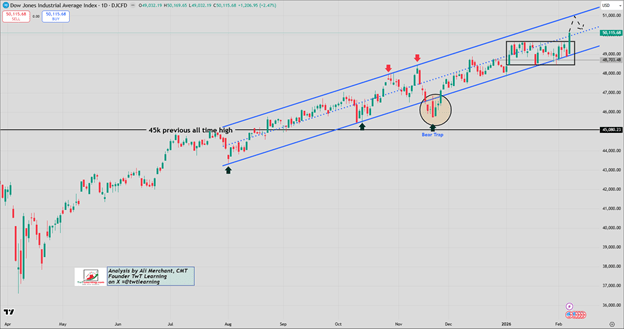
    The index confirmed a breakout from a bullish rectangular consolidation on Friday. As long as support at 49,970 holds, the upside target remains at 51,000.
    DJIA daily candlestick chart.

    Nasdaq 100 Index
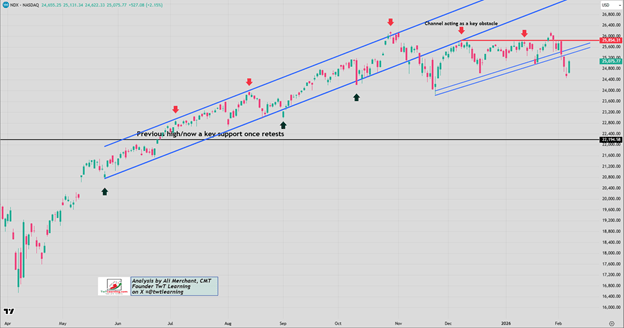
    The NDX broke below the 25,200 support level last Wednesday, in line with the view that a sustained move under 25,200 would open the door toward 24,650. The index subsequently dropped to 24,455 before reclaiming 24,650. It is now rebounding toward 25,200, with further upside toward 25,370. A decisive break above 25,370 would expose resistance near 25,850.
    NDX daily candlestick chart.

    SPX Index
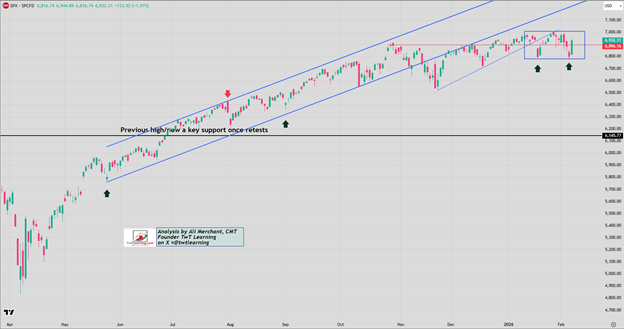
    The SPX successfully defended the 6,790–6,780 support zone during its second pullback of the year. The index is now consolidating within a rectangular range. As long as support at 6,780 holds, the upside target remains 7,010.
    SPX daily candlestick chart.

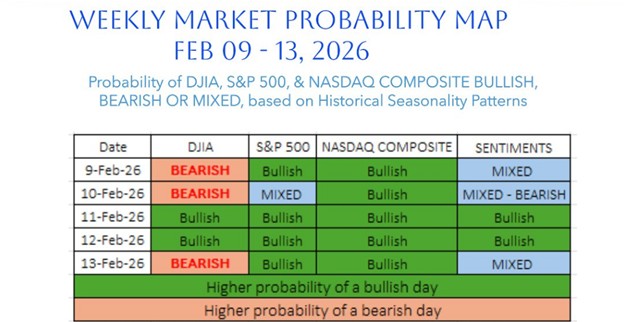
    Weekly Probability Outlook for U.S. Indices

    The U.S. weekly market probability map for Feb. 9–13, 2026 points to a mixed open for U.S. equity indices, followed by a stronger close and a rally developing midweek. The probability maps are based on historical seasonality trends, with sentiment readings generated through a seasonality-driven scoring model.

    Sources: Ali Merchant

  • Looking ahead to the week ahead: Warsh takes center stage alongside central banks

    The US Federal Reserve experienced an eventful week. On Monday, it contacted New York–based banks to assess their USD/JPY exposure, sparking speculation that Washington could be coordinating with Japan to address the Japanese Yen’s weakness. This development prompted a sharp sell-off in the US Dollar early in the week.

    The Fed’s midweek policy meeting resulted in no change to the federal funds rate, which was kept within the 3.50%–3.75% range, in line with expectations. During his press conference, Chair Jerome Powell avoided questions related to politics, his tenure, and the subpoena. However, he pointed to improving economic momentum and reduced risks to both inflation and the labor market.

    The US Dollar Index (DXY) has since rebounded toward the 96.90 level, recovering most of its weekly losses after President Donald Trump nominated former Fed Governor Kevin Warsh as the next Fed Chair on Friday. The nomination now awaits Senate approval. Looking ahead, the US is set to release several key data points next week, including the ISM Manufacturing PMI for January, MBA mortgage applications, Challenger job cuts, and weekly initial jobless claims.

    EUR/USD is hovering around the 1.1880 area after the US Dollar rebounded and recovered nearly all of its weekly losses. In the coming week, Hamburg Commercial Bank (HCOB) will release Manufacturing, Services, and Composite PMIs for both Germany and the Eurozone. Additional Eurozone data include the ECB Bank Lending Survey and December Producer Price Index (PPI), while Germany will publish December Factory Orders and Industrial Production figures.

    GBP/USD is trading near 1.3600 ahead of the Bank of England’s monetary policy announcement on Thursday. Governor Andrew Bailey’s subsequent press conference is expected to shed further light on the central bank’s outlook for interest rates. UK data releases include the final January S&P Global PMIs and the Halifax House Price Index.

    USD/JPY is holding close to the 154.50 level, paring earlier gains after Tokyo CPI data indicated easing inflation in January. Headline inflation slowed to 1.5% year-over-year from 2% in December, while core measures eased to 2%, undershooting forecasts. The softer inflation profile reduces pressure on the Bank of Japan to tighten policy.

    USD/CAD is trading around 1.3580, with the Canadian Dollar maintaining a slight edge against the greenback despite data showing economic stagnation in November. Monthly GDP was flat following a 0.3% contraction in the prior month and fell short of expectations for modest growth. Upcoming Canadian releases include January S&P Global PMIs and the Ivey PMI.

    Gold is trading near the $4,880 area after surrendering all weekly gains. Prices retreated from a record high of $5,598 as profit-taking emerged and the US Dollar strengthened sharply.

    Looking ahead: Emerging views on the economic outlook

    Scheduled central bank speakers for the week:

    Monday, February 2:
    – Bank of England’s Breeden
    – Federal Reserve’s Bostic

    Tuesday, February 3:
    – Federal Reserve’s Barkin

    Wednesday, February 4:
    – Federal Reserve’s Cook

    Thursday, February 5:
    – Bank of England Governor Andrew Bailey
    – Federal Reserve’s Bostic
    – Bank of Canada Governor Tiff Macklem

    Friday, February 6:
    – European Central Bank’s Cipollone
    – European Central Bank’s Kocher
    – Bank of England’s Pill
    – Federal Reserve’s Jefferson

    Central bank meetings and upcoming data set to influence monetary policy decisions

    Key economic data and policy events for the week:

    Monday, February 2:
    – Germany’s December Retail Sales
    – US ISM Manufacturing PMI

    Tuesday, February 3:
    – Reserve Bank of Australia monetary policy decision
    – US December JOLTS job openings

    Wednesday, February 4:
    – Eurozone January Harmonized Index of Consumer Prices (HICP)
    – US January ADP employment report

    Thursday, February 5:
    – Australia’s December trade balance
    – Eurozone December retail sales
    – Bank of England monetary policy decision
    – European Central Bank monetary policy decision

    Friday, February 6:
    – Canada’s January employment change
    – US January nonfarm payrolls
    – US February Michigan consumer sentiment

    Sources: Fxstreet

  • When will the German and Eurozone Q4 GDP figures be released, and what impact could they have on EUR/USD?

    Overview of German and Eurozone Q4 GDP

    Germany’s Federal Statistics Office will publish preliminary fourth-quarter GDP figures at 09:00 GMT on Friday, followed by Eurostat’s release of flash Eurozone GDP data at 10:00 GMT for the same period.

    Germany’s economy is expected to expand by 0.2% quarter-over-quarter in Q4, rebounding from stagnation in the previous quarter, while annual growth is forecast to remain unchanged at 0.3%. At the Eurozone level, seasonally adjusted GDP is projected to grow by 0.2% QoQ in the fourth quarter, down from 0.3% previously, with year-over-year growth seen moderating to 1.2% from 1.4%.

    How might Germany and the Eurozone’s Q4 GDP data influence the EUR/USD exchange rate?

    The EUR/USD pair may face downside pressure if Germany and Eurozone GDP figures come in line with forecasts. Investors will also closely monitor December unemployment data from both regions, as well as Germany’s Consumer Price Index (CPI for January).

    ECB policymaker Martin Kocher cautioned that additional strength in the Euro could lead the central bank to restart interest-rate cuts. After his remarks, market expectations for a summer rate reduction edged higher, with the implied probability of a July cut increasing to roughly 25% from around 15%. The ECB is set to meet next week and is broadly expected to leave interest rates unchanged.

    Meanwhile, EUR/USD is under strain as the US Dollar gains traction amid speculation that US President Donald Trump may nominate former Federal Reserve Governor Kevin Warsh as the next Fed Chair. Trump indicated late Thursday that he would reveal his decision on Friday morning, with markets leaning toward Warsh, who is perceived as relatively hawkish.

    From a technical perspective, EUR/USD is hovering near 1.1920 at the time of writing. Daily chart analysis continues to point to a bullish bias, with the pair holding within an ascending channel. A move toward the upper channel boundary near 1.2050 is possible, followed by 1.2082, the highest level since June 2021. On the downside, initial support is seen at the nine-day Exponential Moving Average (EMA) around 1.1870, with further support near the lower boundary of the channel at approximately 1.1840.

    Sources: Fxstreet

  • Powell enters final phase with rates unchanged and little guidance

    Federal Reserve Chair Jerome Powell offered few substantive remarks during his press conference on Wednesday, sidestepping multiple questions about the upcoming leadership transition as his term ends on May 15. He declined to comment on President Donald Trump’s potential nominee to succeed him, as well as on the president’s public criticism of his tenure.

    Powell also avoided addressing questions related to the Department of Justice investigation involving him and the ongoing Supreme Court case concerning the possible removal of Fed Governor Lisa Cook. In response to these issues, he repeatedly indicated that he had nothing further to add.

    “I have nothing on that for you.”

    He repeated that response seven times in total. On four occasions, he simply said,

    “I don’t have anything on that for you.”

    After the FOMC voted to keep the federal funds rate in a range of 3.50%–3.75%, Powell provided no additional forward guidance beyond reiterating the Fed’s data-dependent, meeting-by-meeting approach. He did, however, acknowledge the underlying strength of the U.S. economy.

    Powell noted that the unemployment rate has remained low at around 4.4% in recent months, even as job growth has slowed. He also said inflation is expected to ease as the effects of President Trump’s tariffs fade.

    Overall, Powell characterized the risks of higher inflation and rising unemployment as balanced, signaling little urgency for policy action. This assessment increases the likelihood that the federal funds rate will remain unchanged at his final two meetings as FOMC chair.

    Officials in the Trump administration broadly share our “Roaring 2020s” outlook, which assumes stronger-than-expected productivity growth will lift real GDP while easing inflation pressures as unit labor cost growth falls toward zero. They argue that this expectation supports additional cuts to the federal funds rate—a view echoed by two dissenting members of the FOMC, who expressed similar reasoning at the latest meeting.

    We take a different view. Cutting the federal funds rate further from current levels would heighten the risk of financial instability, particularly by fueling a melt-up in equity markets. A similar dynamic is already evident in precious metals. Additional rate cuts would also put further downward pressure on the dollar, potentially reigniting inflationary pressures.

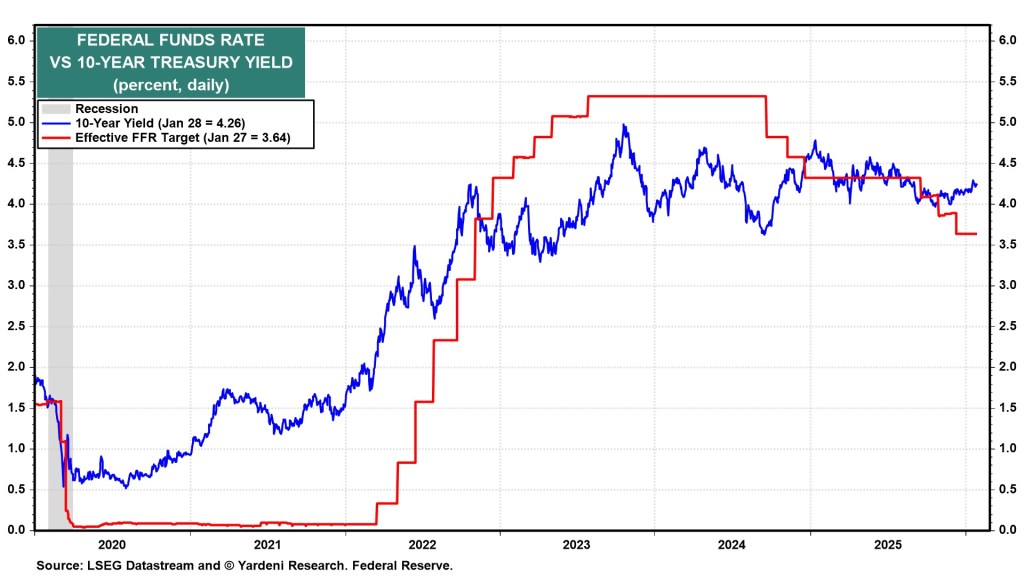
    Bond markets appear to share this skepticism. When the Fed reduced the federal funds rate by 100 basis points in late 2024, the 10-year Treasury yield rose by a similar amount. Even after another 75-basis-point cut late last year, the yield held around 4.00% and has since climbed to 4.26%. We continue to expect the 10-year yield to trade largely between 4.25% and 4.75% this year—levels that were typical in the period before the Global Financial Crisis.

    Sources: Ed Yardeni

  • The US Dollar Index edged lower toward 97.00 amid Fed uncertainty and US shutdown concerns

    The US Dollar Index stays under pressure near 97.00 in Tuesday’s Asian session as concerns over Fed independence grow ahead of expectations that rates will remain unchanged at Wednesday’s meeting.

    The US Dollar Index (DXY) weakened toward 97.00 in Asian trading on Tuesday, with investors awaiting the US ADP Employment Change and Consumer Confidence data later in the day.

    Concerns over the Federal Reserve’s independence have pushed the DXY to its lowest level since September 18, 2025, after President Donald Trump said he would soon name a successor to Fed Chair Jerome when his term ends in May. According to Reuters, betting markets see BlackRock executive Rick Rieder as the leading candidate.

    Tim Duy, chief US economist at SGH Macro Advisors, noted that the actions of the next Fed chair cannot be separated from broader economic conditions or their influence on other FOMC members.

    Adding to the USD’s downside risks are fears of a US government shutdown, with Senate Democratic leader Chuck Schumer pledging to block a funding bill that includes Homeland Security appropriations. Lawmakers face a January 30 deadline to avoid a partial shutdown.

    Meanwhile, the Fed is widely expected to keep rates unchanged at Wednesday’s meeting after three straight cuts late in 2025. Markets will focus on the press conference for signals on the economic outlook and future rate path, with any hawkish tone potentially limiting near-term USD losses.

    Sources: Fxstreet

  • Week Ahead: GDP and PCE inflation take center stage before next Fed meeting

    This is shaping up to be a highly unpredictable week for U.S. and global markets, with numerous wildcard risks—largely tied to developments from the White House.

    Investors will be closely watching for any developments related to the Justice Department’s investigation into Federal Reserve Chair Jerome Powell. Attention will also turn to the Supreme Court on Wednesday, when it hears arguments concerning President Trump’s attempt to remove Fed Governor Lisa Cook.

    Trade policy remains a major wildcard, with tariff headlines likely to emerge rapidly after Trump threatened over the weekend to impose a new 10% levy on imports from eight European countries opposing his push on Greenland. The Supreme Court could also rule this week on the legality of Trump’s tariffs. Meanwhile, fresh rhetoric around Iran, renewed intrigue involving Venezuela, or actions targeting other geopolitical flashpoints could further unsettle markets.

    In Japan, the Bank of Japan is widely expected to keep interest rates unchanged on Friday. However, a weakening yen has revived speculation about possible intervention, leaving the future of the massive yen carry trade hanging in the balance. In China, fourth-quarter GDP growth slowed amid the ongoing property downturn, potentially prompting a policy response.

    All of this sets the stage for a busy week in Davos, where global leaders and policymakers are gathering, with President Trump scheduled to address the forum.

    In the United States, a slate of economic data will keep both investors and Federal Reserve officials engaged during the holiday-shortened week. A revision to third-quarter GDP could clarify whether the initially reported 4.3% growth overstated the economy’s strength or accurately reflected underlying momentum.

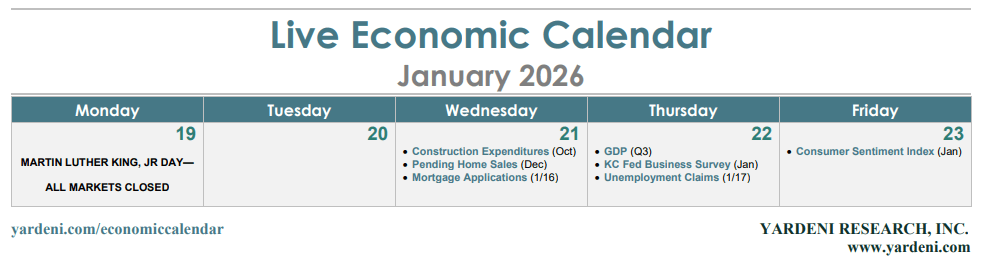
    Below are the key data releases this week that are most likely to shape the FOMC’s outlook ahead of its January 27–28 policy meeting.

    GDP Update: Growth Momentum in Focus

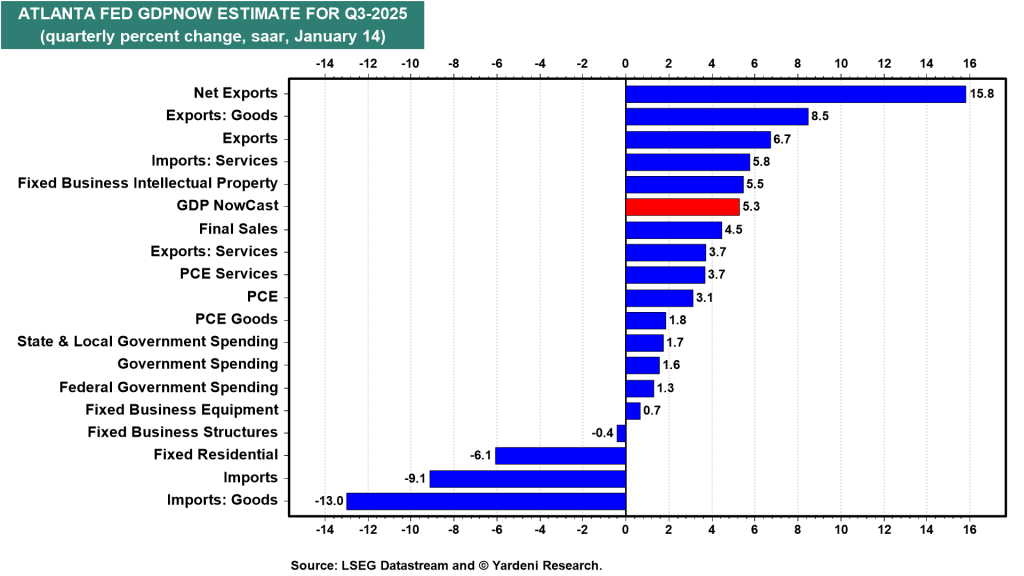
    Overall data indicate the economy stayed resilient through the final three quarters of 2025. Despite a notable slowdown in employment growth, household demand exceeded expectations, while AI-related capital investment surged. Although a modest upward or downward revision to Q3 real GDP (Thursday) is possible, Q4 real GDP is currently tracking at a strong 5.3% annualized pace (see chart).

    Personal income, consumption, and saving

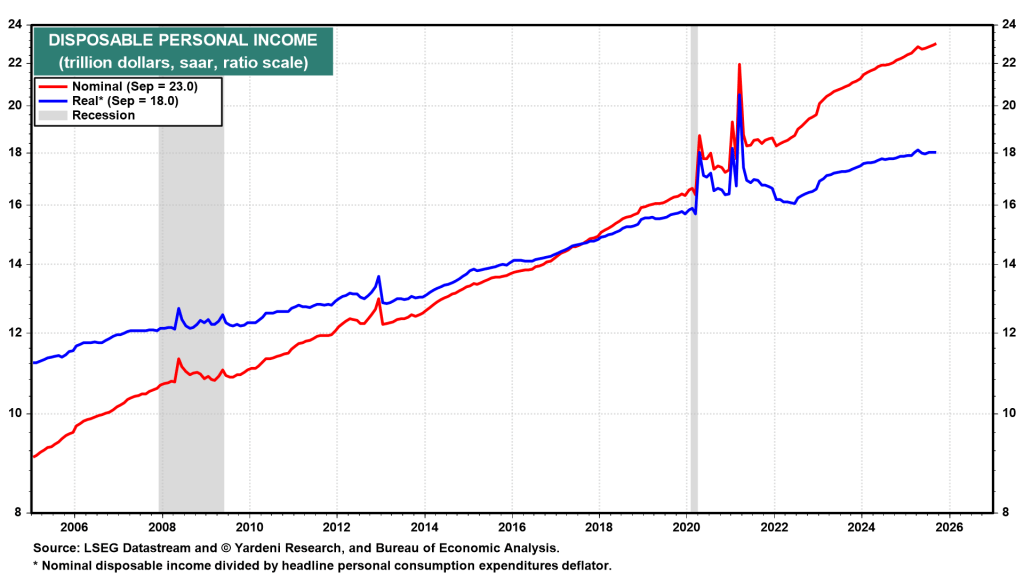
    Personal income data for October and November (Thu) may reinforce the view that real disposable income growth has stalled. This likely reflects demographic effects, as retiring Baby Boomers exit the labor force and no longer generate wage income. If consumer spending remains resilient, it would suggest households—particularly retirees—are increasingly drawing on retirement savings.

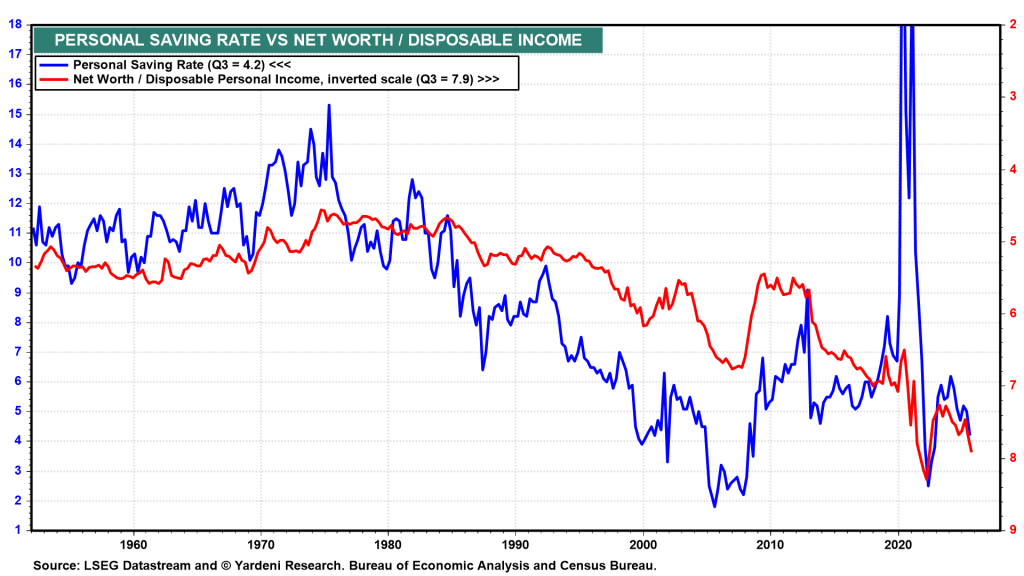
    The personal saving rate (Thu) is likely to continue declining under our framework, particularly if household net worth keeps rising to record levels relative to disposable income (chart).

    PCE inflation

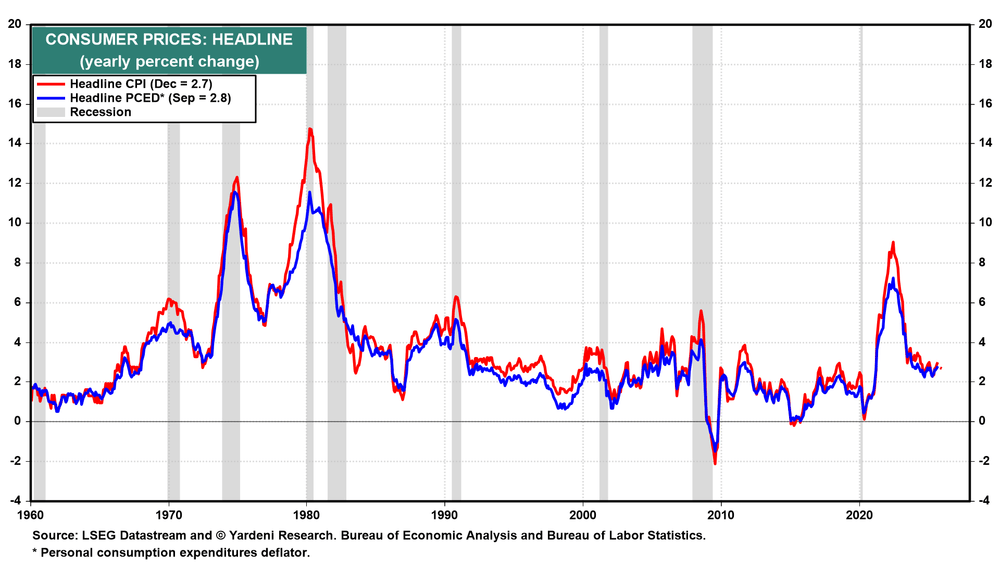
    The Bureau of Economic Analysis will calculate October PCE inflation (Thu) using the average of September and November CPI data. Meanwhile, the Cleveland Fed’s Inflation Nowcasting model projects headline and core PCE inflation at 2.65% y/y and 2.70% in November (chart).

    Unemployment claims

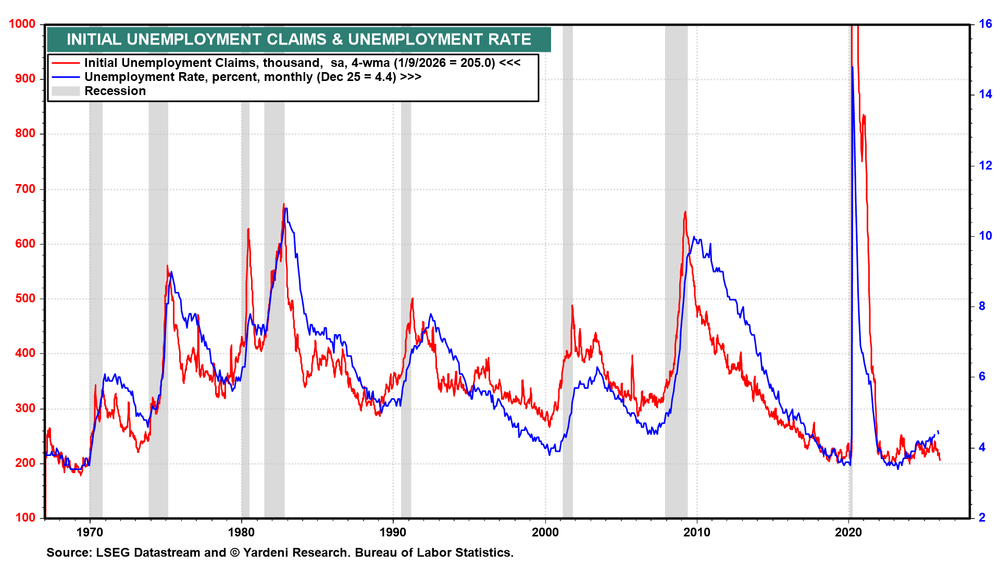
    Initial jobless claims (Thu) have declined in recent weeks, indicating that January’s unemployment rate likely edged lower from December’s 4.4% (chart).

    Sources: Yardeni
  • No layoffs even as tariff-related cost pressures continue across Federal Reserve districts

    The Federal Reserve’s Beige Book released Wednesday indicated that “tariff-driven cost pressures were widespread across every district.” Out of the 12 Fed districts, only two saw mild price increases, while the remaining 10 experienced more intense price pressure. This suggests the Fed is unlikely to reduce benchmark interest rates at the upcoming FOMC meeting—unless signs of labor market weakness push them to cut rates again to support hiring.

    Meanwhile, a 5.1% increase in existing home sales in December could point to a potential recovery in the housing sector. The median price of homes sold last month was $405,400, a gain of just 0.4% year-over-year, indicating that home price appreciation remains limited.

    The Commerce Department reported that retail sales increased 0.6% in December, surpassing economists’ forecasts of a 0.5% gain. In addition, October’s retail sales were revised to a 0.1% decline, instead of the previously estimated 0.2% rise. Overall, 10 of the 13 retail categories posted higher sales in November, making this a strong performance that should continue to support solid GDP expansion.

    Meanwhile, three missile-capable ships and an aircraft carrier are being deployed to the Middle East in a show of force aimed at pressuring Iran’s government. Crude oil markets are pricing in the possibility that Iran’s oil exports could be removed from global supply, depriving the regime of revenue. This signals that President Trump may take further action beyond sanctions and a 25% tariff on nations that trade with Iran.

    Intense diplomatic efforts have been taking place between Iran and neighboring Arab countries. On Wednesday, President Trump said Iran had halted the killing of anti-government demonstrators and would not carry out death sentences against people accused of seeking to overthrow the regime. His comments suggested the U.S. might be stepping back from launching military strikes. Trump told reporters that the U.S. had received word Iran had “no plans to execute protesters.”He went on to say that new information indicated the deaths had ceased and the executions had been stopped, adding that many believed executions were scheduled for that day.

    Sources: Investing

  • U.K. economy bounced back in November with a 0.3% monthly increase in GDP

    The U.K. economy showed signs of recovery in November following a weak start to the fourth quarter, though economic outlooks remain uncertain.

    Data published Thursday by the Office for National Statistics revealed that the U.K.’s gross domestic product increased by 0.3% in November, rebounding from a 0.1% monthly decline in October. Year-over-year, the U.K. economy grew by 1.4% in November, up from 1.1% growth the month before.

    The manufacturing sector saw strong growth of 2.1% in November, supported by the ongoing reopening of Jaguar Land Rover’s factories as the company continues to recover from last year’s cyberattack.

    However, Michael Brown, senior research strategist at Pepperstone, cautioned that this modest growth rate does little to inspire confidence in the U.K.’s economic outlook. He pointed out that risks remain heavily skewed to the downside, and that recent government policy reversals have eroded up to two-thirds of the fiscal flexibility that Chancellor Rachel Reeves had secured in the November Budget.

    Late last year, Finance Minister Reeves increased taxes to help reduce the deficit and support higher welfare spending, but the tax hikes were less severe than initially expected.

    Reeves recently announced a £4.3 billion fund aimed at easing the impact of upcoming interest rate hikes on the hospitality sector, especially as Covid-era support ends in April and property valuations are updated.

    In December, the Bank of England cut interest rates at its final policy meeting of 2025, with expectations of further cuts this year due to forecasts of a significant slowdown in inflation. Alan Taylor, an external member of the Bank’s monetary policy committee, noted this earlier in the week.

    He added that falling energy prices and measures introduced in the autumn budget to reduce living costs should help bring inflation back to the 2% target by mid-2026.

    “Interest rates are likely to keep declining, provided my economic outlook aligns with the data, as it has over the past year,” Taylor said. British inflation eased to 3.2% in November 2025, falling more than anticipated but still above the Bank of England’s 2% goal.

    Sources: BBC

  • Upcoming Economic Week: Inflation and Retail Sales to Shape Fed Policy Outlook

    If economists were meteorologists, this week’s forecast would predict a data blizzard. However, clarity is expected to improve as markets receive highly anticipated reports on inflation, retail sales, and industrial production ahead of the Federal Reserve’s policy meeting on January 28.

    Few economists expect Fed Chair Jerome Powell and the Federal Open Market Committee (FOMC) to ease monetary policy again later this month—and neither do we. This week’s data could either confirm or challenge that view, starting with the December consumer price index report on Tuesday.

    The Fed drama intensified last week after President Donald Trump instructed Fannie Mae and Freddie Mac to purchase $200 billion in mortgage bonds—an action typically undertaken by the Fed itself. Many saw this move as an attempt to restart quantitative easing. Meanwhile, Fed Governor Stephen Miran told Bloomberg he anticipates 150 basis points of rate cuts this year.

    What’s still missing, however, is significantly lower inflation and a recession that would justify such aggressive easing. This week will also feature speeches from several Fed officials, which could provide insight into the central bank’s thinking. The lineup starts with New York Fed President John Williams on Monday, followed by Governors Miran (Wednesday), Michael Barr (Thursday), Michelle Bowman (Friday), and Vice Chair Philip Jefferson (Friday).

    Here’s a rundown of this week’s key data releases likely to influence the timing and scale of any future Fed rate cuts:

    Inflation

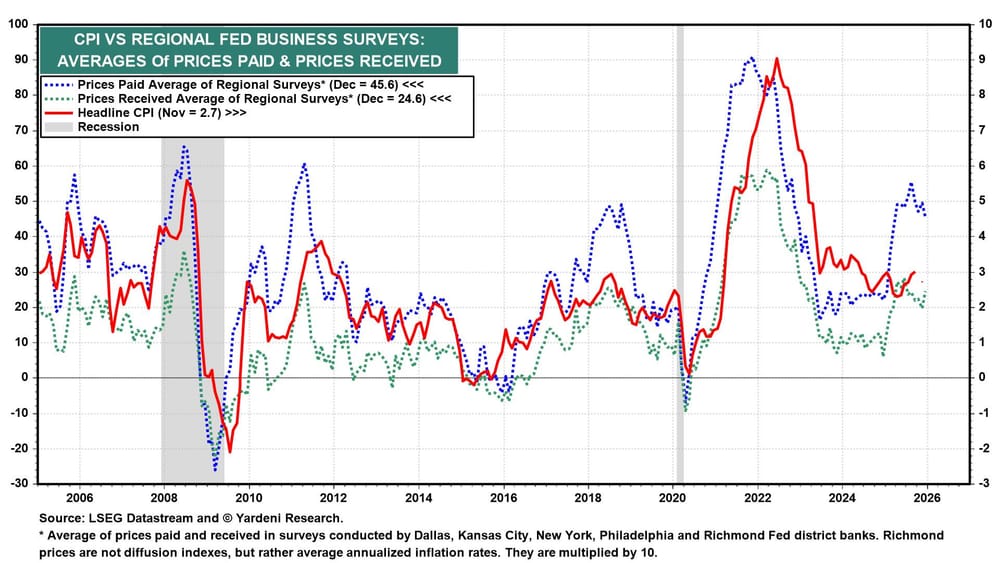
    Since the 43-day government shutdown in October and November, investors have struggled to gauge inflation accurately. The 2.7% year-over-year CPI rise in November, a slight dip from October’s 3.0%, was met with caution, as the shutdown likely disrupted the Bureau of Labor Statistics’ data gathering.

    This increases the importance of the upcoming CPI and PPI reports, which will be key indicators before the FOMC’s January 28 interest rate decision.

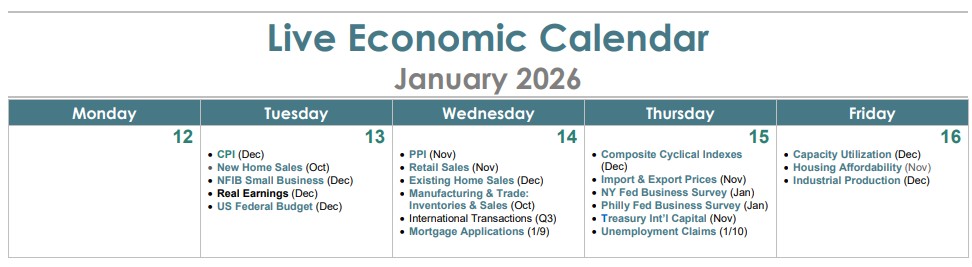
    The upcoming CPI report on Tuesday is expected to show a modest easing in inflation, with the Cleveland Fed’s model forecasting a 0.2% monthly increase and 2.6% year-over-year growth. The November PPI report, due Wednesday, is considered less impactful, while import and export price data for November will be released on Thursday.

    Retail sales

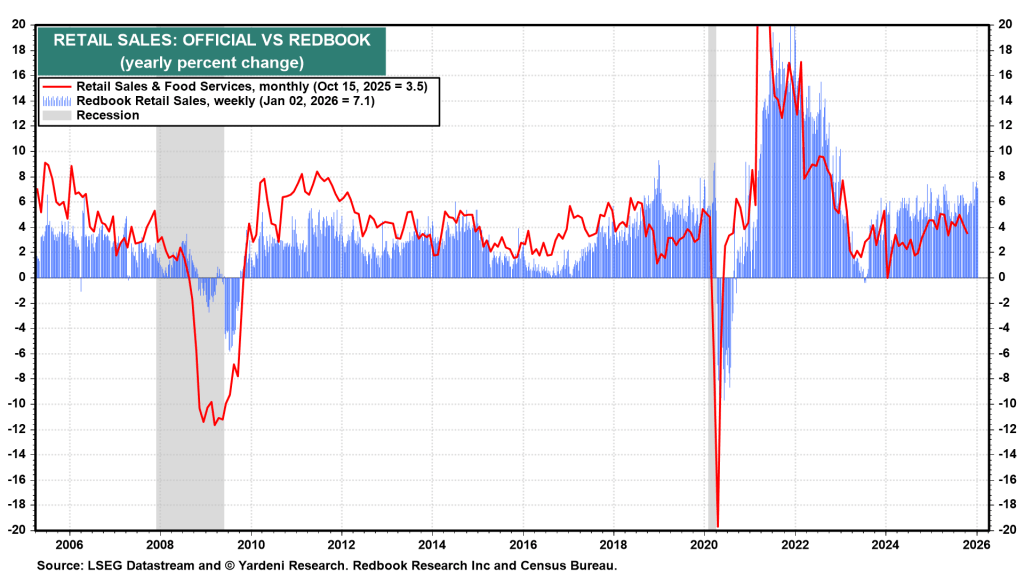
    Retail sales (Wednesday) are expected to show a slight increase in November after remaining flat in October (see chart). Overall, we believe consumer spending remains resilient despite rising living costs and soft employment figures. Additional important demand indicators this week include December existing home sales (Wednesday) and mortgage applications for the week ending January 9 (Wednesday).

    Jobless claims

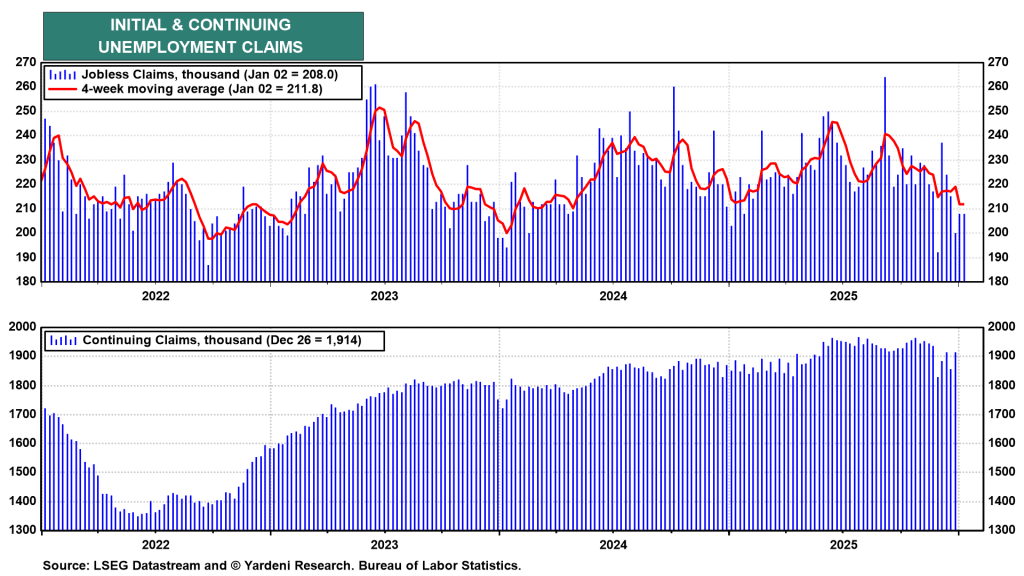
    We anticipate layoffs will stay minimal, which has been the key insight from recent initial unemployment claims data (Thursday) (see chart). While demand for labor may be slowing in certain sectors, the feared AI-driven collapse in the job market has not materialized yet.

    Composite economic indicators & business surveys

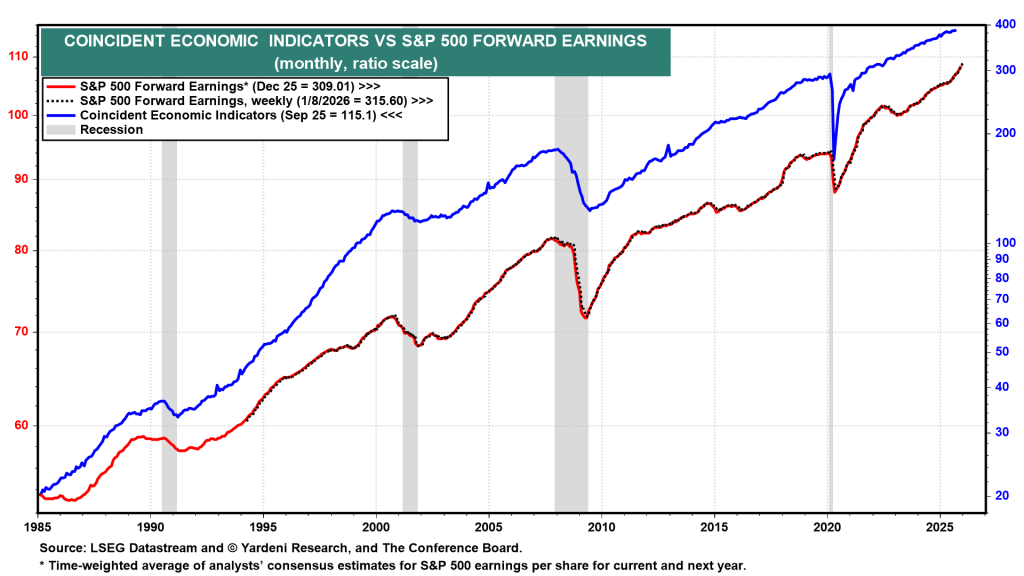
    The composite cyclical indicators for December, due Thursday, are expected to show the coincident index holding at a record high, while the (mis)leading index continues its decline. Additionally, given delays in official hard data, the National Federation of Independent Business’ Small Business Optimism Index for December (Tuesday) should provide valuable insights, following its rise to 99 in November. Later in the week, the Federal Reserve banks of New York and Philadelphia will release their January business surveys (Thursday).

    Our preferred coincident indicator is the S&P 500 forward earnings per share, which has accelerated in recent weeks and hit record highs (see chart).

    Sources: Investing

  • GBP/CAD Holds Steady Amid Mixed Canadian Employment Data

    GBP/CAD is trading close to one-month highs as investors react to mixed employment data from Canada. Higher unemployment rates and weaker wage growth have capped gains for the Canadian dollar. Attention now turns to the upcoming UK employment and GDP reports scheduled for next week.

    The Canadian Dollar (CAD) remained largely unchanged against the British Pound (GBP) on Friday, with GBP/CAD showing little directional movement as the market reacted modestly to Canada’s latest employment data. At the time of writing, the pair is trading around 1.8636, close to a one-month high.

    Statistics Canada reported that employment increased by 8,200 jobs in December, surpassing expectations of a 5,000 job decline but significantly lower than November’s 53,600 gain. Meanwhile, the unemployment rate rose to 6.8% from 6.5%, higher than the anticipated 6.6%.

    Wage growth showed signs of slowing, with average hourly wages rising 3.7% year-over-year in December, down from 4.0% previously.

    From a monetary policy standpoint, the mixed employment report is unlikely to significantly change short-term expectations for the Bank of Canada (BoC). The market largely anticipates that the central bank will keep interest rates steady throughout most of 2026.

    While some analysts had speculated about a possible rate hike later in the year, the recent labor data—characterized by rising unemployment and slower wage growth—weighs against that possibility and supports a cautious, wait-and-see approach.

    At its December meeting, the BoC held its policy rate at 2.25%, describing it as “about the right level.” Market participants are now focused on upcoming Canadian inflation figures expected later this month, which could influence near-term monetary policy forecasts.

    In the UK, attention is shifting to key economic releases next week, including labor market data on Tuesday and the November GDP report on Thursday.

    On a broader scale, the interest rate gap between the BoC and the Bank of England (BoE) continues to favor the British Pound, maintaining upward momentum for GBP/CAD.

    Additionally, the Canadian Dollar remains sensitive to developments in the oil market. Increased U.S. regulation of Venezuelan oil supplies has raised expectations of greater global output, heightening concerns over oversupply that could pressure oil prices and weigh on the Loonie, given Canada’s role as a major energy exporter.

    Sources: Fxstreet

  • EUR/USD Weekly Forecast: U.S. Dominates Global Market Direction at the Start of 2026

    U.S. employment figures reinforce the Federal Reserve’s cautious stance on monetary policy. Meanwhile, Europe’s economic growth remains sluggish, but policymakers appear comfortable with the current pace. As demand for the U.S. Dollar stays strong, the EUR/USD pair has potential to continue its downward move toward the 1.1470 level.

    The EUR/USD pair opened the year on a weak note, declining for the second week in a row to hover near 1.1640, marking its lowest level in a month. The US Dollar gained strength across the foreign exchange market, supported by geopolitical tensions and robust US employment figures.

    Geopolitical Unrest Drives Financial Markets Early in 2026

    On Saturday morning, the world learned that U.S. President Donald Trump had executed a precise military operation in Venezuela, capturing then-President Nicolás Maduro and his wife, Cilia Flores, and transporting them to the United States to face charges related to narco-terrorism. Delcy Rodriguez, Maduro’s Vice-President, has now taken control of Venezuela. Although there was initial criticism of Trump’s actions, Rodriguez quickly shifted her stance and expressed willingness to cooperate with the U.S.

    President Donald Trump did not hide his motives for the U.S. military action in Venezuela. At a press conference following the operation that removed Nicolás Maduro from power, Trump said the United States would exercise control over Venezuela and its oil resources and warned of further measures if the Venezuelan government resisted. He described a future “transition” for the country’s governance, but did not outline specific plans for democracy or civilian rule.

    In the days after the raid, international tensions gradually eased, but the situation remained unresolved. One clear strategic factor behind the U.S. intervention was limiting Venezuela’s oil ties with major global powers, including Russia and China — a goal linked to broader geopolitical rivalry.

    Meanwhile, Russia carried out a significant missile strike on Ukraine early on Friday, shortly after Ukraine and its European partners agreed on elements of postwar security guarantees. The attack was widely interpreted as Russian President Vladimir Putin challenging Western support for Kyiv and signaling that sanctions, including restrictions on Russian oil, would not deter Moscow’s military actions.

    In addition, Trump reignited controversy with comments about Greenland, an autonomous territory of Denmark. He argued that the U.S. needs Greenland for national security reasons and suggested Washington might pursue control of the island — a stance that drew criticism from European leaders and sparked fears of future U.S. territorial ambitions.

    Europe Maintains Ongoing Stability

    News from Europe has had little impact on the Euro (EUR), which is understandable given the Eurozone’s fragile yet steady stability, with ongoing growth, manageable inflation, and no significant employment concerns.

    Eurostat reported that the seasonally adjusted unemployment rate in the Euro area stood at 6.3% in November, slightly down from 6.4% in October 2025 but up from 6.2% in November 2024. The broader EU unemployment rate remained stable at 6.0% in November 2025 compared to October, though it rose from 5.8% a year earlier.

    The Hamburg Commercial Bank (HCOB) released the final December figures for the Eurozone’s Services and Composite Purchasing Managers’ Indexes (PMIs). The data showed a twelfth consecutive monthly increase in private sector activity, with the Composite PMI at 51.5, down from 52.8 in November. Services output also declined to 52.4 from 53.6, marking three-month lows for both indicators.

    Regarding inflation, Germany’s preliminary December Harmonized Index of Consumer Prices (HICP) increased 2% year-over-year, lower than November’s 2.6% and below the 2.2% forecast. Monthly inflation rose by 0.2%, half the expected 0.4%. The Eurozone’s overall HICP inflation matched expectations at 2% annually, with a 0.2% monthly rise following November’s 0.2% decline.

    Germany reported mixed figures for November, with retail sales falling 0.6% while industrial production saw a modest 0.8% increase.

    On monetary policy, European Central Bank (ECB) Vice President Luis de Guindos told Bloomberg that current interest rates are appropriate as inflation targets have been met, though uncertainty remains high. This aligns with the ECB’s current stance: pausing rate changes while maintaining vigilance.

    U.S. Employment and Economic Growth Update

    The U.S. macroeconomic calendar was busy with key data mostly signaling progress. The Institute for Supply Management (ISM) reported December Manufacturing PMIs, showing a contraction in manufacturing output as the index fell to 47.9 from 48.2 in November, below expectations of 48.3. However, the Employment Index improved slightly to 44.9 from 44, while the Prices Paid Index remained steady at 58.5. Meanwhile, the Services PMI rose to 54.4 from 52.6, with the employment sub-index increasing to 52 from 48.9 and the Prices Paid Index easing to 64.3 from 65.4.

    The trade deficit narrowed sharply to $59.1 billion in October, down from $78.3 billion, reflecting the impact of Trump’s policies.

    Employment data was mostly positive. The ADP report showed private sector job growth of 41,000 in December, a bit below the expected 47,000 but an improvement over November’s revised -29,000. The JOLTS report recorded 7.146 million job openings at November’s end, down from 7.449 million in October. Job cuts announced in December dropped 50% from November to 35,553, the lowest monthly total since July 2024.

    The December Nonfarm Payrolls (NFP) report showed 50,000 new jobs added, below the 60,000 forecast, while the unemployment rate fell to 4.4%, better than the anticipated 4.5%. November’s payrolls were revised down to 56,000 from 64,000. This data put some short-term pressure on the USD but did not alter the Federal Reserve’s cautious monetary policy.

    The Fed cut interest rates by 25 basis points in December as expected, signaling the possibility of one more cut in 2026—less than markets hope but consistent with a cautious stance focused on employment. Market watchers anticipate at least two rate cuts this year, especially with Chairman Jerome Powell’s term ending in May and a likely replacement aligned with Trump’s preference for more aggressive easing. Still, no immediate Fed action is expected in the first meeting of 2026.

    What’s coming up next on the agenda?

    In the days ahead, attention will turn to U.S. inflation data, with the December Consumer Price Index (CPI) scheduled for release on Tuesday, followed by the Producer Price Index (PPI) for October and November on Wednesday. November Retail Sales data will also be published on Wednesday. These reports are expected to influence the Federal Reserve’s future policy decisions and, consequently, the direction of the U.S. Dollar.

    EUR/USD technical analysis

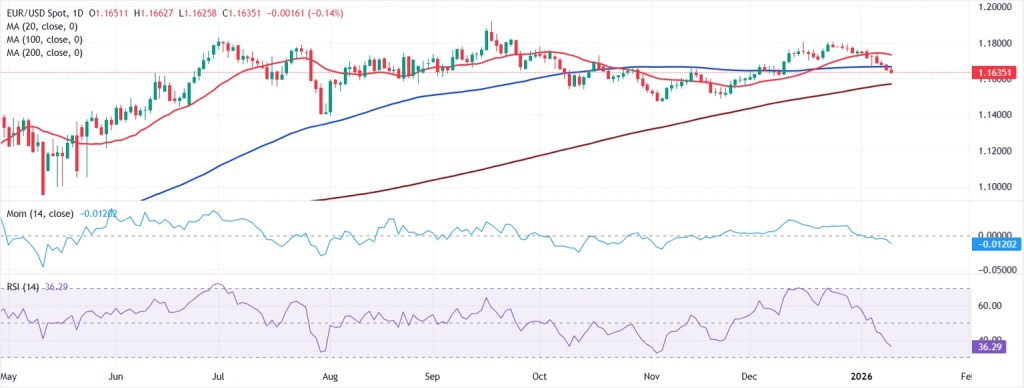
    From a technical standpoint, the daily chart shows a bearish outlook for EUR/USD with potential for further decline. The 20-day Simple Moving Average (SMA) is trending downward but still sits above the 100- and 200-day SMAs, indicating weakening short-term momentum. The price remains below the 20-day and 100-day SMAs at 1.1733 and 1.1666 respectively, while the rising 200-day SMA at 1.1571 acts as support. The Momentum indicator has dropped below its midpoint, maintaining strong bearish momentum, and the Relative Strength Index (RSI) is falling toward 36, suggesting lower prices ahead. A close above the 100-day SMA at 1.1666 could relieve some selling pressure and target the 20-day SMA at 1.1733, but failure to break this resistance leaves the pair vulnerable to test the 200-day SMA support at 1.1571.

    On a broader scale, the weekly chart also points to continued bearishness. The pair trades beneath the flattened 20-week SMA near 1.1665, with upside limited by this level. The 100- and 200-week SMAs are rising at 1.1085 and 1.0856 but remain far below the current price, so they are less relevant short term. The Momentum indicator on the weekly chart has turned downward but stays within neutral territory, while the RSI is declining around 52.

    If the pair falls below the key 1.1600 level, the next significant support lies near 1.1470, a major long-term pivot. Overall, bears will maintain control as long as EUR/USD stays below the 1.1740-1.1750 resistance zone.

    Sources: Fxstreet

  • NFP Outlook: Is There Real Upside in Job Growth?

    Leading indicators suggest this month’s NFP report could exceed expectations, with headline job growth potentially landing in the 80–120K range. Read on for a deeper breakdown.

    NFP Highlights

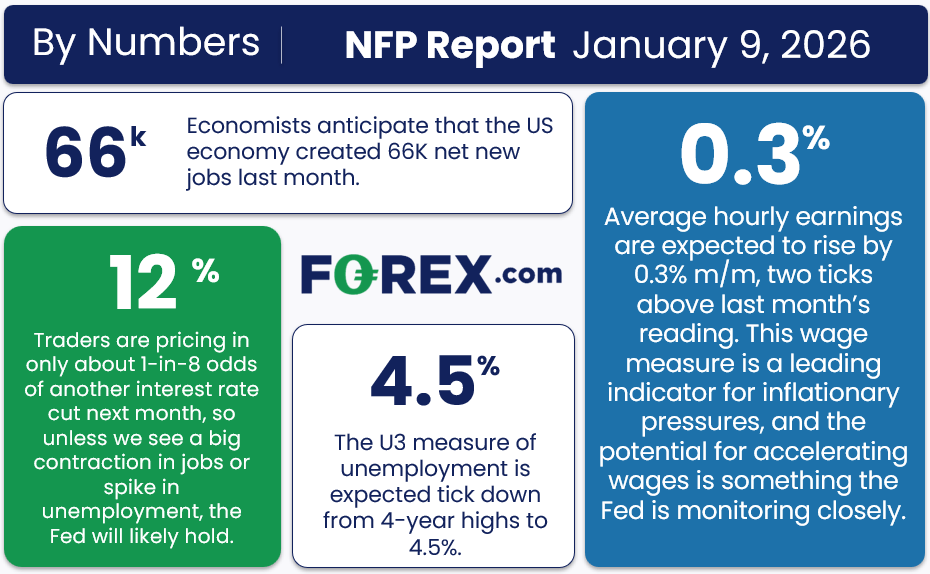
    • Consensus forecast: +66K jobs, earnings up +0.3% m/m, unemployment rate at 4.5%.
    • Outlook: Forward-looking data point to a stronger-than-expected result, with payroll gains possibly reaching between 80K and 120K.
    • Market impact: A positive surprise could allow AUD/USD to continue its rebound toward the mid-0.6600s, or even retest former resistance now acting as support near 0.6600.

    Release timing

    The December NFP report is scheduled for Friday, January 9, at 8:30 a.m. ET.

    NFP Report Expectations

    Market participants anticipate the NFP report will show the U.S. economy added around 66K jobs, with average hourly earnings increasing 0.3% month-on-month (3.6% year-on-year) and the U-3 unemployment rate edging lower to 4.5%.

    NFP Overview

    Economic data releases are gradually normalizing after the U.S. government shutdown disrupted—and in some cases eliminated—Q4 statistics. Ahead of the latest labor market update, economists expect conditions in December to reflect a continued “low hiring, low firing” environment.

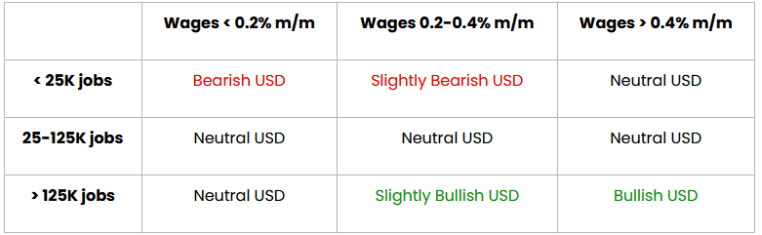
    As illustrated in the graphic below, traders are largely confident that the Federal Reserve will hold off on further rate cuts this month. Only a significant downturn in the labor market—such as a clear drop in job numbers or unemployment climbing above 4.7%—would likely undermine this confidence.

    Consequently, market reactions to the NFP release may be muted, particularly since the anticipated Supreme Court ruling on President Trump’s “emergency” tariffs—due about 90 minutes later—is likely to dominate attention.

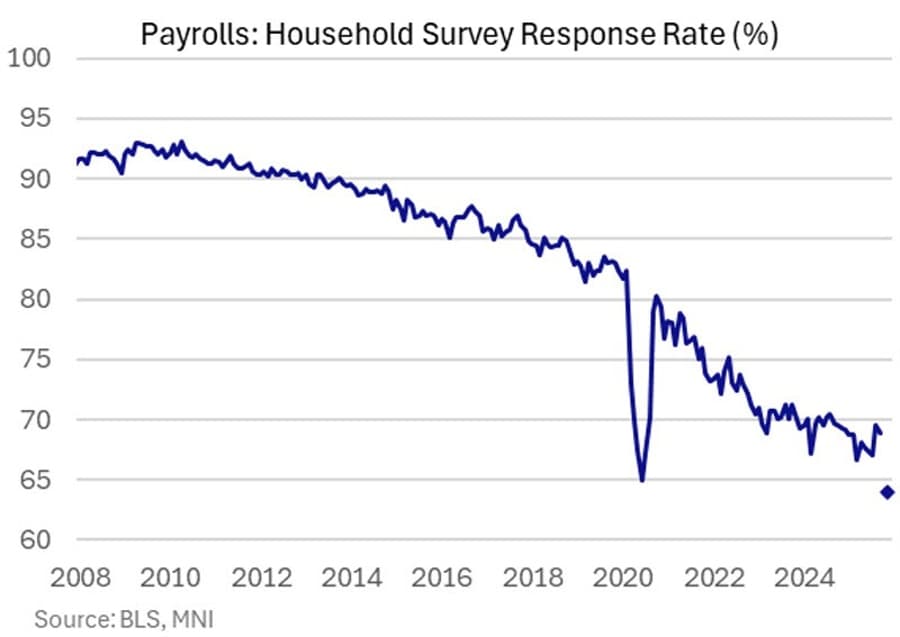
    Another factor dampening trader response is the long-term decline in survey response rates for the NFP. As the chart below illustrates, the Bureau of Labor Statistics (BLS) has experienced a significant drop in response rates over the past decade, increasing uncertainty around the accuracy of the jobs data compared to previous years.

    Looking ahead into 2026 and beyond, readers are advised to approach all survey-based economic data with greater skepticism and to rely on a diverse range of data sources when drawing robust conclusions about the U.S. economy.

    Nonfarm Payrolls Outlook

    As our regular readers know, we rely on four historically dependable leading indicators to assess each month’s NFP report:

    • The ISM Services Employment subindex rose to 52.0 from 48.9 last month.
    • The ISM Manufacturing Employment subindex increased slightly to 44.9 from 44.0.
    • The ADP Employment report showed 41K jobs added, improving from last month’s -29K but still below economists’ forecast of 49K.
    • The 4-week moving average of initial unemployment claims dropped to 212K from 217K last month.

    Considering these data points and our internal models, the indicators suggest that this month’s NFP report could exceed expectations, with job gains potentially in the 80–120K range. However, a wide margin of uncertainty remains due to declining survey response rates.

    That said, month-to-month variations in the NFP report are notoriously unpredictable, so it’s wise not to place too much confidence in any forecast—even ours. As always, other components of the release, such as the closely monitored average hourly earnings and the unemployment rate, will also influence market reactions.

    Possible Market Response to NFP

    From a technical perspective, the US dollar is trading close to one-month highs against several major currencies but remains near the midpoint of its three-month range, resulting in a balanced risk outlook ahead of the release.

    Technical Overview of the US Dollar: AUD/USD Daily Chart

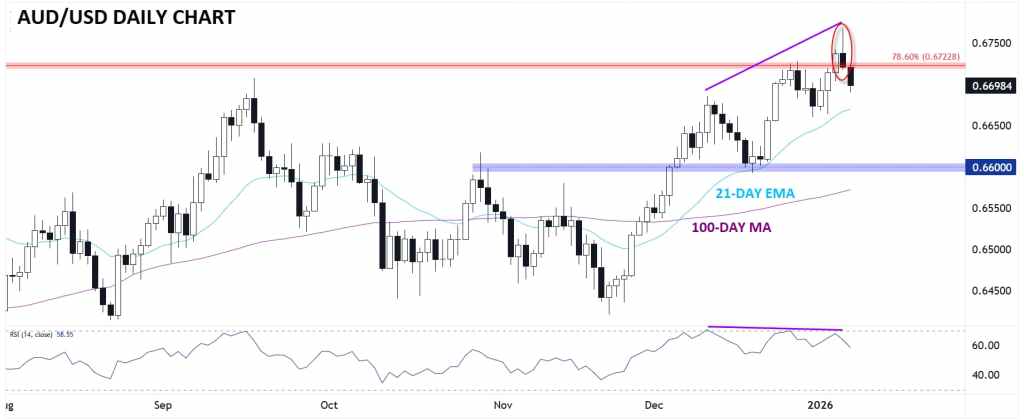
    From a technical standpoint, AUD/USD finds itself in a notable position ahead of the jobs report. Earlier this week, the pair reached a 15-month high near 0.6800 but then formed a “Dark Cloud Cover” pattern on Wednesday, indicating an intraday shift from buying to selling pressure. This reversal is further supported by a triple bearish divergence on the 14-day RSI, suggesting waning bullish momentum and reinforcing the possibility of a near-term peak.

    Should the jobs data surpass expectations, it may diminish the likelihood of a January Fed rate cut and raise doubts about March, thereby strengthening the US dollar. In that case, AUD/USD could continue its decline toward the mid-0.6600s or revisit the former resistance level, now acting as support, near 0.6600. Conversely, a strong report pushing the pair back above the 78.6% Fibonacci retracement at 0.6725 would negate the near-term bearish outlook.

    Sources: Investing @ Forex

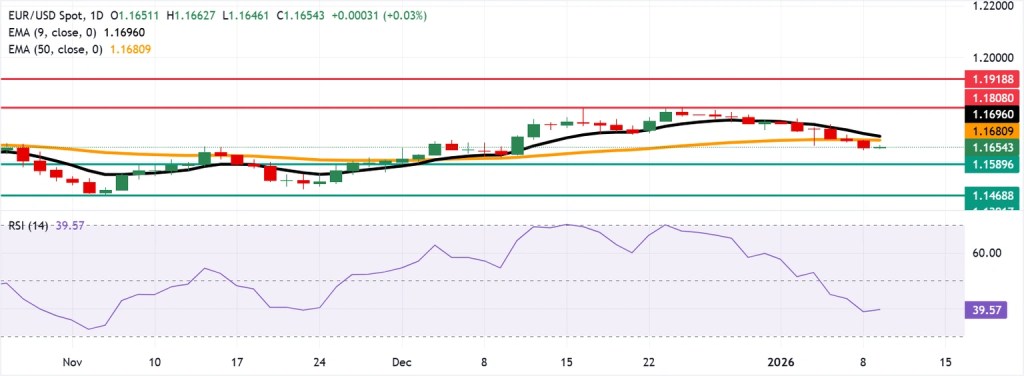
  • EUR/USD Price Outlook: Holds around 1.1650 as momentum weakens

    • EUR/USD is trading below the nine-day and 50-day EMAs, which stand at 1.1680 and 1.1696, respectively.
    • The 14-day Relative Strength Index (RSI) is at 39, signaling weakening momentum and a bearish outlook.
    • The pair could potentially decline further toward the six-week low of 1.1589.

    EUR/USD steadies near 1.1650 during Asian trading on Friday, following a five-day losing streak. The 14-day Relative Strength Index (RSI) sits at 39, indicating bearish momentum that is weakening rather than signaling oversold levels.

    Technical analysis of the daily chart reveals the pair trading below both the nine- and 50-day Exponential Moving Averages (EMAs), with the short-term EMA rolling over at 1.1696 and the 50-day EMA flattening around 1.1680. While the crossover pattern remains positive, the lack of support from the moving averages leaves the short-term outlook vulnerable.

    The EUR/USD pair may test the area near the six-week low of 1.1589, established on December 1. A daily close below this initial support could open the way to the next key level at 1.1468, the lowest point since August 2025.

    On the upside, immediate resistance is found at the crossover of the medium- and short-term moving averages around 1.1680 and 1.1696, respectively. A daily close above these levels would likely restore momentum, pushing EUR/USD toward the three-month high of 1.1808 reached on December 24, and potentially further to 1.1918, the highest level since June 2021.

    EUR/USD: Daily Chart

    Sources: Fxstreet

  • Frequently Asked Questions (FAQ) From Speculators (Traders) and Investors

    Are there any scams in the financial market?

    Yes, scams exist in every market, including traditional ones. This happens because scammers see opportunities to make illegal money by exploiting market demand.

    What scamming cases are common in this market?

    Case 1: Following a signal provider’s instructions to open large positions with a small account, resulting in quick losses.

    Case 2: Leading investors to invest in assets that are not available or do not exist in the market.

    Case 3: Convincing people to deposit funds with a broker or financial institution that lacks a financial services license.

    Case 4: Forging company’s financial documents and records to deceive investors.

    How to avoid scam in this market?

    Suggestion 1: Verify the financial service license of the broker or financial institution.

    Suggestion 2: Verify the educational background of the signal provider.

    Suggestion 3: Verify which company provides the asset and confirm its legal business activities.

    Suggestion 4: Contact to The Eternal Sovereign to support further

    What knowledge is needed to speculate (trade) or invest in the financial market?

    Once you have a foundation, the knowledge you need to focus on is fundamental and technical analysis to trade or invest effectively.

    1. Fundamental knowledge helps you forecast the market’s future direction and protect your funds effectively.
    2. Technical knowledge helps you execute positions more precisely.

    For a complete understanding, please refer to the Knowledge section.

    Does having knowledge mean I can speculate (trade) or invest effectively?

    No, having knowledge without practice makes it difficult to speculate and invest effectively. You will need a team or advisor to help you make informed decisions through market analysis and practical education.

    Therefore, you can see that from small to large financial institutions, they always have teams or advisors to support decision-making.

    What are the benefits of news and analysis (opinions and analysis) in the financial market?

    1. Stay Informed: Keeps you updated on market events, trends, and economic changes.
    2. Better Decision-Making: Helps you understand market sentiment and potential impacts on assets.
    3. Identify Opportunities: Spot emerging trends or risks early through expert insights.
    4. Diversify Perspectives: Gain different viewpoints to avoid biased decisions.
    5. Improve Timing: News and analysis can guide when to enter or exit positions.

    If I have many other questions, requests, or issues that need to be addressed, what should I do?

    You can contact us anytime to resolve your issues. Our advice and consulting services are free of charge. Please don’t hesitate to reach out.

  • Gold Holds Steady Ahead of US Jobs Report for Rate-Cut Signals

    Gold held steady as traders balanced a stronger dollar with upcoming U.S. economic data on Friday that could influence this year’s interest rate policy.

    Gold hovered around $4,465 an ounce, up 3.4% for the week through Thursday, but faced some selling pressure after U.S. initial jobless claims for the week ending January 3 came in slightly below expectations. Meanwhile, the Bloomberg Dollar Spot Index, which measures the strength of the U.S. dollar, has risen 0.5% so far this year, making gold more costly for many buyers.

    The December jobs report due Friday is expected to provide insight into whether the Federal Reserve will pursue additional interest rate cuts following three consecutive reductions in 2025. While nonfarm payrolls are forecasted to show stronger job growth, the unemployment rate is expected to remain steady—mixed signals that may reduce the likelihood of the Fed accelerating further rate cuts.

    Gold just completed its strongest annual gain since 1979, surging about 65% last year and hitting a record high of $4,549.92 in late December. The powerful rally was driven by central bank purchases and increased investment in exchange-traded funds, fueled by the “debasement trade.” Additionally, lower borrowing costs—beneficial for non-yielding assets like gold—have further propelled its rise.

    Traders are closely monitoring the upcoming selection of a new Federal Reserve chair. Treasury Secretary Scott Bessent indicated that President Donald Trump is expected to make a decision this month regarding Jerome Powell’s successor, as Powell’s term concludes in May. According to Bessent, four candidates are currently being considered.

    Sources: Bloomberg

  • Asian stocks sluggish as markets await crucial US jobs report; China’s CPI reaches highest level in 3 years

    Most Asian stock markets saw modest gains on Friday, following a mixed close on Wall Street as investors remained cautious ahead of crucial U.S. jobs data that could influence expectations for future Federal Reserve interest rate cuts.

    U.S. markets closed Thursday with mixed results: technology stocks pulled back after recent advances, putting pressure on the Nasdaq, while the Dow and S&P 500 showed little movement.

    Futures for major Wall Street indexes remained mostly flat during Friday’s Asian trading session.

    Asian stocks mostly flat as Nikkei posts gains

    Asian markets showed limited movement, reflecting investor caution, with the technology sector leading declines.

    South Korea’s KOSPI index remained mostly flat after reaching record highs earlier in the week, as chipmakers Samsung Electronics (KS:005930) and SK Hynix (KS:000660) dropped between 1.5% and 3%.

    Australia’s S&P/ASX 200 gained 0.3%, while Singapore’s Straits Times Index held steady.

    Futures for India’s Nifty 50 also remained largely unchanged.

    In contrast, Japanese stocks outperformed the region, with the Nikkei 225 rising 1% and the broader TOPIX index increasing 0.3%. A weaker yen against the U.S. dollar supported exporters’ prospects.

    Looking ahead, investor attention is focused on the U.S. nonfarm payrolls report expected later on Friday, which could offer crucial insights into the health of the world’s largest economy and influence the Federal Reserve’s monetary policy outlook.

    China’s December CPI reaches highest level in 3 years, PPI deflation slows

    In China, official data released on Friday showed consumer inflation rose to its highest level in nearly three years, offering tentative signs of improving demand.

    The consumer price index increased 0.8% year on year in December, the fastest pace in about 34 months, while monthly prices rose 0.2%. At the same time, producer price deflation eased, indicating some stabilization in factory-gate prices.

    The data indicated that China could be nearing an end to a prolonged deflationary period that has dampened economic growth, squeezed corporate earnings, and restrained consumer spending.

    China’s blue-chip Shanghai Shenzhen CSI 300 index gained 0.3%, while the Shanghai Composite rose 0.6%. Hong Kong’s Hang Seng traded flat.

    Sources: Investing

  • USD/CAD climbs past 1.3850 amid ongoing worries about Canadian oil demand

    • The USD/CAD pair strengthened as the commodity-linked Canadian dollar struggled amid growing concerns over demand for Canadian oil.
    • Canada’s Prime Minister Mark Carney stated that Canadian crude remains low risk and competitive despite increasing Venezuelan exports.
    • Meanwhile, the U.S. dollar held steady as cautious market sentiment prevailed ahead of Friday’s key jobs report, influenced by fragile economic data.

    USD/CAD extended its winning streak to a fifth consecutive day, trading near 1.3860 during Asian session on Thursday. The pair strengthened as the commodity-linked Canadian dollar faced pressure following U.S. President Donald Trump’s indication of plans to resume Venezuelan crude imports, raising concerns about increased supply and intensified competition for Canadian oil demand.

    Despite this, Prime Minister Mark Carney affirmed that Canadian crude remains low risk and competitive even amid potential growth in Venezuelan exports. Carney’s office also announced his upcoming visit to China from January 13–17, aiming to diversify Canada’s export markets beyond the United States amid ongoing uncertainty over U.S. trade policy.

    Canada’s seasonally adjusted Ivey Purchasing Managers’ Index (PMI) rose to 51.9 in December 2025 from 48.4 in November, exceeding the expected 49.5 and marking a return to expansion after a month of contraction. Canada’s Trade Balance data for October is scheduled for release on Thursday.

    The U.S. dollar (USD) remained steady amid a fragile U.S. economic outlook ahead of Friday’s key jobs report, which has moderated market sentiment. The U.S. Nonfarm Payrolls (NFP) for December are forecasted to show a gain of 55,000 jobs, down from 64,000 in November.

    On Wednesday, the Institute for Supply Management (ISM) reported the U.S. Services PMI increased to 54.4 in December from 52.6 in November, beating the expected 52.3. Additionally, the Automatic Data Processing (ADP) Employment Change showed an increase of 41,000 jobs in December, following a revised loss of 29,000 jobs in November, though this was slightly below market expectations of 47,000.

    Sources: Fxstreet

  • Federal Reserve could accelerate rate cuts amid rising deflation risks

    The ISM service index suggests potential positive revisions for fourth-quarter GDP growth. On Wednesday, the Institute for Supply Management (ISM) reported that its non-manufacturing service sector index increased to 54.4 in December from 52.6 in November, marking the third consecutive month of expansion and the fastest pace of growth in over a year.

    The new orders sub-index rose sharply to 57.9 from 52.9, while business activity climbed to 56 from 54.5. Additionally, new export orders improved to 54.2, up from 48.7 in November. Out of 16 surveyed service industries, 11 showed expansion in December.

    Conversely, the ISM manufacturing index fell to 47.9 in December from 48.2 the prior month, continuing its contractionary trend for the tenth straight month (a reading below 50 indicates contraction). Only 2 of 17 manufacturing industries—Electrical Equipment, Appliances & Components, and Computer & Electronic Products—reported growth, likely supported by strong data center demand.

    ADP’s December report showed private payrolls increasing by 41,000, missing economists’ expectation of 48,000. This follows a loss of 29,000 private jobs in November, meaning just 12,000 private jobs were created over the last two months. Manufacturing shed 5,000 jobs in December, while education and health services added 39,000, and leisure and hospitality gained 24,000 jobs. Regionally, the West lost 61,000 private sector jobs, while the South led with a gain of 54,000.

    Residential investment acted as a 5.1% drag on GDP growth during the second and third quarters. Strengthening GDP going forward will depend largely on stabilizing the residential real estate market, which remains sluggish due to high mortgage rates, rising insurance costs, and an oversupply in several key areas. According to the Intercontinental Exchange, prices for U.S. condominiums dropped 1.9% in September and October, with high homeowners association (HOA) fees and insurance expenses cited as major factors. In nine major metropolitan regions, over 25% of condominiums have fallen below their original sale prices. While multiple Federal Reserve rate cuts could help support home prices, the current weakness is fueling deflationary concerns that the Fed needs to address.

    If deflation emerges from (1) weak housing and rental prices, (2) low crude oil prices, and (3) deflation imported from China and other struggling global economies, the Fed may need to implement rapid interest rate cuts totaling around 100 basis points. With President Trump expected to nominate a new Fed Chair soon, current Chair Jerome Powell is likely to become a lame duck. Minutes from the December Federal Open Market Committee (FOMC) meeting indicated at least one more 0.25% rate cut is probable, but any further deflationary signals could prompt the Fed to enact much larger reductions in key rates in the coming months.

    President Trump is expected to nominate a new Federal Reserve Chair in January who will likely reverse the Fed’s current restrictive policies and adopt a more pro-business stance. Should Kevin Hassett, the current Chair of the Council of Economic Advisors, be appointed, the Fed would gain a strong economic advocate, a development that many find promising and exciting.

    Sources: Investing

  • U.S. Futures Flat as Wall Street Pulls Back from Records Ahead of Jobs Report

    U.S. stock index futures were mostly flat on Wednesday evening, after Wall Street’s major benchmarks ended the session broadly lower from record highs, as investors looked ahead to key U.S. employment data due later this week.

    S&P 500 futures edged up 0.1% to 6,967.0, while Nasdaq 100 futures were little changed at 25,837.25 by 20:03 ET (01:03 GMT). Dow Jones futures also added 0.1% to 49,263.0.

    Wall Street Pulls Back From Record Highs Ahead of U.S. Jobs Data

    During the session, the S&P 500 declined 0.3%, while the Dow Jones Industrial Average dropped 0.9%. In contrast, the Nasdaq Composite added 0.2%, supported by selective gains among large-cap technology stocks that helped offset broader market weakness.

    Both the S&P 500 and the Dow had reached record highs in the previous session, and the mixed performance pointed to some profit-taking after the recent rally.

    Figures from payroll processor ADP showed that private-sector job growth in December came in below expectations, signaling a slowdown in hiring momentum toward year-end.

    Although the ADP report is often seen as volatile and not always a reliable guide to official government data, it added to evidence that the labor market may be gradually cooling.

    Focus now shifts to Friday’s highly anticipated nonfarm payrolls report, which is expected to offer clearer insight into employment trends and wage growth. The data will be closely watched by markets evaluating the probability and timing of potential Federal Reserve rate cuts in the months ahead. Weaker-than-expected job growth could reinforce expectations that the Fed may begin easing policy earlier in 2026.

    Attention on rising tensions between the US and Venezuela

    Geopolitical strains continued to run high after U.S. forces apprehended Venezuelan President Nicolás Maduro, yet financial markets have so far exhibited only limited, short‑lived reactions to the dramatic turn of events. Investors appear to be largely unfazed by the heightened political risk, although the episode has introduced fresh uncertainty into the outlook for energy markets. U.S. President Donald Trump stated that Venezuela’s interim leadership would transfer up to 50 million barrels of crude oil to the United States.

    Sources: Investing

  • US Dollar: Key Data Once Again Driving the Market

    Markets are increasingly overlooking geopolitical issues—including developments in Venezuela and Greenland—while economic data is set to reclaim its role as the primary market driver in the latter half of the week. Today’s releases of ADP, JOLTS, and ISM services carry downside risks for the US dollar. Expectations of further rate cuts also point to softer FX performance in Central and Eastern Europe.

    USD: Data May Weigh on Momentum

    The impact of the Venezuela shock has largely dissipated. Although oil prices eased yesterday, they remain close to pre-4 January levels, equities continued to advance, and FX markets have shifted focus away from geopolitics. This reflects a post-“Liberation Day” tendency to ignore headlines and adopt a more measured outlook.

    The dollar recovered modestly yesterday, likely supported by seasonal inflows and a slight rise in front-end swap rates rather than geopolitical factors. Unless the US intensifies its stance on Greenland or intervenes again in Venezuela, markets are expected to re-center on macro data in the second half of the week.

    Today’s ISM services index is anticipated to be weak, but price action will likely be driven more by ADP (consensus: 50k) and the JOLTS job openings data. Notably, ADP has undershot expectations in seven of the past ten releases. Given our dovish view on the US labor market, we see upcoming employment data as carrying asymmetric downside risks for the dollar.

    Looking beyond today, our near-term outlook remains neutral to slightly constructive on the greenback.

    EUR: Inflation Risks to the Downside, but ECB Outlook Largely Unchanged

    German inflation undershot consensus yesterday, decelerating to 1.8% YoY (2.0% in EU harmonised terms). As our economist notes here, the disinflation appears broad-based – i.e., beyond the base effect – with prices falling in leisure, clothing, and food.

    That raises the chance of a sub-2.0% print today (consensus is at 2.0%) for the eurozone CPI flash estimate. Expectations are for the core CPI to remain unchanged at 2.4%, though; that is a measure that needs to start trending lower more decisively to revive any dovish dissent within the ECB.

    For now, implications for ECB rate expectations are likely to be limited unless inflation starts undershooting materially and consistently. By extension, the euro may not be taking many cues from the print and will remain almost entirely driven by the US dollar leg.

    Sources: Think.ing

  • Australian CPI in November falls faster than expected, but underlying inflation remains stubborn

    Australian CPI inflation slowed more than expected in November as electricity prices eased, though core inflation remained sticky and above the Reserve Bank of Australia’s target band. Data from the Australian Bureau of Statistics released Wednesday showed annual CPI rising 3.4%, below forecasts of 3.6% and down from 3.8% in October.

    The slowdown in inflation was mainly driven by electricity prices rising at a softer pace than in the previous month, while housing, food, and transport costs continued to climb. Core inflation remained persistent, with the trimmed mean CPI at 3.2% in November, easing slightly from 3.3% in October but still above the RBA’s 2%–3% target range. Goods inflation cooled to 3.3% from 3.8%, largely due to slower electricity price growth, while services inflation also eased to 3.6% from 3.9%, mainly reflecting seasonal factors. The ABS said Black Friday had minimal impact on prices. Although headline CPI softened, it remains uncertain whether the decline is enough to shift the RBA’s hawkish outlook, as the central bank paused its rate-cut cycle in late 2025 and signaled rates will stay unchanged amid stubborn inflation.

    ANZ analysts said the November CPI figures suggest the RBA is likely to keep rates unchanged in February, while potentially debating a rate hike later in the year. They added that inflation pressures are expected to ease as 2026 progresses, with the cash rate forecast to remain at 3.60% over their outlook period. Meanwhile, Australian inflation unexpectedly accelerated in late 2025, driven by higher housing and food costs, while the gradual removal of Canberra’s electricity subsidies also pushed prices higher.

    Sources: Investing

  • EUR/USD slips as weak Eurozone data pressures the euro, with markets awaiting US jobs figures

    EUR/USD retreats toward 1.1710 after being rejected near 1.1740, giving back recent gains as downward revisions to Eurozone PMIs and softer German inflation renew selling pressure on the euro. With investors now awaiting key US labor market data, expectations for Federal Reserve monetary policy remain a major driver for the euro dollar exchange rate.

    EUR/USD trades in a volatile market on Tuesday, hovering around 1.1710 at the time of writing, down 0.15% on the day. The pair has surrendered earlier gains as weaker Eurozone economic data revives concerns over the region’s growth outlook.

    Selling pressure on the euro intensified after the downward revision of the Eurozone HCOB Services Purchasing Managers Index (PMI). The index was revised to 52.4 for December, below the preliminary estimate of 52.6 and down from 53.1 in November, signaling a slowdown in services sector activity—one of the main drivers of the European economy.

    Meanwhile, German inflation data released on Tuesday point to a clear easing in price pressures. Annual CPI inflation slowed to 1.8% in December from 2.3% in November, while the Harmonized Index of Consumer Prices (HICP) dropped to 2.0% from 2.6%, coming in below market expectations. These readings reinforce expectations of a more subdued inflation environment across the Eurozone, limiting near-term upside for the euro.

    On the US front, economic releases have also added to volatility in EUR/USD trading. The Services PMI was revised down to 52.5 in December, its lowest level in eight months, while the Composite PMI slipped to 52.7. According to S&P Global, softer demand, weaker new orders, and slower employment growth signal that the US economy is losing momentum, even as cost pressures remain elevated.

    As a result, expectations for US monetary policy remain a key driver of the euro-dollar pair. Fed Governor Stephen Miran said on Tuesday that upcoming data are likely to support further interest rate cuts, arguing that the Federal Reserve could lower rates by more than 100 basis points this year as current policy remains restrictive and continues to weigh on economic growth.

    Overall, EUR/USD continues to trade amid mixed macroeconomic signals from both sides of the Atlantic. With no clear near-term catalyst, price action remains uneven, while investors now turn their focus to upcoming US labor market data to better gauge the timing of potential Federal Reserve easing and the short-term direction of the US dollar.

    Sources: Fxstreet