- The Australian dollar held near a 14-month high of 0.6724, reached in the previous session, as expectations for interest rate hikes by the Reserve Bank of Australia continued to build.
- The currency has found support amid growing bets that the RBA may maintain a more hawkish stance, even as global central banks move closer to easing cycles.
- Traders are now looking ahead to the Federal Reserve’s December meeting minutes, due on Tuesday, for further clues on the Fed’s policy outlook for 2026.
The Australian dollar rose against the U.S. dollar on Monday, holding near a 14-month high of 0.6724 reached on December 26, as the currency drew support from growing expectations of interest rate hikes by the Reserve Bank of Australia (RBA).

Minutes from the RBA’s December meeting showed that board members are becoming less confident that monetary policy remains sufficiently restrictive. The minutes also indicated the board is prepared to tighten policy further if inflation fails to ease as expected, placing renewed focus on the fourth-quarter CPI report due on January 28.
Analysts said a stronger-than-expected core inflation reading for the fourth quarter could prompt the RBA to deliver a rate hike at its February 3 policy meeting.
Bloomberg reported on Sunday that China’s Ministry of Finance plans to expand targeted investment in priority sectors, including advanced manufacturing, technological innovation and human capital development, following a year-end meeting that outlined fiscal policy priorities for the coming year. Any meaningful impact on China’s economic outlook could have spillover effects on the Australian dollar, given Australia’s close trade links with China.
Separately, China on Monday launched its “Justice Mission 2025” military drills, simulating a blockade around Taiwan, China Daily reported, citing Senior Colonel Shi Yi of the People’s Liberation Army’s Eastern Theater Command. The exercises underscore persistent geopolitical risks in Asia, keeping markets alert to potential spillovers into global shipping routes, the semiconductor supply chain and regional foreign exchange markets should the drills be prolonged or repeated.
U.S. Dollar Weakens Amid Growing Bets on More Fed Rate Cuts

- The U.S. Dollar Index (DXY), which tracks the greenback against six major currencies, declined to around 97.90 amid growing expectations of further Federal Reserve rate cuts in 2026. Market participants are closely watching the Federal Open Market Committee’s (FOMC) December meeting minutes, due Tuesday, for clues on the central bank’s policy direction.
- At its December meeting, the Fed cut interest rates by 25 basis points to a target range of 3.50%–3.75%, completing a total of 75 basis points in reductions throughout 2025 amid cooling labor market conditions and persistent inflation pressures.
- The CME FedWatch tool shows an 81.7% probability that rates will remain unchanged at the January meeting, up from 77.9% last week, while the chance of another 25-basis-point cut has dropped to 18.3% from 22.1%.
- U.S. labor data painted a mixed picture last week, with initial jobless claims falling to 214,000—better than the expected 223,000—while continuing claims rose slightly to 1.923 million. The four-week average of initial claims edged down to 216,750.
- Meanwhile, delayed data from the U.S. Bureau of Economic Analysis showed the economy grew at an annualized rate of 4.3% in Q3, surpassing market expectations of 3.3% and the previous quarter’s 3.8% growth.
- In Australia, headline inflation rose to 3.8% in October from 3.6% in September, staying above the Reserve Bank of Australia’s (RBA) 2–3% target range. This has fueled expectations for a rate hike as early as February 2026, with both Commonwealth Bank of Australia and National Australia Bank forecasting a rise to 3.85% at the RBA’s first policy meeting of the year.
- Consumer inflation expectations in Australia also climbed to 4.7% in December from 4.5% in November, supporting the RBA’s hawkish outlook.
Australian Dollar Holds Steady Near 14-Month Highs Above 0.6700
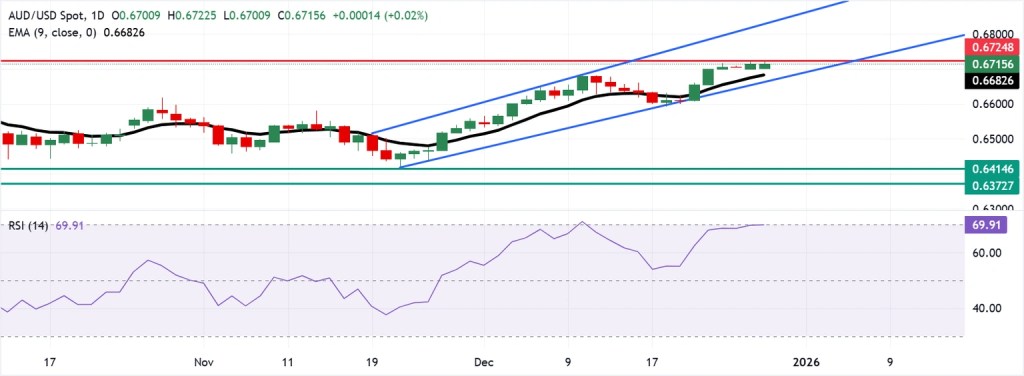
AUD/USD hovered around 0.6720 on Monday, maintaining an upward trajectory within an ascending channel pattern on the daily chart, signaling a persistent bullish bias.
The pair remains above the rising nine-day Exponential Moving Average (EMA), which continues to advance and supports the short-term uptrend. The 14-day Relative Strength Index (RSI) stands at 70.24, indicating strong momentum but also overbought conditions.
Immediate resistance is seen at 0.6724, the highest level since October 2024. A break above this point could open the way toward the upper boundary of the ascending channel near 0.6830.
Failure to surpass this resistance may lead to a consolidation or a pullback toward the nine-day EMA at 0.6683, followed by support around the lower boundary of the ascending channel near 0.6660. A break below the channel could expose the six-month low at approximately 0.6414, recorded on August 21.
Sources: Fxstreet
 THE ETERNAL SOVEREIGN