Below are the top 10 events and surprises that could impact financial markets and the global economy in 2026. These are not forecasts but potential macroeconomic, geopolitical, or market developments currently unpriced or underestimated by markets. We also assess the probability of each event occurring (high, medium, low).
“History is full of surprises, and so is the future.”
— George W. Bush
Before we explore the 10 surprises for 2026, let’s briefly review some of the unexpected developments that shaped 2025.
Trump 2.1
Trump initially imposed sweeping tariffs, particularly on China, but rising concerns over living costs prompted a policy shift. By mid-2025, he reopened negotiations and rolled back some tariffs, sparking renewed interest in Chinese equities among U.S. investors.

Germany Pushes for Fiscal Stimulus
Under a CDU-led coalition, Germany relaxed its debt brake and unveiled a $500 billion fiscal stimulus package. However, the country avoided issuing Eurobonds. As a result, public debt increased from 62.2% of GDP in 2024 to a projected 63.5% in 2025, while nominal GDP growth remained sluggish at just 0.2%, according to the European Commission.
Near-Zero Inflation in Europe — Negative Rates Return in Switzerland
Eurozone inflation eased to 2.2%, with the ECB’s key interest rate steady at 2%. Meanwhile, inflation in Switzerland dropped to 0% in November. However, the Swiss National Bank (SNB) has yet to reinstate negative interest rates.
Trump & Musk: From Allies to Adversaries
A predicted public rift between Trump and Elon Musk materialized in mid-2025 following a series of policy disagreements. Musk distanced himself from Dogecoin, refocusing on Tesla (NASDAQ: TSLA), SpaceX, and xAI. Despite the split, there is no indication that U.S. government support or contracts for Tesla or SpaceX have diminished. Tesla shares have gained 14% year-to-date.
And Then There Were the Real Surprises—The Ones No One Saw Coming:
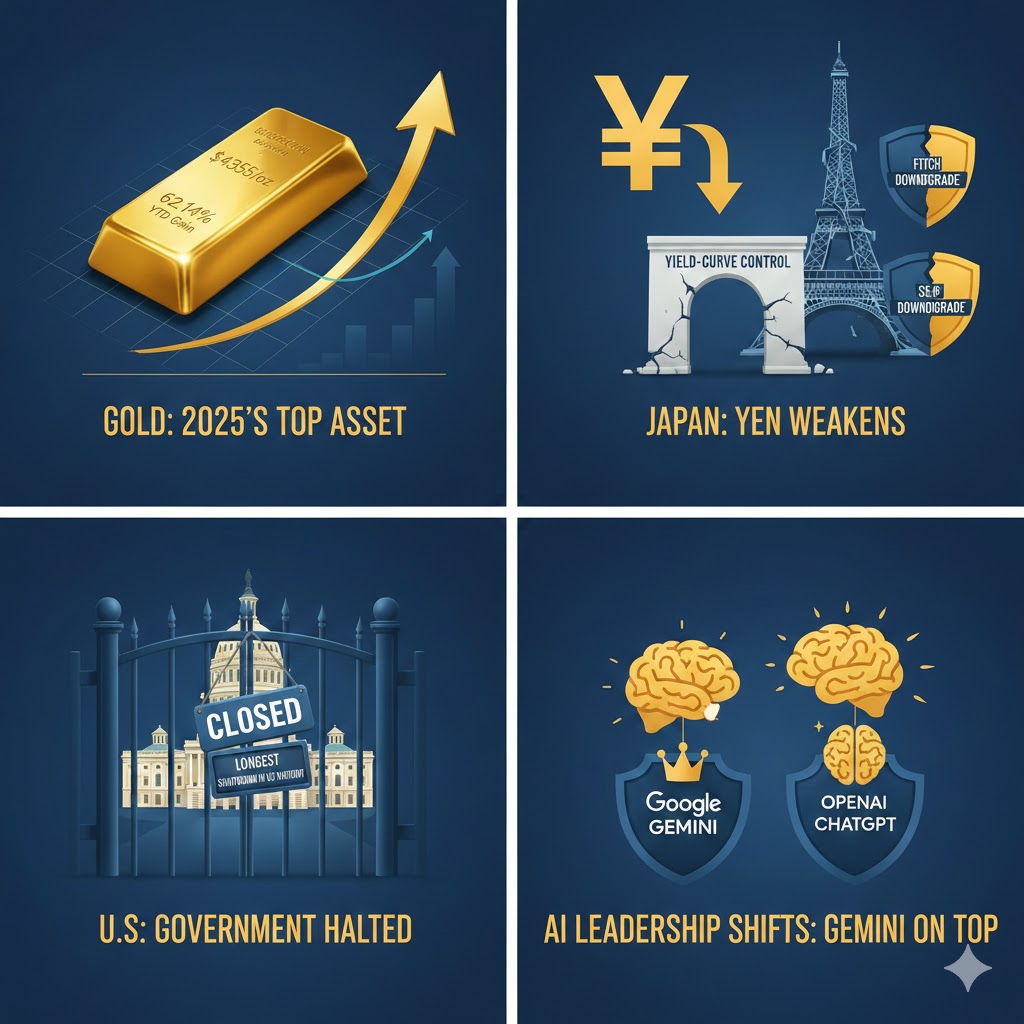
- Gold emerged as 2025’s standout asset, soaring to a record high of $4,355 per ounce and delivering its best annual return since 1979, with a 62.14% year-to-date gain.
- Japan fully exited its yield-curve control policy, yet the yen continued to weaken against major currencies.
- France’s sovereign debt was downgraded twice in 2025—first by Fitch, then by S&P.
- The U.S. endured the longest government shutdown in its history.
- Google’s Gemini surpassed OpenAI’s ChatGPT across multiple benchmark rankings, reshaping the AI leadership landscape.
What unexpected developments could 2026 bring?
SURPRISE #1: MOST US TARIFFS ARE ROLLED BACK
Trump’s victory in the 2024 election—alongside recent Democratic gains in special elections—reflects deep voter frustration with the rising cost of living, now the dominant political issue in the US.

At the same time, private companies have shifted into a “wait-and-see” mode. Major US investment decisions are being delayed until after the 2026 midterms, as businesses are reluctant to commit billions amid the risk that trade rules could be rewritten within months. This investment freeze is weighing on economic momentum and increasing the risk of a Republican setback. Trump understands what is at stake. A Republican loss in the midterms would likely hand Democrats control of Congress, opening the door to a repeal of his tariff agenda.
Republicans are acutely aware of the financial strain facing households and recognise that tariffs feed directly into higher consumer prices. To avoid any perception of economic weakness ahead of the midterms, the administration may be pushed to accelerate trade negotiations. This urgency is reinforced by fears that a Democratic-controlled House in 2026 could launch an extended wave of impeachment proceedings.
In this environment, “acceptable” trade agreements with Canada, Mexico, Brazil and India become plausible—even if they ultimately lack depth, much like earlier deals struck with the UK, the EU and Japan.
The broader trend would point to lower tariffs, a shift widely viewed as supportive of economic growth. Markets would likely welcome the move, extending the equity rally.
SURPRISE #2: KEVIN WARSH BECOMES FED CHAIR — AND MARKETS LOVE IT
This is a double surprise. First, Kevin Warsh is appointed Fed Chair, leapfrogging the current frontrunner, Kevin Hassett. The second surprise is the market’s enthusiastic reaction. Rather than fixating on the risk of diminished Federal Reserve independence vis-à-vis the White House, investors embrace the prospect of a new, more pro-growth monetary policy regime.

The current Fed has been criticised for being “too slow” to cut rates—much as it was previously faulted for keeping rates “too low” after the pandemic, a stance widely blamed for fuelling inflation. Against that backdrop, Warsh’s appointment is seen as a reset.
Markets also increasingly conclude that fears of Trump exerting full control over the Fed are overstated. While Trump would have nominated four of the seven Board of Governors, the rate-setting FOMC includes five additional voting members who were not Trump appointees. As a result, the Fed’s institutional independence remains intact—unlike the central banks of China or Japan.
Warsh’s arrival, and his perceived growth-oriented stance, introduces three shifts that markets quickly welcome. First, the new leadership is expected to support faster and deeper cuts to short-term interest rates to stimulate the economy. Second, the “new” Fed is likely to tolerate slightly higher inflation, potentially lifting the upper bound of the target range from 2.0% to 2.5%. Finally, Warsh is widely regarded as a seasoned policymaker with a strong understanding of financial markets—standing in sharp contrast to Powell’s perceived unpopularity and alleged “arrogance” among investors.
Defying expectations, markets embrace the shift. US assets surge, while capital inflows hit record levels.
SURPRISE #3: THE GREENBACK’S REVIVAL
Against widespread bearish forecasts, the US dollar could mount a strong and unexpected rebound in 2026, supported by three underappreciated forces.
Superior growth and investment. Markets increasingly recognise that the US economy continues to outpace the eurozone, Japan and the UK. This advantage is underpinned by massive, forward-looking investment—such as the $350bn committed to AI infrastructure in 2025—cementing the United States as the unrivalled destination for global capital.

Positive real yields. The dollar remains one of the few major currencies offering investors positive real returns, in stark contrast to the negative real yields prevailing in the euro, yen and Swiss franc.
Undervaluation and institutional stability. IMF purchasing-power estimates suggest the dollar is roughly 10% undervalued (for example, a USD/CHF fair value near 0.95). At the same time, markets increasingly view “de-dollarisation” narratives as lacking credibility, given the absence of any viable alternative matching the USD’s political, legal and institutional stability.
Politics provide an additional tailwind. A stronger dollar helps ease cost-of-living pressures ahead of the 2026 midterms, while reduced policy uncertainty—through tariff rollbacks and a new Fed chair—further supports USD strength.
A rising dollar would boost European exporters, while a weaker Swiss franc could help Swiss equities rank among the strongest-performing markets globally in local-currency terms.
SURPRISE #4: THE COMEBACK OF THE REAL ECONOMY
A powerful rotation unfolds across global equity markets as the real economy stages a decisive comeback. Economic momentum in 2026 accelerates well beyond even the most bullish forecasts, driven by a rare alignment of three major policy levers.
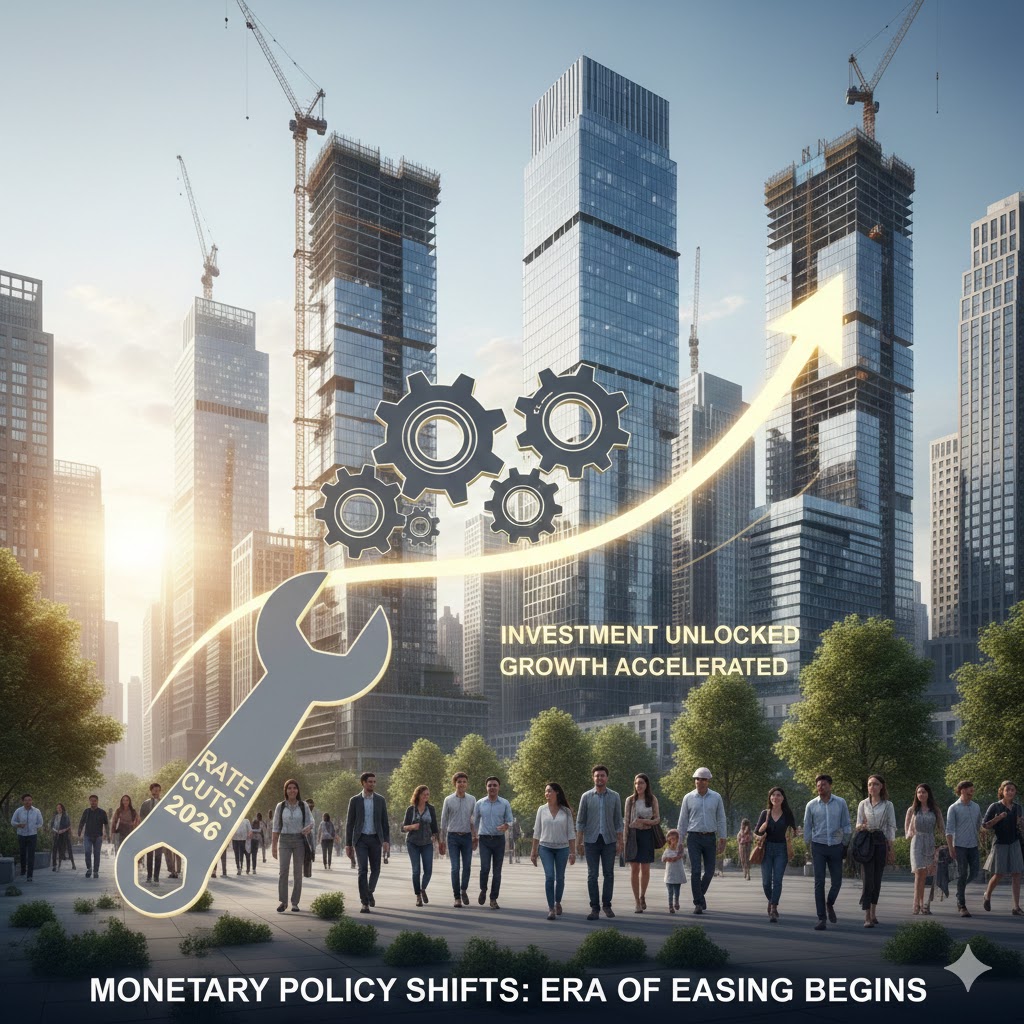
Monetary policy turns accommodative. After years of battling inflation, major central banks shift decisively toward easing, delivering multiple rate cuts through 2026. Lower borrowing costs unlock investment and directly stimulate activity in capital-intensive, cyclical sectors.
Fiscal support remains robust. Governments continue to channel spending into infrastructure, manufacturing, R&D, defence and green technologies, sustaining demand and reinforcing the growth impulse.
Targeted deregulation. Selective regulatory easing—particularly in financials and energy—creates a more market-friendly environment, unlocking capital and encouraging risk-taking in credit-sensitive segments.
This policy convergence triggers a pronounced rotation in equity leadership. Value and cyclical stocks outperform the previously dominant large-cap growth names through the first half of 2026.
Sectors such as Industrials, Financials, Materials and Energy benefit disproportionately from accelerating growth, low interest rates and deregulation. Their relatively attractive valuations further enhance their appeal as the cycle broadens. Small- and mid-cap stocks follow a similar trajectory.
Outside the US, developed markets such as Europe and Japan, alongside Emerging Markets, also deliver strong performance, supported by lower technology concentration and greater exposure to cyclical and value sectors.
The resurgence of the real economy—particularly in manufacturing and infrastructure—drives demand for physical inputs. Combined with lingering supply constraints, this creates a powerful tailwind for commodities, including crude oil, industrial metals (copper, aluminium) and potentially precious metals such as gold.
However, this “real economy” boom is unlikely to last indefinitely. As growth accelerates and demand increasingly outstrips supply, inflation expectations rise and bond yields rebound sharply from their mid-cycle lows. Higher yields raise discount rates and improve the relative appeal of bonds, placing growing pressure on equity valuations.
By mid-2026, this renewed surge in bond yields triggers a broad market correction, bringing the cyclical outperformance of the real economy to an end and ushering in a more volatile—and potentially structurally different—market regime.
SURPRISE #5: THE PRODUCTIVITY BOOM ARRIVES FASTER THAN EXPECTED
By 2026, the long-promised productivity boom finally materialises in the data, driven by a new operating model that seamlessly integrates people, AI agents and robots—automating both cognitive and physical work.
Companies begin reporting labour-productivity gains of 20–40% as large-scale AI agents automate entire workflows, from customer service and accounting to procurement and logistics. What catches markets off guard is the speed at which robotics joins the wave. Low-cost, flexible industrial robots and autonomous systems rapidly proliferate across warehouses, factories and fulfilment centres, compressing operating costs while accelerating output.
AI takes over cognitive processes; robots handle physical execution. Together, they deliver a step-change in efficiency. Corporations enjoy a powerful phase of margin expansion before wage renegotiations fully adjust, prompting management teams to upgrade earnings guidance aggressively.
Markets respond in kind. Technology valuations re-rate higher as investors price in a multi-year uplift in profitability, while bond yields decline on expectations that rapid productivity gains will keep inflation structurally contained. The economy enters a rare “deflationary boom”—where robust growth coexists with disinflation.
SURPRISE #6: US AND EUROPEAN COMPANIES EMBRACE CHINA’S “OPEN-WEIGHTS” AI MODEL
By 2026, a growing consensus emerges that the US has made a strategic misstep by concentrating its AI ecosystem around massive, proprietary “closed-weights” models such as ChatGPT and Gemini. While powerful, these systems require enormous computing resources and remain costly to deploy, limiting their scalability beyond the world’s largest corporations.

China, by contrast, has pursued a fundamentally different strategy. It has focused on developing smaller, more efficient models—such as DeepSeek and Alibaba’s Qwen—that deliver higher usable compute in real-world applications. With fewer parameters and simpler architectures, these models are dramatically cheaper to run, an advantage amplified by China’s lower energy costs.
Crucially, many of these models are released as “open-weights,” with parameters freely accessible. This allows developers to run them locally, fine-tune them for specific tasks, and integrate them rapidly into existing systems—flexibility that US closed-weights models largely lack.
The results are increasingly visible. Recent studies suggest that Chinese open-weights models have overtaken comparable US systems in terms of global adoption. As a consequence, US and European companies also begin gravitating toward these models. Firms such as Airbnb publicly favour Alibaba’s Qwen, citing its speed, adaptability and cost efficiency.
This shift challenges the long-held assumption that “bigger is always better” in AI. Markets begin to reassess the competitive positioning of leading US AI platforms, with investors questioning whether scale alone provides a durable moat. As confidence in the proprietary-model ecosystem weakens, capital starts to rotate away from the broader “OpenAI complex”—including beneficiaries such as Nvidia and Oracle—triggering a sharp correction in the Nasdaq.
SURPRISE #7: THE FAILURE OF EUROPE’S INFRASTRUCTURE PUSH
Germany rolls out a major fiscal expansion in 2025–26, centred on defence modernisation and infrastructure spending, supported by legislative changes that effectively bypass the constitutional “debt brake.” Initially, the programme revives optimism among businesses and investors, raising hopes of a long-awaited European growth revival.
Over time, however, markets begin to reassess the effectiveness of the flagship €500bn German special fund. It becomes increasingly clear that much of the spending lacks true additionality. Rather than financing genuinely new, high-productivity investments, a significant share is used to substitute for existing budget items—avoiding spending cuts elsewhere. Part of the fund is also diverted toward measures closer to public consumption, including certain social outlays, rather than productivity-enhancing capital investment.
Structural headwinds persist. Germany remains constrained by heavy regulation (notably labour and environmental rules), elevated energy costs, and a private sector that fails to regain momentum. At the same time, renewed US tariffs begin to weigh on exports.
The result is another downturn. The German economy slips back into recession, unemployment rises sharply, and political instability intensifies. The Merz government’s fragile coalition collapses, triggering snap elections. After failed attempts to form a Grand Coalition, the far-right AfD secures more than 35% of the vote and ultimately takes power.
Markets react forcefully. European sovereign bonds and equities sell off, credit spreads widen, and the euro depreciates sharply—falling toward 0.85 against the Swiss franc. The shock reverberates beyond Europe, ultimately tipping the global economy into recession.
SURPRISE #8: THE US LAUNCHES A MILITARY INTERVENTION IN VENEZUELA
Crude oil prices spike briefly as US strikes target key Venezuelan energy infrastructure, triggering fears of supply disruption. The rally, however, proves short-lived.
Following the installation of a pro-US government, Venezuela—home to the world’s largest proven oil reserves—rapidly ramps up production. The surge in output ultimately pushes oil prices back down, reversing the initial shock.
Strategically, the episode aligns neatly with Trump’s agenda: removing the Maduro regime while easing inflationary pressures through lower energy prices.
SURPRISE #9: FUSION TECHNOLOGY REWRITES THE GEOPOLITICAL ORDER
A major breakthrough in fusion technology in 2026—specifically the achievement of engineering break-even, where a reactor generates more energy than the entire plant consumes, in a compact and scalable design—would dramatically accelerate the arrival of a virtually unlimited, safe and carbon-free energy source.
This accelerated timeline would be driven by the success of private-sector pioneers such as Commonwealth Fusion Systems (CFS) and Helion, which are pursuing diverse, fast-tracked technological pathways. A decisive breakthrough would validate their approaches and shift fusion from decades of pure research into a phase of rapid industrial scaling and commercialisation.
The consequences would be profound.
First, global power dynamics would be reshaped as the influence of traditional petrostates erodes. Countries whose wealth and geopolitical leverage depend on oil and gas exports would face a sharp decline in relevance. Second, fusion would enable near-total energy independence, as nations could rely on widely available fuels such as deuterium and lithium rather than geopolitically constrained fossil resources.
Geopolitical competition would pivot away from securing hydrocarbon supply chains toward leadership in fusion technology, intensifying rivalry among the US, Europe and China. At the same time, the productivity gains would be substantial. Abundant, cheap, 24/7 carbon-free energy would remove the power-cost constraint for energy-intensive industries such as steel and cement, as well as large-scale processes including desalination and carbon capture.
Finally, fusion would meet the exponential energy demands of advanced AI, supercomputing and hyperscale data centres without environmental compromise, underpinning sustained growth across the digital economy.
SURPRISE #10: OCCUPY WALL STREET 2.0 TRIGGERS A UNIVERSAL MINIMUM INCOME
Occupy Wall Street (OWS) was a left-wing populist movement that erupted in 2011, protesting economic inequality, corporate power and the influence of money in politics. Centered in Zuccotti Park in New York’s Financial District, it reflected the profound distrust of the private sector in the aftermath of the Great Recession.
Fifteen years later, similar frustrations resurface on a far broader scale. A sharply “K-shaped” economy—where AI-driven sectors and high-income earners thrive while low- to middle-income households and traditional industries struggle—sparks a new wave of social unrest across major global capitals.
To contain mounting public anger, the US and other G7 governments respond with a dramatic policy shift: the introduction of a universal minimum income.
The announcement initially calms the streets, but financial markets quickly focus on the long-term implications. Inflation expectations rise, fiscal deficits widen, and public debt trajectories deteriorate. Investors reassess risk across asset classes, triggering a global sell-off in both equity and bond markets—just months ahead of the US midterm elections.
Sources: Investing
 THE ETERNAL SOVEREIGN